Partnership Marketing Strategy:
The Complete B2B Growth Blueprint for 2026

TL;DR (Quick Summary)
If you want faster growth without increasing ad spend, a partnership marketing strategy helps you:
- Reach warm audiences through trusted partners
- Generate qualified B2B leads
- Reduce customer acquisition cost
- Scale globally using LinkedIn
- Build authority and credibility
Companies using partnerships grow 30–40% faster than those relying only on paid ads.
This guide shows:
- What is partnership marketing
- How to do B2B marketing on LinkedIn
- Proven LinkedIn marketing strategies & tactics
- Step-by-step framework to implement
Introduction
B2B marketing is getting expensive.
Paid ads cost more. Cold emails convert less. SEO takes time.
So how are smart companies still growing fast?
They aren’t shouting louder.
They’re borrowing trust.
That’s exactly where a partnership marketing strategy changes the game.
Instead of chasing customers alone, you collaborate with:
- Complementary businesses
- Agencies
- Consultants
- SaaS tools
- Influencers
- Local partners
And together, you tap into each other’s audience.
At MindCentrix, we’ve helped multi-location brands and global companies scale revenue using structured partnerships + LinkedIn. This guide shares the exact system.
What is Partnership Marketing?
Let’s simplify.
Partnership marketing is a growth strategy where two or more businesses collaborate to share audiences, leads, or revenue through mutually beneficial campaigns.
Instead of competing, you combine strengths.
Example:
If you’re:
- A digital marketing agency → partner with CRM software
- A SaaS company → partner with consultants
- A web dev firm → partner with SEO agencies
Both sides get:
- Qualified leads
- Brand exposure
- Trust transfer
- Lower CAC
This is why a strong partnership marketing strategy works better than cold outreach.
Why Partnership Marketing Works So Well in B2B
- Trust transfers instantly
When your partner recommends you, customers trust you faster.
Referral leads convert 3–5x higher than cold leads.
- Lower acquisition cost
Instead of paid ads:
- co-webinars
- email swaps
- LinkedIn collaboration
- bundled services
You get leads for almost zero cost.
- Faster market expansion
Multi-location businesses can use local partners to enter new regions quickly.
Example:
MindCentrix partnered with regional consultants → expanded into 3 new cities in 6 months.
- Long-term growth engine
Unlike ads that stop when budget ends, a partnership marketing strategy creates recurring pipelines.

Get an Expert Google Ads Audit for Your Business
Uncover wasted spend, fix performance gaps, and scale ROI with certified Google Ads specialists.
Types of Partnership Marketing You Can Use
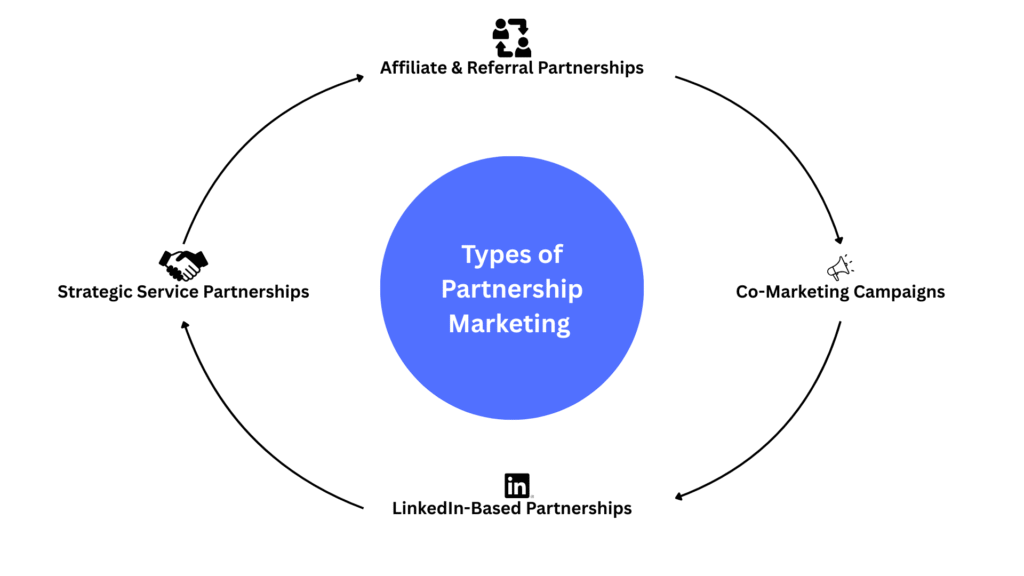
Let’s break it down with real-world usage.
- Strategic Service Partnerships
Collaborate with businesses offering complementary services.
Example:
SEO agency + Web development company
Together:
- Bundle services
- Pitch bigger projects
- Increase deal size
Result: 40% higher average revenue per client
- Affiliate & Referral Partnerships
Partners promote you and earn commission.
Works best for:
- SaaS
- Consulting
- Agencies
- Tech tools
This model scales fast without heavy marketing costs.
- Co-Marketing Campaigns
Joint:
- Webinars
- Case studies
- Events
- Whitepapers
Both brands share audience lists.
Instant exposure.
- LinkedIn-Based Partnerships
One of the most powerful channels today.
Which brings us to the big question…
Advanced Partnership Models Used by High-Growth B2B Companies
As your partnership marketing strategy matures, you can go beyond simple referrals and move into structured revenue systems that enterprise brands use to scale faster and more predictably.
Here are four advanced frameworks that align marketing, sales, and partnerships together.
1. Revenue Operations (RevOps) Integration
Revenue Operations (RevOps) connects marketing, sales, and customer success into one unified revenue engine.
Instead of treating partnerships as “just marketing,” RevOps treats them as measurable revenue channels.
This means:
- Tracking partner-sourced MQLs
- Monitoring pipeline contribution
- Measuring partner ROI
- Aligning sales teams with partner deals
For example, if a LinkedIn partner webinar generates 300 leads, RevOps helps you track:
Lead → MQL → SQL → Deal → Revenue
Companies with strong RevOps see:
👉 20–30% faster deal cycles
👉 15–20% higher close rates
When building a scalable partnership marketing strategy, RevOps ensures nothing leaks from the funnel.
2. Joint Venture (JV) Partnerships
A Joint Venture (JV) is a deeper collaboration where two businesses share risks, resources, and profits for a specific campaign or offering.
Unlike basic referrals, JVs feel like “co-owned growth.”
Examples include:
- Co-branded services
- Shared product bundles
- Combined go-to-market launches
- Regional expansion partnerships
Example:
A web development agency + digital marketing agency launch a bundled “Growth Package” and split revenue 50/50.
This creates:
- Bigger contracts
- Higher trust
- Faster sales
For multi-location companies, JV partnerships are powerful for entering new cities or countries without heavy investment.
3. Channel Marketing for Scalable Distribution
Channel Marketing allows you to sell through partners instead of selling directly.
Your partners become your sales force.
Common channels:
- Agencies
- Consultants
- Resellers
- Technology integrations
- Affiliates
Instead of acquiring every client yourself, channel partners bring pre-qualified prospects.
For SaaS and B2B services, channel marketing often contributes:
👉 30–50% of total revenue
When executed correctly, channel marketing becomes the backbone of a long-term partnership marketing strategy.
4. Understanding MQLs and SQLs in Partnership Funnels
Not all leads are equal.
To evaluate partnership success, you must track:
MQL (Marketing Qualified Lead)
Someone interested but not ready to buy yet.
SQL (Sales Qualified Lead)
A lead verified by sales and ready for conversation.
Let’s say:
- Partner webinar → 500 signups
- 200 become MQLs
- 80 become SQLs
- 20 become customers
Now you know exactly which partner delivers revenue — not just traffic.
This level of tracking turns partnerships from “guesswork” into “predictable growth.”
How to Do B2B Marketing on LinkedIn (Step-by-Step)
LinkedIn is THE platform for partnership marketing.
Decision makers live here.
Step 1: Optimize your profile
Your company page must show:
- Clear positioning
- Case studies
- Testimonials
- Service offerings
- Authority content
Without this, outreach fails.
Step 2: Use Sales Navigator smartly
Filter by:
- Industry
- Location
- Company size
- Job title
Target:
- founders
- marketing heads
- agency owners
- consultants
These people become ideal partners.
Step 3: Warm outreach (not spam)
Bad:
“Hey let’s partner”
Good:
“Loved your recent post on B2B SaaS growth. We help similar clients with performance marketing. Open to exploring a value-based partnership?”
Personalization increases replies 4x.
Step 4: Offer mutual value
Never ask first.
Instead:
- invite to webinar
- feature them in blog
- co-create content
Trust first. Deals later.
Step 5: Nurture consistently
Comment + share + engage.
Partnerships grow through relationships, not pitches.
How to Use LinkedIn for Business Marketing Effectively
Here’s how smart brands use LinkedIn beyond posting random content.
Content authority strategy
Post:
- insights
- case studies
- data reports
- thought leadership
This attracts inbound partnerships automatically.
Employee advocacy
When 10 team members share content → reach grows 10x.
LinkedIn Events & Webinars
Host joint sessions with partners.
Generates:
- warm leads
- credibility
- high engagement
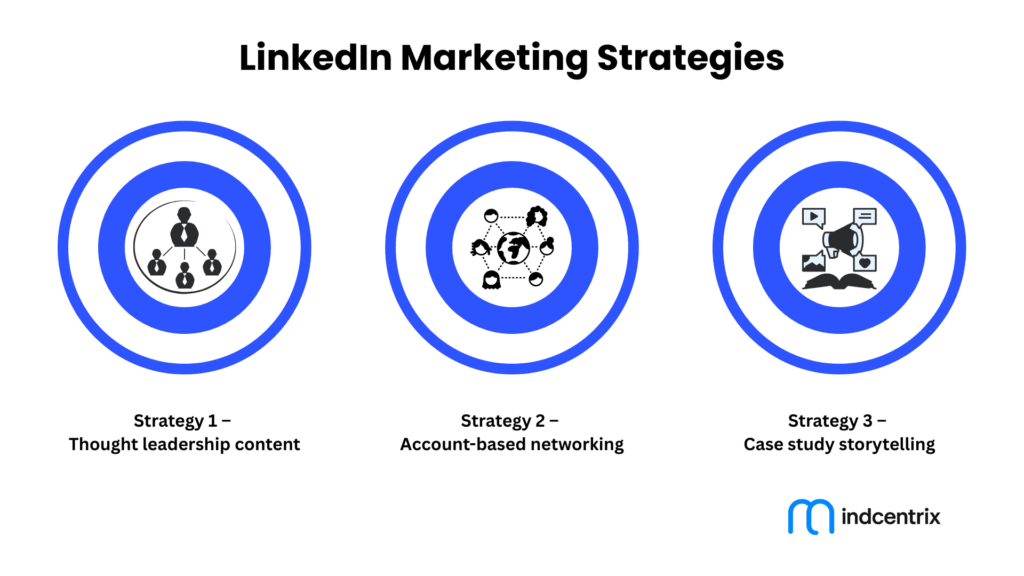
LinkedIn Marketing Strategies That Drive Partnerships
Now let’s get tactical.
Strategy 1 – Thought leadership content
When you look like an expert, partners approach you.
Example:
Weekly industry analysis posts
Strategy 2 – Account-based networking
Create a list of 100 dream partners and systematically engage.
Like → Comment → DM → Collaborate
Strategy 3 – Case study storytelling
Nothing builds trust like proof.
Show:
Problem → Solution → ROI
Decision makers love data.
LinkedIn Marketing Tactics That Actually Convert
These small tactics often outperform big strategies.
Tactical moves:
- Personalized video messages
- Polls to spark engagement
- Carousel posts
- Testimonials
- Partner shoutouts
- Collaborative posts
Each builds familiarity and partnership interest.
Step-by-Step Partnership Marketing Strategy Framework
Here’s the exact structure we use at MindCentrix.
Step 1 – Identify ideal partners
Define:
- Same audience
- Non-competing
- Complementary services
Step 2 – Create value offer
What do they gain?
- Leads
- Visibility
- Revenue share
Be specific.
Step 3 – Launch co-marketing campaigns
Examples:
- Webinar series
- Joint ebooks
- Newsletter swaps
- LinkedIn lives
Step 4 – Track results
Measure:
- leads generated
- revenue
- conversion rate
- CAC
Step 5 – Scale winners
Double down on partnerships that work.
Kill what doesn’t.
Real Example (Mini Case Study)
A multi-location IT company partnered with:
- CRM vendor
- Cloud consultant
- LinkedIn trainer
Together:
- 6 webinars
- shared email lists
- LinkedIn cross-promotion
Result in 6 months:
- 320+ qualified leads
- 27 enterprise clients
- 60% lower acquisition cost
That’s the power of a proper partnership marketing strategy.
Common Mistakes to Avoid
- Random outreach
- One-sided value
- No tracking
- Short-term mindset
- Ignoring LinkedIn
Partnerships require process.
Final Thoughts
If you’re relying only on ads and cold calls, growth will always feel expensive.
But a smart partnership marketing strategy turns:
Other people’s audiences → your customers
Other people’s trust → your credibility
Other people’s reach → your growth
That’s exactly how modern B2B brands scale.
At MindCentrix, we help businesses design and execute high-impact partnership ecosystems combined with LinkedIn marketing.
Frequently Asked Questions

Bhavisya
Written by Bhavisya, a Google Ads Certified Specialist at MindCentrix, with 10+ years of hands-on experience managing PPC advertising for lawyers across the United States.
Bhavisya has planned and optimized Google Ads, Local Service Ads (LSAs), and pay-per-click campaigns for divorce lawyers, personal injury attorneys, criminal defense firms, and family law practices in competitive U.S. markets such as California, Texas, Florida, and New York.
Their work aligns strictly with Google Ads policies for legal services, including personal hardship and restricted legal content compliance, ensuring campaigns are both ethical and profitable.

Boost Your Brand Visibility 🚀
Get personalized digital strategies that drive growth and engagement.
Let’s Talk📬 Stay Updated
Get the latest insights and guides delivered right to your inbox.
🔗 Related Topics
- Loading related posts...