Beyond the Hype:
How to Evaluate Digital Transformation Consulting Services

- 1The AI & Automation Trap: Research shows that many enterprise AI initiatives never reach production because governance, process complexity, and organizational friction outweigh technology challenges.
- 2Execution Reality: Internal IT teams frequently balance modernization initiatives alongside business-as-usual operations, making experienced digital transformation partners valuable for accelerating delivery.
- 3Vendor Evaluation Matters: The V.A.U.L.T.™ Framework helps enterprise leaders assess consulting partners through Vendor Neutrality, Architectural Depth, User Adoption, Lifetime TCO, and Time-to-Value.
- 4Built for Enterprise Leaders: This guide is designed for CIOs, CTOs, CEOs, VPs of Digital Transformation, and Enterprise Architects evaluating strategic transformation investments.
Who this guide is not for: Organizations looking for basic CRM setup, standard website development, plugin installation, or standalone SaaS implementation services.
Throughout this guide, you'll learn how to evaluate consulting partners, reduce architectural risk, improve user adoption, understand total cost of ownership (TCO), and accelerate business outcomes through structured, enterprise-grade digital transformation.
Introduction: The Modern Enterprise Tech Trap
Enterprise software development has entered an era of paradox. Organizations spend millions on digital transformation consulting services and solutions, yet executive satisfaction remains at an all-time low.
The industry has moved past the overused “70% of digital transformations fail” cliché. Modern enterprise failure modes are far more specific and expensive. According to the S&P Global Market Intelligence Enterprise AI Survey, the percentage of organizations abandoning the majority of their AI and automation initiatives surged to 42%, up from 17% in previous cycles. On average, enterprise organizations discarded 46% of their proof-of-concept (PoC) projects before reaching production environments.
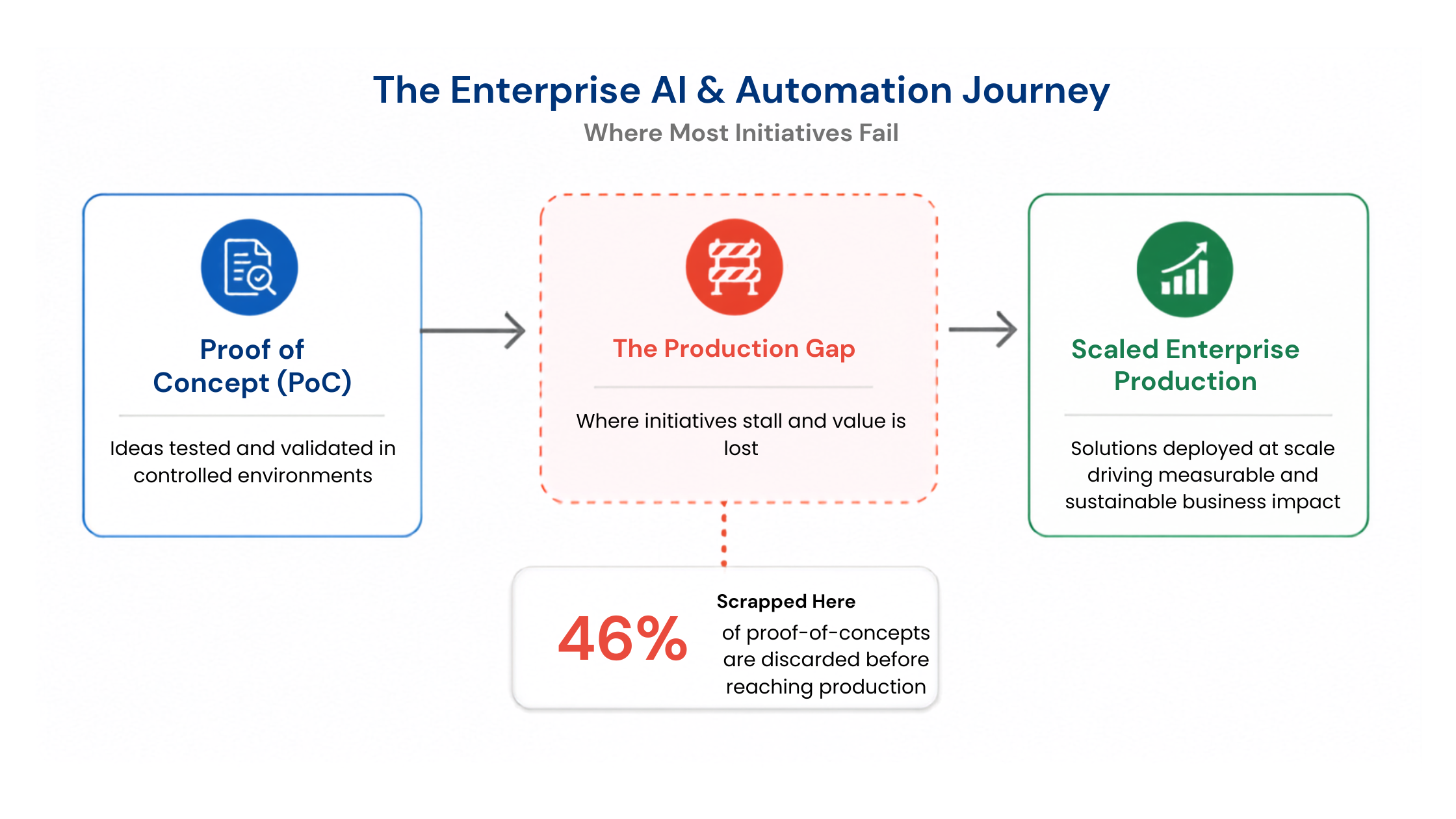
The underlying cause is rarely model failure or raw software defects. Projects fail in the gap between the initial demonstration and production deployment because companies purchase software tools without restructuring broken underlying workflows.
Traditional management consulting firms often compound this issue by delivering high-level slide decks and leaving internal engineering teams stranded during actual implementation. Selecting full-service digital transformation consultants must be treated as an architectural and financial partnership—one accountable for production code, data integrity, and measurable business performance.
Strategic Scope: IT Consulting vs. Full-Service Transformation
Understanding what is digital transformation consulting services requires making a clear distinction between basic IT support, specialized software implementation, and full-service transformation consulting..
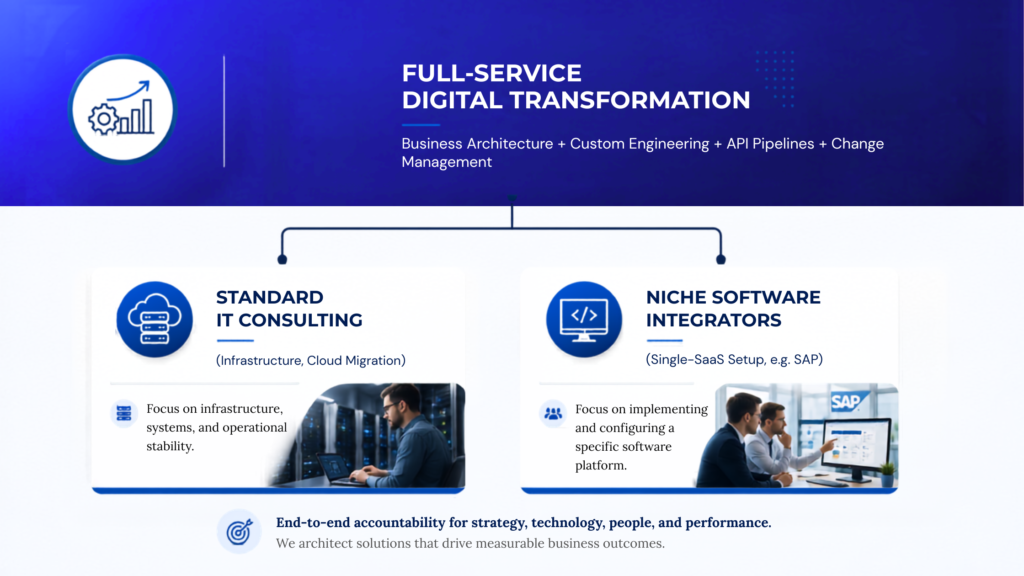
- Standard IT Consulting: Focuses on infrastructure maintenance, network security upgrades, cloud server migrations, or hardware lifecycle management.
- Niche Software Integrators: Focuses on configuring a single SaaS product (e.g., setting up Salesforce or customizing an SAP instance). These firms often push their assigned platform regardless of whether it fits your broader technology ecosystem.
- Full-Service Digital Transformation Consultancy Services: Takes end-to-end accountability for business process re-engineering, custom backend development, API integration across disparate systems, data pipeline normalization, and workforce change management.
Scope Matrix: Evaluating Partner Depth
Dimension | Standard IT Consulting | Niche Software Integrator | Full-Service Digital Transformation Consultant |
Primary Objective | Keep existing systems operational and secure. | Deploy a specific software tool according to vendor specs. | Re-architect operations, software, and workflows for business ROI. |
System Interoperability | Low (Focused on isolated infrastructure). | Medium (Tied to platform-specific APIs). | High (Builds custom middleware, microservices, and unified APIs). |
Execution Ownership | Task-based execution. | Feature-level configuration. | End-to-end strategy, code deployment, and workforce onboarding. |
Change Management | Minimal (Covers basic user permissions). | Basic (Provides software user manuals). | Comprehensive (Process engineering, training, and adoption metrics). |

Get an Expert Google Ads Audit for Your Business
Uncover wasted spend, fix performance gaps, and scale ROI with certified Google Ads specialists.
The V.A.U.L.T.™ Vendor Evaluation Framework
To evaluate full-service digital transformation consultants without relying on generic marketing claims, enterprise buying committees should use the V.A.U.L.T.™ Framework.
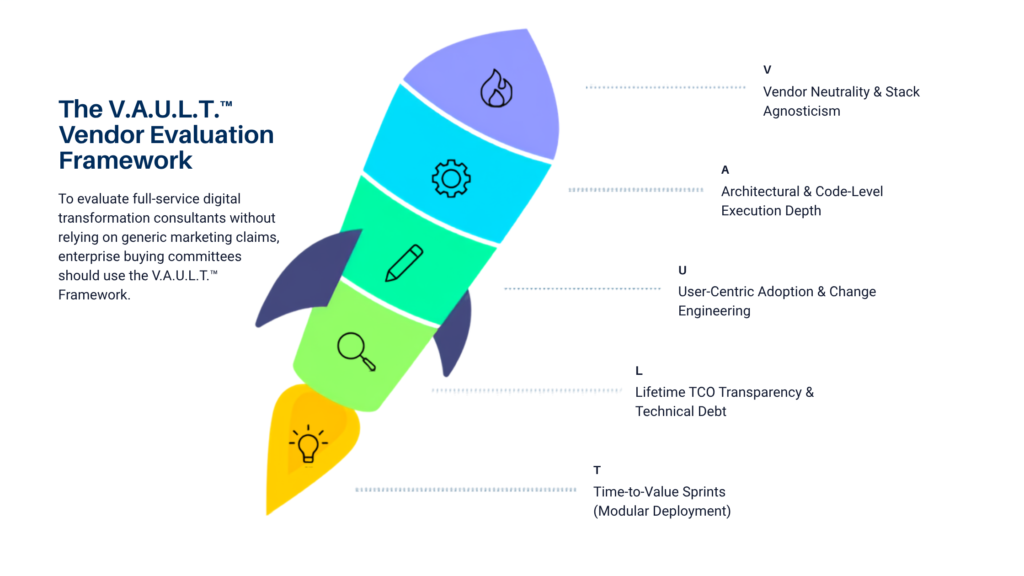
- V – Vendor Neutrality & Stack Agnosticism
A consultant should not be a glorified software reseller. Inquire directly about vendor commission structures. True transformation partners evaluate your existing technical debt, internal developer skill sets, and operational requirements before recommending a tech stack—whether that involves custom PHP microservices, headless architectures, or enterprise cloud platforms.
- A – Architectural & Code-Level Execution Depth
Strategy without code execution leads to abandoned projects. Validate that the consulting firm maintains in-house software engineers, database architects, and security experts. Ask to audit sample code repositories, schema architectures, and integration middleware built for previous clients.
- U – User-Centric Adoption & Change Engineering
Software failure often stems from human friction. Top-tier digital transformation consultancy services integrate UI/UX designers and change management specialists early in the discovery phase. They map existing employee workflows to eliminate unnecessary steps, ensuring high platform adoption upon launch.
- L – Lifetime Total Cost of Ownership (TCO) Transparency
The initial build invoice accounts for only a fraction of lifetime software costs. A reliable transformation partner delivers a transparent TCO breakdown covering cloud infrastructure scaling, ongoing maintenance, API usage fees, license growth tiers, and security patch schedules over a 3-to-5-year horizon.
- T – Time-to-Value Sprints (Modular Deployment)
Avoid “big bang” rollouts that attempt to deliver a multi-year project all at once. Require your consulting partner to work in modular execution sprints. While market averages for complex enterprise builds often span 6 to 12 months, top-performing delivery teams structure releases to deploy functional, revenue-generating modules into production every 60 to 90 days.
Industry Benchmark Analysis: Consultant Types & Rate Structures
Note: Hourly rate and timeline figures below represent a synthesis based on MindCentrix market analysis and cross-market agency rate audits.
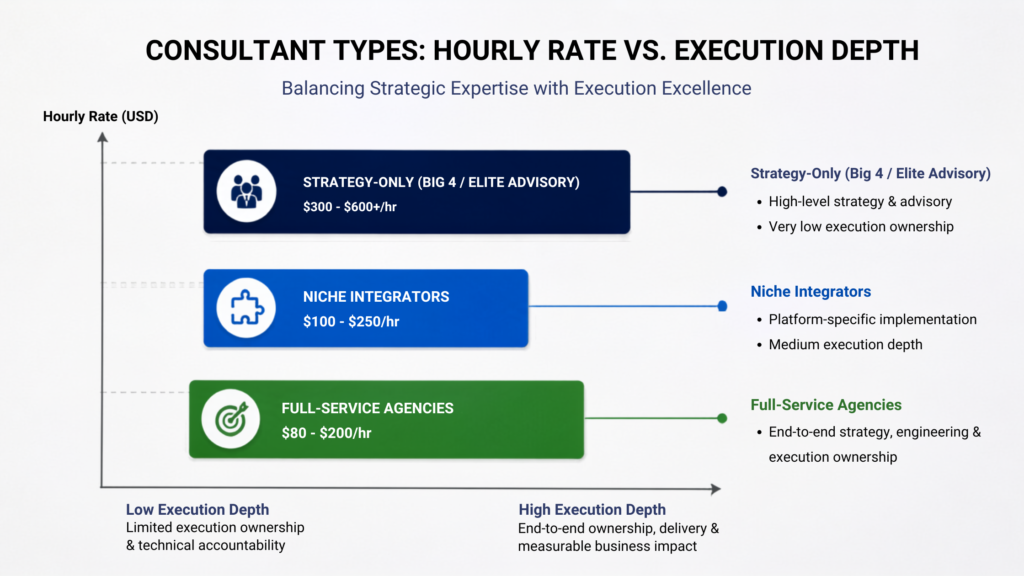
Selecting the right partner requires balancing strategic capabilities against execution costs. The table below outlines how different agency models compare across the enterprise consulting landscape:
Consultant Category | Average Hourly Rate Range* | Typical Project Timeline | Execution Ownership | Primary Fit / Use Case |
Strategy-Only (Big 4 / Elite Advisory) | $300 – $600+/hr | 6 – 12 Months (Strategy deck only) | Very Low (Outsources or hands off code execution) | Boardroom alignment, M&A due diligence, high-level restructuring. |
Full-Service Transformation Agency | $80 – $200/hr | 3 – 9 Months (Phased modular rollouts) | Very High (In-house architecture, custom code, & deployment) | Mid-market & enterprise custom development, legacy modernization, process automation. |
Niche Systems Integrators | $100 – $250/hr | 2 – 6 Months | Medium (Locked strictly to single software ecosystem) | Single-SaaS rollouts (e.g., dedicated Salesforce, SAP, or ServiceNow setup). |
Offshore / Low-Cost Staffing Firms | $25 – $50/hr | Variable (High risk of timeline slip) | High Code / Low Strategy (Requires heavy client management) | Executing tactical developer tasks from pre-existing technical specifications. |
*Market rate ranges derived from MindCentrix industry benchmark analysis.
Decoding Pricing Models for Digital Transformation Services
When evaluating what are different pricing models for digital transformation consulting services, enterprise buyers must select an agreement structure that aligns risk appropriately between the client and the agency.
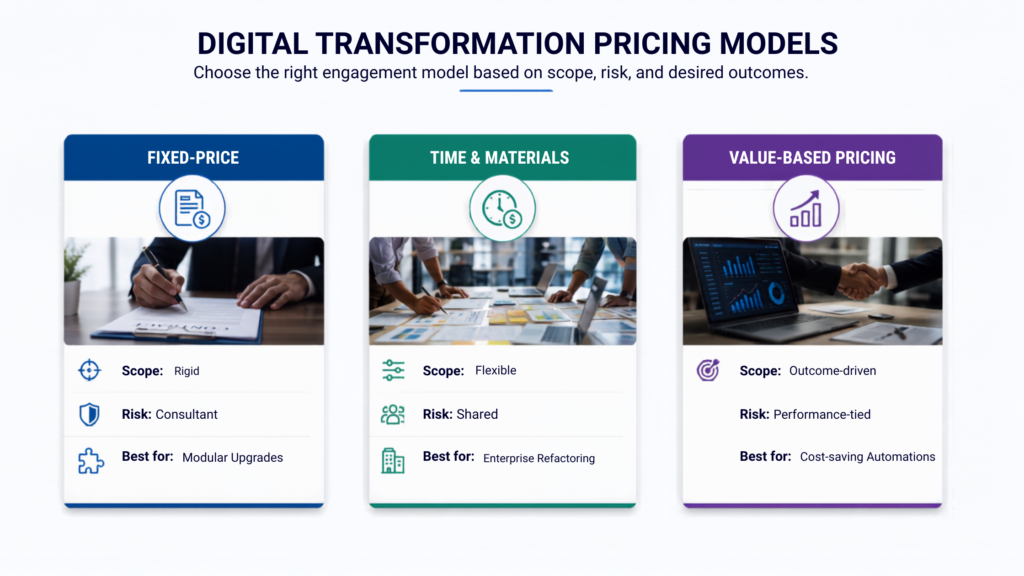
- Fixed-Price Milestone Model ($50,000 – $250,000+ per phase)
- Mechanism: The project scope, design assets, API requirements, and deliverables are defined upfront, with payments tied to specific delivery milestones.
- Best Used For: Well-defined, isolated technical upgrades—such as migrating a legacy database schema or building a custom API wrapper.
- Risk Profile: Low initial financial uncertainty, but highly inflexible if unforeseen legacy system technical debt is discovered mid-project.
- Time & Materials (T&M) / Agile Sprint Model ($80 – $200/hr)
- Mechanism: Clients pay for actual engineering hours and resources utilized, managed in 14-day agile development sprints.
- Best Used For: Complex, enterprise-wide modernizations where business requirements evolve as legacy code is refactored.
- Risk Profile: Maximum architectural flexibility and faster time-to-market; requires active project management to keep sprint velocity on budget.
- Value-Based / Outcome-Driven Model (10% – 20% of Verified Savings or Revenue Impact)
- Mechanism: Consulting fees are tied directly to achieving key business performance metrics (KPIs), such as reducing order processing cycle times by 40% or lowering customer service operational overhead.
- Best Used For: Process-automation initiatives with clear baseline metrics established prior to kick-off.
- Risk Profile: Highly aligned incentives between client and vendor; requires absolute transparency and shared performance-tracking tools.
- Continuous Optimization & Advisory Retainer ($5,000 – $25,000/month)
- Mechanism: A dedicated team of solutions architects, developers, and DevOps engineers provides ongoing feature updates, security audits, and infrastructure optimization.
- Best Used For: Post-launch digital acceleration, continuous integration, and keeping custom web applications aligned with evolving business needs.
Conclusion: Bridging Strategy and Execution
Digital transformation fails when leadership treats software implementation as a mere purchase order rather than a core operational evolution. Deploying modern platforms on top of broken, undocumented processes only speeds up operational errors.
Achieving measurable ROI from digital transformation consulting services requires aligning business architecture, engineering discipline, and user adoption. By utilizing the V.A.U.L.T.™ Framework, enterprise leaders can select transparent, technically capable partners who deliver production-grade code alongside strategic direction.
Executive Action Plan
Ready to audit your enterprise system architecture using the V.A.U.L.T.™ Framework?
- Step 1: Download our internal Technical Debt & Schema Evaluation Checklist.
- Step 2: Map your core business workflows to identify manual data entry bottlenecks across your existing software stack.
- Step 3: Schedule a 1-on-1 Digital Maturity & System Architecture Audit with the technical strategy team at MindCentrix to establish a clear, modular roadmap for your digital transformation initiative.
Client Reference
Frequently asked questions
Expert answers to common enterprise digital transformation questions.
Most enterprise digital transformation initiatives take between 3 and 9 months when delivered through a phased implementation strategy.
Internal IT teams focus on keeping operations running while specialists accelerate modernization.
Common approaches include Re-host, Re-platform, Refactor and Replace.
Evaluate efficiency, velocity and revenue growth.


Boost Your Brand Visibility 🚀
Get personalized digital strategies that drive growth and engagement.
Let’s Talk📬 Stay Updated
Get the latest insights and guides delivered right to your inbox.
🔗 Related Topics
- Loading related posts...