How Healthcare Organizations Reduce Analytics Risk: A Practical Framework for Safer, More Reliable Healthcare Analytics
- 1Define the decision before defining the dashboard, metric, or analytical model.
- 2Identify the data required for the decision and establish clear ownership of critical datasets, metrics, models, and reports.
- 3Validate data for accuracy, completeness, consistency, relevance, and timeliness before relying on analytical outputs.
- 4Document data lineage and maintain consistent definitions for high-value healthcare metrics so results can be traced and understood.
- 5Apply appropriate privacy, security, and access controls to protect sensitive healthcare information throughout the analytics process.
- 6Validate analytical models across relevant populations and use cases rather than assuming performance will remain consistent everywhere.
- 7Monitor models, dashboards, data pipelines, and source systems after deployment to identify changes, failures, and emerging risks.
- 8Provide enough context around analytical outputs so healthcare users can interpret results correctly and understand their limitations.
- 9Maintain human oversight when analytical outputs can materially affect patients or other high-impact healthcare decisions.
- 10Create a process for investigating, correcting, documenting, and learning from analytical failures.
Healthcare organizations have more data than ever.
Electronic health records, laboratory systems, claims, imaging platforms, patient portals, remote monitoring devices, operational systems, and AI applications can all contribute information to the analytical environment.
The challenge is no longer simply getting access to data.
The harder question is:
Can the organization trust the analytical result enough to use it for an important decision?
That question matters because analytics can fail without producing an obvious technical error.
A dashboard can display a perfectly calculated number based on an incomplete dataset. A predictive model can perform well during development but behave differently when the patient population or clinical workflow changes. Two departments can report different results because they use different definitions of the same metric.
In other words, analytics risk is not limited to cybersecurity or regulatory compliance.
It can begin with the data, continue through transformation and analysis, and ultimately appear when a person interprets the result and acts on it.
That is why understanding how healthcare organizations reduce analytics risk requires a lifecycle approach rather than a single security control.
This guide explains that lifecycle and provides a practical framework healthcare leaders, analytics teams, data engineers, compliance professionals, and technology teams can use to identify and control analytics risk.
What Is Analytics Risk in Healthcare?
Healthcare analytics risk is the possibility that data, calculations, models, dashboards, or AI-generated outputs contribute to an incorrect, misleading, unauthorized, unsafe, unfair, or poorly understood decision.
The risk can appear at multiple points:
Data → Context → Validation → Analytics → Interpretation → Decision → Monitoring
This is a more useful way to look at healthcare analytics than treating risk as a problem that begins and ends with data security.
For example, suppose a hospital dashboard reports a 30-day readmission rate.
The formula may be technically correct.
But several things could still be wrong:
- the source system may have stopped sending a category of encounters;
- the denominator may have changed after an EHR configuration update;
- one facility may be using a different definition of readmission;
- patient records may not have been matched correctly;
- the dashboard may be showing data that is several days old;
- an exclusion rule may have changed without being documented.
The dashboard itself may not have failed.
The decision context around the dashboard has failed.
That distinction is central to effective healthcare analytics risk management.
Why Is Healthcare Analytics Risk Different?
Healthcare data is unusually complex because it is generated across different systems, workflows, organizations, and points in time.
A patient’s information may exist across:
- electronic health records;
- laboratory systems;
- pharmacy systems;
- imaging platforms;
- claims systems;
- scheduling platforms;
- patient portals;
- remote monitoring devices;
- health information exchanges;
- research databases;
- population health platforms.
These systems may use different identifiers, terminology, timestamps, formats, and business rules.
Interoperability standards can make information exchange more consistent, but interoperability alone does not guarantee that the resulting analytical dataset is appropriate for every use case.
NIST notes that healthcare AI depends heavily on data that is accurate, complete, consistent, relevant, and timely.
That leads to an important principle:
Accessible data is not automatically trustworthy analytical data.
The organization must understand what the data represents, how it was produced, how it changed, and whether it is appropriate for the decision being supported.
The Six Layers of Healthcare Analytics Risk
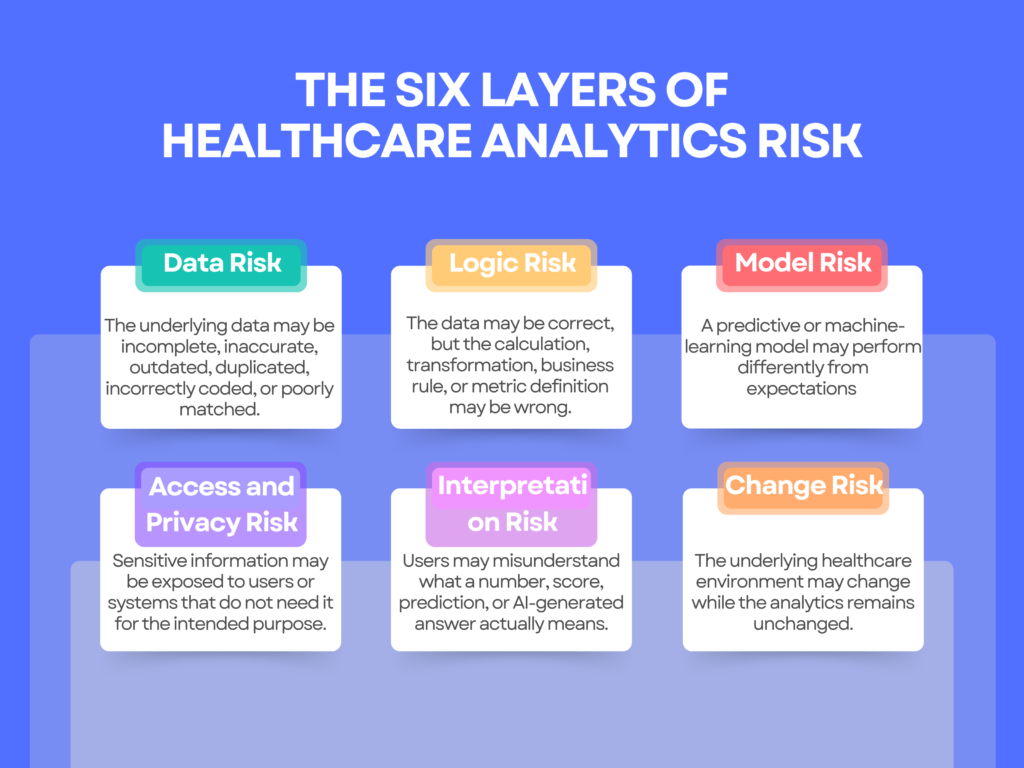
A practical way to identify risk is to examine six layers.
- Data Risk
The underlying data may be incomplete, inaccurate, outdated, duplicated, incorrectly coded, or poorly matched.
- Logic Risk
The data may be correct, but the calculation, transformation, business rule, or metric definition may be wrong.
- Model Risk
A predictive or machine-learning model may perform differently from expectations because of bias, weak validation, population differences, or changes after deployment.
- Access and Privacy Risk
Sensitive information may be exposed to users or systems that do not need it for the intended purpose.
- Interpretation Risk
Users may misunderstand what a number, score, prediction, or AI-generated answer actually means.
- Change Risk
The underlying healthcare environment may change while the analytics remains unchanged.
This last category is particularly important.
A model does not exist in isolation. It operates inside a changing clinical, operational, technical, and regulatory environment.
Understand Where Your Healthcare Analytics Risk Begins
Identify gaps across data quality, lineage, metrics, models, access, AI workflows, and monitoring—and turn them into a practical, prioritized risk roadmap with MindCentrix.
What Is the Most Commonly Missed Healthcare Analytics Risk?
One of the most overlooked risks is context loss.
A number can be mathematically correct and still be misleading when the user does not know:
- which population was included;
- when the data was collected;
- which records were excluded;
- how the metric was calculated;
- whether the source system changed;
- whether the result is comparable with previous periods;
- whether the model was validated on a similar population.
For this reason, healthcare analytics should communicate more than the result.
It should communicate the conditions under which the result is meaningful.
This is especially important as healthcare organizations increasingly combine traditional analytics with AI and predictive systems.
A Practical Framework for How Healthcare Organizations Reduce Analytics Risk

The following framework is designed to connect governance with day-to-day analytics operations.
Step 1: Start With the Decision, Not the Data
Before building a dashboard, report, model, or AI workflow, ask:
What decision is this information supposed to support?
This sounds simple, but it changes the entire design process.
Suppose an organization wants to predict which patients may require additional follow-up after discharge.
The team should first establish:
- Who will use the prediction?
- What decision will they make?
- How quickly must the prediction be available?
- What information is required?
- What happens when the prediction is wrong?
- What happens when the model cannot produce a prediction?
- When should a human review override the system?
The answers determine the appropriate level of analytical control.
A low-impact operational trend does not necessarily require the same governance as an analytical system supporting a high-consequence decision.
Step 2: Classify the Analytical Use Case by Risk
Not every dashboard or model deserves the same amount of governance.
A useful approach is to classify analytical assets according to potential impact.
Lower-impact analytics
Examples may include:
- historical operational reporting;
- aggregated marketing or administrative trends;
- non-sensitive performance summaries.
Controls may focus primarily on data quality, access, calculation accuracy, and reporting consistency.
Medium-impact analytics
Examples may include:
- staffing forecasts;
- utilization analysis;
- financial forecasting;
- operational resource allocation.
These may require stronger validation, documentation, monitoring, and ownership.
Higher-impact analytics
Examples may include systems that influence:
- clinical prioritization;
- patient risk assessment;
- treatment-related decisions;
- eligibility or access decisions;
- high-impact population interventions.
These use cases generally warrant stronger validation, transparency, monitoring, human oversight, and documented limitations.
The principle is:
Governance should be proportional to consequence.
Step 3: Establish Data Ownership
Analytics becomes difficult to govern when nobody clearly owns the underlying information.
For important data assets, identify:
- data owner;
- technical owner;
- business or clinical owner;
- data steward;
- privacy/security responsibility;
- analytics owner.
Ownership does not mean that one person is responsible for everything.
It means accountability is visible.
For example:
Responsibility | Typical Owner |
Source data | System/Data Owner |
Data quality | Data Steward |
Metric definition | Business or Clinical Owner |
Data pipeline | Data Engineering |
Analytical model | Analytics/Data Science |
Privacy | Privacy/Compliance |
Security | Security/IT |
Clinical application | Clinical Leadership |
Governance | Data/Analytics Governance |
The exact structure will vary, but important analytical assets should never become organizational orphans.
Step 4: Measure Data Quality for the Intended Use
A common mistake is asking:
“Is this data clean?”
A better question is:
“Is this data fit for this particular analytical purpose?”
A dataset can be acceptable for one use and unsuitable for another.
For example, a small amount of missing information may be tolerable in a high-level trend report but unacceptable for a clinical prediction model.
NIST identifies accuracy, completeness, consistency, relevance, and timeliness as important aspects of healthcare data quality, particularly for AI-enabled applications.
Healthcare organizations should therefore establish quality checks around:
- completeness;
- accuracy;
- consistency;
- validity;
- uniqueness;
- timeliness;
- plausibility;
- representativeness.
The checks should be connected to the decision the data supports.
Step 5: Make Data Lineage Traceable
Ask a simple question:
“Where did this number come from?”
For a critical metric, the answer should not require several meetings and a spreadsheet archaeology exercise.
A useful lineage path might look like:
EHR → Data Warehouse → Transformation → Patient Cohort → Metric → Dashboard
For each important analytical output, organizations should be able to identify:
- original source;
- relevant table or field;
- extraction time;
- transformation rules;
- business logic;
- exclusions;
- metric definition;
- model version, if applicable;
- report/dashboard version;
- owner;
- validation date.
Lineage becomes especially important when an unexpected result appears.
Instead of asking, “Why did this number change?” the team can work backward through the analytical chain.
Step 6: Create a Metric Contract
A metric contract is one of the simplest ways to reduce disagreement between analytics teams.
For each important metric, document:
Metric name
The official name.
Definition
What the metric actually measures.
Numerator
What counts toward the result.
Denominator
Which population is included.
Exclusions
Which records are intentionally removed.
Source
Where the data originates.
Refresh frequency
How often the metric changes.
Owner
Who is responsible for its definition.
Validation
How the calculation is checked.
Version
When the definition or logic changed.
Consider the word “readmission.”
If one department defines it as any admission within 30 days and another excludes certain planned admissions, both teams may produce technically correct calculations.
But the numbers cannot be compared without understanding the definitions.
Metric governance solves that problem before it becomes a reporting argument.
Step 7: Control Access Without Making Analytics Unusable
Healthcare organizations need access to information to produce useful analytics.
They also need to limit unnecessary access to sensitive information.
HHS describes risk analysis as a foundational component of the HIPAA Security Rule and emphasizes identifying risks and implementing appropriate administrative, physical, and technical safeguards for electronic protected health information.
The practical question is:
What information does this analytical workflow actually need?
Potential controls include:
- role-based access;
- least-privilege permissions;
- data classification;
- de-identification where appropriate;
- pseudonymization where appropriate;
- field-level restrictions;
- controlled analytical environments;
- access logging;
- periodic permission reviews.
For example, an operational dashboard may require aggregated information rather than direct access to identifiable patient records.
The safest analytical dataset is often not the largest one.
It is the one that contains what the use case requires—and no more.
Step 8: Validate Patient Matching and Interoperability
When information comes from multiple systems, organizations must establish confidence that records refer to the correct patient, encounter, event, or clinical concept.
Patient matching errors can create two different problems.
False separation
One patient’s information is incorrectly split across multiple records.
False combination
Information belonging to different people is incorrectly joined.
Both can distort analytics.
Healthcare organizations should validate:
- patient identifiers;
- encounter identifiers;
- duplicate records;
- source-system mappings;
- timestamps;
- terminology mappings;
- code-set changes;
- missing events;
- cross-system relationships.
FHIR and other interoperability standards can support structured exchange, but organizations still need validation at the analytical layer.
Step 9: Validate Models Before They Become Operational
A predictive model should not be considered trustworthy simply because it performed well on a development dataset.
Validation should consider:
- intended use;
- target population;
- data quality;
- performance;
- calibration;
- sensitivity and specificity where appropriate;
- false positives;
- false negatives;
- missing-data behavior;
- subgroup performance;
- generalizability;
- known limitations.
HHS has highlighted that healthcare AI/ML systems can be affected by differences between development and deployment populations, changes in data over time, practitioner or patient behavior, and changes in data capture practices.
That means validation should ask:
“Does this model work here, for this purpose, with this population and this workflow?”
—not simply:
“Did this model perform well somewhere?”
Step 10: Test for Bias Across Relevant Populations
Bias should not be treated as a theoretical issue.
It should be treated as a measurable model-performance question.
Where appropriate, organizations should compare analytical performance across relevant populations and investigate meaningful differences.
Possible evaluation dimensions may include:
- age;
- sex;
- race or ethnicity where legally and ethically appropriate;
- geography;
- socioeconomic factors;
- clinical subgroups;
- language;
- care setting.
The objective is not to force every group to have identical outcomes.
The objective is to understand whether the analytical system behaves differently across groups and whether those differences are justified, expected, harmful, or indicative of a data or model problem.
NIST’s AI Risk Management Framework includes fairness and harmful-bias management among the characteristics organizations should consider when managing AI risk.
Step 11: Monitor for Drift After Deployment
This is where many analytics programs become too static.
A model or dashboard may be validated on launch day and then left alone.
Healthcare does not remain static.
Patient populations change.
Clinical workflows change.
Coding practices change.
Data sources change.
Technology platforms change.
Therefore, analytics should be monitored after deployment.
Data drift
The characteristics of incoming data change.
Population drift
The population using the service becomes different from the development population.
Concept drift
The relationship between inputs and outcomes changes.
Workflow drift
People begin using the system differently from the original design.
Definition drift
A business or clinical definition changes.
Monitoring should therefore look beyond system uptime.
It should examine whether the analytical result remains meaningful.
Step 12: Explain the Output, Not Just the Number
Consider a dashboard showing:
Risk Score: 82
What does 82 mean?
Is it:
- probability?
- percentile?
- relative risk?
- severity?
- confidence?
- a proprietary score?
Without context, users may interpret the same number differently.
A responsible analytical interface should make clear:
- what the output represents;
- what it does not represent;
- which data was used;
- when the data was refreshed;
- known limitations;
- appropriate interpretation;
- expected action;
- when human review is required.
Transparency is becoming increasingly important as AI-generated information enters healthcare workflows.
NIST’s AI RMF emphasizes characteristics such as validity, reliability, transparency, explainability, privacy, security, and fairness when managing AI risk.
A Composite Example: How a Small Analytics Change Can Become a Big Problem
Consider this composite scenario.
A healthcare network operates several facilities and uses a centralized dashboard to monitor 30-day readmissions.
After an EHR configuration change, the dashboard shows a noticeable improvement.
Leadership initially assumes the improvement reflects better patient outcomes.
The analytics team later discovers that a particular category of encounters is no longer flowing into the analytical dataset in the same way.
The readmission calculation itself is functioning correctly.
The dashboard is refreshing correctly.
There is no obvious software failure.
The problem is upstream.
The source-system change altered the population being measured.
This example illustrates why healthcare analytics risk cannot be reduced to:
“Does the dashboard work?”
The better questions are:
- Did the source data change?
- Did the population definition change?
- Did the metric denominator change?
- Did the transformation logic change?
- Was the change documented?
- Did downstream reports receive an alert?
- Was the metric still comparable with previous periods?
This is why change management belongs inside analytics governance.
Healthcare Analytics Risk Control Matrix
The following matrix can be used as a starting point for an internal analytics risk review.
Risk | What Can Go Wrong? | Early Warning Signal | Practical Control |
Data quality | Missing or incorrect records distort analysis | Sudden increase in missing fields | Automated quality checks |
Patient matching | Records are assigned to the wrong patient | Duplicate/unmatched identifiers | Identity reconciliation |
Metric definition | Teams use different definitions | Conflicting dashboard results | Metric catalog and owner |
Data lineage | Nobody can explain a result | Manual spreadsheet dependencies | End-to-end lineage |
Access | Sensitive information is exposed unnecessarily | Excessive permissions | Least-privilege access |
Model performance | Predictions become unreliable | Performance decline | Continuous validation |
Model bias | Performance differs across groups | Subgroup performance gap | Stratified evaluation |
Model drift | Environment changes after deployment | Input/output distribution changes | Drift monitoring |
Interpretation | Users misunderstand the output | Repeated user confusion | Context and limitations |
Source-system change | Analytics silently changes | Unexpected metric movement | Change-impact testing |
AI output | Plausible but unsupported content is accepted | Unverifiable claims | Grounding and human review |
Governance | Nobody owns the analytical asset | Unclear escalation path | Named accountable owner |
This matrix should not be treated as a universal checklist.
The appropriate controls depend on the organization’s technology, use cases, jurisdiction, and risk tolerance.
How Should Healthcare Organizations Prioritize Analytics Risks?
A long list of risks is not the same as a useful risk program.
A practical prioritization model considers four factors:
Impact
What happens if the analytical result is wrong?
Likelihood
How likely is the failure?
Detectability
How quickly would the organization notice it?
Exposure
How widely is the analytical output used?
A relatively minor error used by three analysts may require less immediate attention than a subtle error embedded in a dashboard used daily across an entire health system.
This allows organizations to focus resources where they matter most.
Common Mistakes in Healthcare Analytics Risk Management
Mistake 1: Treating Compliance as the Entire Risk Strategy
HIPAA, GDPR, DPDP and other privacy frameworks can establish important obligations, but compliance does not automatically make an analytical result accurate.
A dashboard can follow access-control requirements and still calculate the wrong denominator.
Compliance and analytical reliability should therefore be treated as related but distinct control areas.
Mistake 2: Validating Only the Model
A strong model cannot compensate for unreliable input data.
Model governance needs to include the data pipeline that feeds the model.
Mistake 3: Letting Every Team Define Its Own Metrics
Local flexibility can be useful, but uncontrolled definitions eventually create conflicting versions of organizational truth.
Critical metrics need shared definitions and clear ownership.
Mistake 4: Assuming Historical Performance Predicts Future Performance
Healthcare environments change.
A model or analytical rule that worked previously may need reassessment when the underlying population, workflow, data source, or clinical practice changes.
Mistake 5: Showing Numbers Without Context
A number without a definition is not necessarily an insight.
Users need enough context to understand what the number represents and how it should be used.
Mistake 6: Treating AI as a Separate Governance Problem
AI risk is connected to existing data, security, privacy, model, and governance risks.
Creating a completely separate AI process can leave gaps between conventional analytics and AI-enabled workflows.
A better approach is to extend existing governance where possible and add controls for AI-specific risks.
How AI Is Changing Healthcare Analytics Risk
AI introduces additional analytical possibilities, but it also introduces new failure modes.
Healthcare organizations using AI may need to consider:
- hallucinated information;
- unreliable generated summaries;
- hidden model limitations;
- sensitive information exposure;
- prompt manipulation;
- inconsistent outputs;
- model changes;
- inadequate source grounding;
- unclear provenance;
- automation bias;
- inappropriate human reliance.
WHO has emphasized the importance of transparency, documentation, intended use, human intervention, data quality, external validation, and risk management when AI is used in health.
NIST’s AI RMF provides a broader risk-management structure built around Govern, Map, Measure, and Manage.
A particularly relevant development is the growing attention to documenting AI involvement in healthcare information itself. NIST’s current work around AI transparency in FHIR explores mechanisms for identifying AI-influenced data and recording provenance information about the AI system, inputs, prompts, and participants involved.
That points toward an important future requirement:
Healthcare organizations may increasingly need to know not only where a piece of information came from, but whether and how AI influenced it.
What About Healthcare Analytics Outside the United States?
Healthcare analytics is not governed by one global privacy framework.
Organizations operating across jurisdictions need to understand the requirements applicable to their specific activities.
For example:
- U.S. organizations may need to consider HIPAA and other federal/state requirements.
- Organizations handling applicable European personal data may need to consider GDPR.
- Organizations operating in India may need to consider India’s Digital Personal Data Protection framework and other applicable healthcare and sector-specific requirements.
- Other jurisdictions have their own privacy, health-data, medical-device, and AI requirements.
The important point is not to copy a U.S.-specific governance model into every environment.
Instead:
Map the analytical use case to the laws, contractual obligations, security requirements, and professional responsibilities that apply to that organization.
WHO has specifically highlighted the importance of understanding jurisdiction and privacy requirements when deploying AI for health, including the different contexts created by frameworks such as GDPR and HIPAA.
A Healthcare Analytics Risk Assessment Checklist
Before putting an important analytical asset into production, ask:
Data
- Do we know where the data comes from?
- Is it appropriate for this use case?
- Are missing values understood?
- Are duplicates controlled?
- Is patient matching reliable?
- Is the information sufficiently current?
- Have source-system changes been considered?
Context
- What population does the result represent?
- What time period does it cover?
- What exclusions apply?
- What assumptions are being made?
- Can the result be compared with previous periods?
Logic
- Is the calculation documented?
- Has the logic been independently reviewed?
- Are numerator and denominator definitions clear?
- Are business rules version-controlled?
Governance
- Is there an accountable owner?
- Is the intended use documented?
- Are limitations documented?
- Is there an escalation path?
Privacy and Security
- Is only necessary information being used?
- Are permissions appropriate?
- Is sensitive data protected?
- Are access events recorded?
Models
- Was the model validated?
- Was it evaluated on a relevant population?
- Were important subgroups assessed?
- Are false-positive and false-negative behaviors understood?
- Is drift being monitored?
User Experience
- Can users understand the output?
- Are limitations visible?
- Is the expected action clear?
- Is human review required?
Operations
- Are data pipelines monitored?
- Are anomalies detected?
- Is there a rollback or retirement process?
- Can the organization reconstruct how an important result was produced?
If several answers are “no,” the analytical asset may require additional controls before it becomes operationally important.
A Practical Analytics Risk Maturity Model
Healthcare organizations do not need to build a perfect governance program overnight.
A more realistic approach is to progress through maturity levels.
Level 1: Visibility
The organization identifies its dashboards, models, data sources, and AI systems.
Question: What do we actually have?
Level 2: Ownership
Important analytical assets receive accountable owners.
Question: Who is responsible?
Level 3: Standardization
Critical metrics, definitions, validation rules, and access practices become standardized.
Question: Are we doing this consistently?
Level 4: Monitoring
Data pipelines, models, reports, and analytical outputs are monitored after deployment.
Question: How do we know when something changes?
Level 5: Risk-Based Governance
Higher-impact analytical use cases receive stronger controls.
Question: Are our controls proportional to the consequences?
Level 6: Continuous Improvement
Incidents, anomalies, user feedback, model performance, and changing requirements feed back into the governance process.
Question: Are we learning from what happens in production?
What Does a Mature Healthcare Analytics Environment Look Like?
A mature environment is not necessarily the one with the most dashboards or the most sophisticated AI models.
It is the environment where people can answer important questions quickly.
For a critical metric:
Where did this number come from?
For a model:
Who was this model validated on?
For a dashboard:
What definition is being used?
For sensitive data:
Who can access it and why?
For an unexpected result:
What changed?
For an AI-generated output:
What system produced it, what information influenced it, and who reviewed it?
For a production model:
Is it still performing as expected?
Those answers are signs of analytical maturity.
How MindCentrix Can Help Reduce Healthcare Analytics Risk
Analytics risk management becomes difficult when dashboards, data pipelines, reporting tools, AI systems, and governance processes are managed separately.
MindCentrix approaches the problem as an interconnected digital and analytics workflow.
A Healthcare Analytics Risk Assessment can be structured around the areas that most directly affect analytical reliability.
- Analytics Inventory
Identify:
- dashboards;
- reports;
- models;
- data sources;
- AI workflows;
- critical analytical processes.
- Data-Flow Mapping
Document how important information moves from source systems to analytical outputs.
- Data-Quality Review
Assess:
- completeness;
- consistency;
- freshness;
- duplication;
- anomalies;
- source-system dependencies.
- Metric Governance Review
Review:
- definitions;
- formulas;
- ownership;
- exclusions;
- version history;
- cross-dashboard consistency.
- Analytics and Model Review
Assess:
- validation;
- assumptions;
- population fit;
- subgroup performance;
- monitoring;
- limitations.
- Privacy and Access Review
Identify areas where data access may be broader than the analytical purpose requires.
- AI Governance Review
For AI-enabled workflows, assess:
- intended use;
- data inputs;
- output validation;
- human oversight;
- provenance;
- monitoring;
- known limitations.
- Prioritized Risk Roadmap
Instead of producing a report that sits on a shelf, the assessment should finish with a prioritized action plan:
Critical → High → Medium → Low
Each item can be mapped to:
- risk;
- business impact;
- recommended control;
- owner;
- priority;
- implementation effort.
The result is a practical roadmap for making analytics more traceable, understandable, and reliable.
Final Thoughts
Healthcare organizations do not reduce analytics risk simply by buying better analytics software or adding another security control.
They reduce it by making the analytical lifecycle visible.
They know:
where the data came from,
what happened to it,
how the metric or model was created,
who owns it,
what its limitations are,
who can access it,
how users should interpret it,
and
what happens when the underlying environment changes.
That is what turns analytics from a collection of numbers into a controlled decision-support capability.
The most useful standard is therefore not:
“Is this dashboard accurate?”
It is:
“Can we explain why this result should be trusted for this decision, under these conditions, and what we will do if those conditions change?”
That is the foundation of safer, more reliable healthcare analytics.
Questions? We've got answers.
Understand healthcare analytics risk, from data quality and governance to model monitoring, AI risk, privacy, and human oversight.
Healthcare organizations reduce analytics risk by managing the full lifecycle from data collection through decision-making. This includes data-quality controls, data lineage, metric governance, privacy and security controls, analytical validation, model monitoring, transparency, human oversight, and change management.
Healthcare analytics risk is the possibility that inaccurate, incomplete, poorly governed, insecure, biased, outdated, or misunderstood analytical information contributes to an inappropriate decision. The risk can occur anywhere across the analytics lifecycle, from the original data source and transformation process to metrics, models, outputs, interpretation, and the eventual decision.
No. Security and privacy are important parts of analytics risk, but they are only two components. Analytics can also fail because of poor data quality, incorrect calculations, inconsistent metric definitions, model drift, bias, interoperability problems, or user misunderstanding. A secure analytics environment can still produce unreliable information if other parts of the lifecycle are not governed.
Analytical outputs depend on the quality and suitability of their inputs. Poor-quality data can distort patient cohorts, trends, predictions, and operational decisions. Important data-quality characteristics include accuracy, completeness, consistency, relevance, and timeliness. Data-quality controls should therefore be part of the analytics lifecycle rather than treated as a one-time technical check.
Data lineage documents how information moves from its original source through transformations, calculations, models, and final outputs. It helps teams understand where analytical information came from, what happened to it along the way, and how a final metric, dashboard, prediction, or analytical conclusion was produced. This can make unexpected results easier to investigate.
Organizations can use automated data-quality checks, anomaly detection, pipeline monitoring, metric validation, model-performance monitoring, access monitoring, and change-impact testing. These controls can help identify unusual behavior or unexpected changes earlier. Human review remains important for investigating unusual results and evaluating high-impact analytical outputs in their appropriate context.
Model drift occurs when changes in the underlying data, patient population, workflow, or relationship between variables cause an analytical model's behavior or performance to change over time. Monitoring for changes in data characteristics and model performance can help organizations determine when additional investigation, validation, recalibration, or other action may be appropriate.
There is no universal review frequency for every healthcare analytics model. The appropriate frequency depends on the model's intended use, potential impact, rate of environmental change, data characteristics, and observed performance. Higher-impact models may require stronger ongoing monitoring and more frequent evaluation than lower-impact analytical use cases.
Organizations can reduce AI analytics risk by defining intended use, validating input data, evaluating performance across relevant populations, documenting limitations, monitoring production behavior, protecting sensitive information, and maintaining appropriate human oversight. Organizations should also establish procedures for investigating unexpected outputs and managing changes throughout the AI lifecycle. Structured AI risk-management frameworks can help provide a consistent approach.
No. HIPAA addresses important privacy and security obligations, but compliance with applicable requirements does not eliminate every form of analytics risk. An organization can still have incorrect metrics, poor data quality, weak model validation, misleading analytical outputs, or problems with interpretation. Risk analysis and appropriate safeguards are important components of managing healthcare information and analytics environments.
Human oversight provides an opportunity to evaluate analytical information in context, particularly when an incorrect result could have significant consequences. People can investigate unusual outputs, consider information that may not be represented in the analytical system, and determine whether additional review is necessary. The appropriate level of human involvement depends on the use case and its potential impact.
Yes. Security and privacy controls do not necessarily require organizations to make analytics unusable. Least-privilege access, appropriate data minimization, controlled analytical environments, de-identification where suitable, logging, and regular access reviews can help balance analytical utility with privacy and security requirements. Controls should be designed around the sensitivity and intended use of the information.
A practical assessment should examine the complete analytics lifecycle rather than focusing on a single technical component. This can include data sources, data quality, lineage, metric definitions, access controls, privacy, analytical logic, model validation, bias, monitoring, AI workflows, change management, ownership, and user interpretation. The assessment should also consider how analytical outputs are ultimately used in operational or clinical decision-making.
Strategic Digital Growth for Modern Businesses

MindCentrix is a digital growth partner helping businesses turn digital potential into profitable performance.
If you're trying to figure out what's holding your ecommerce growth back, start with the problem — not the marketing package.
Explore Your Growth Opportunities

Boost Your Brand Visibility 🚀
Get personalized digital strategies that drive growth and engagement.
Let’s Talk📬 Stay Updated
Get the latest insights and guides delivered right to your inbox.
🔗 Related Topics
- Loading related posts...
Insights to help you
grow smarter.
Practical strategies, expert perspectives, and fresh ideas to help your business navigate the digital world.
Loading latest insights...