
Web Development Outsourcing Company in India: How to Choose the Right Partner
- 1Business understanding
- 2Relevant technical expertise
- 3Project ownership
- 4Communication
- 5Security
- 6Source-code and IP ownership
- 7SEO knowledge
- 8Analytics implementation
- 9Scalability
- 10Quality assurance
- 11Documentation
- 12Post-launch support
Hiring a web development outsourcing company in India is easy.
Choosing one that can take responsibility for the technology behind your business is a different exercise.
A website can be visually impressive and technically functional while still creating problems for the business. Slow pages can hurt user experience. Poor URL planning can damage organic visibility. A disconnected form can send valuable leads nowhere. An undocumented codebase can make the next developer spend weeks understanding what the previous team built.
That is why outsourcing web development should not be reduced to comparing hourly rates.
The real question is:
Can this development partner build something that works for the business today and remains manageable tomorrow?
This guide takes a practical look at how to evaluate an Indian web development partner, compare outsourcing models, assess proposals, protect SEO and analytics during development, and avoid the problems that often appear after launch.
What Is Web Development Outsourcing?
Web development outsourcing means hiring an external team to handle some or all of your website or web application development.
The engagement might cover a single project, ongoing development, technical maintenance, or a combination of services.
For example, a business might outsource:
- A complete website redesign
- WordPress development
- Custom PHP development
- E-commerce development
- Web applications
- API integrations
- CRM integrations
- Platform migrations
- Performance optimization
- Technical maintenance
The important distinction is how much responsibility the external team owns.
Hiring one developer to complete assigned tasks is very different from hiring a partner responsible for discovery, architecture, development, QA, deployment, documentation, and support.
Before approaching a web development outsourcing company in India, decide which of those relationships your business actually needs.
Development capacity vs. development ownership
Suppose your internal team already has a product manager and designer but needs three additional developers for six months.
You don’t necessarily need a full-service development partner.
Staff augmentation may be enough.
Now consider a company with an outdated website, limited technical resources, several third-party integrations, and an upcoming redesign.
That business may benefit more from a partner that can own the project from technical discovery through launch.
The right outsourcing model starts with the gap you need to fill, not the services a vendor happens to sell.
Why Businesses Outsource Web Development to India
India has a large technology-services ecosystem covering web development, software engineering, e-commerce, cloud services, QA, and digital transformation.
For international businesses, this creates access to external technical teams without building every capability internally.
But “India is less expensive” is not a sufficient outsourcing strategy.
The useful question is whether the economics and expertise make sense for your particular project.
Access to specialized expertise
A company might need Laravel for one project, WordPress for another, React for a web application, and specialist QA for a migration.
Hiring permanent employees for every requirement creates a large fixed cost.
An external partner can provide access to different skills as project requirements change.
Flexible capacity
Development needs aren’t always constant.
A business may need substantial resources during a migration and much less capacity afterward.
Outsourcing gives the business another way to manage those peaks.
Faster access to a development team
Recruiting an internal team takes time.
An established development provider already has recruitment, management, and delivery infrastructure in place.
That can shorten the path between defining a project and starting development.
The important caveat
Outsourcing doesn’t remove management.
It changes where management happens.
Your business still needs clear requirements, approvals, ownership, and communication.
A vendor that requires constant supervision can eliminate much of the operational benefit you’re trying to gain.
Four Common Outsourcing Models
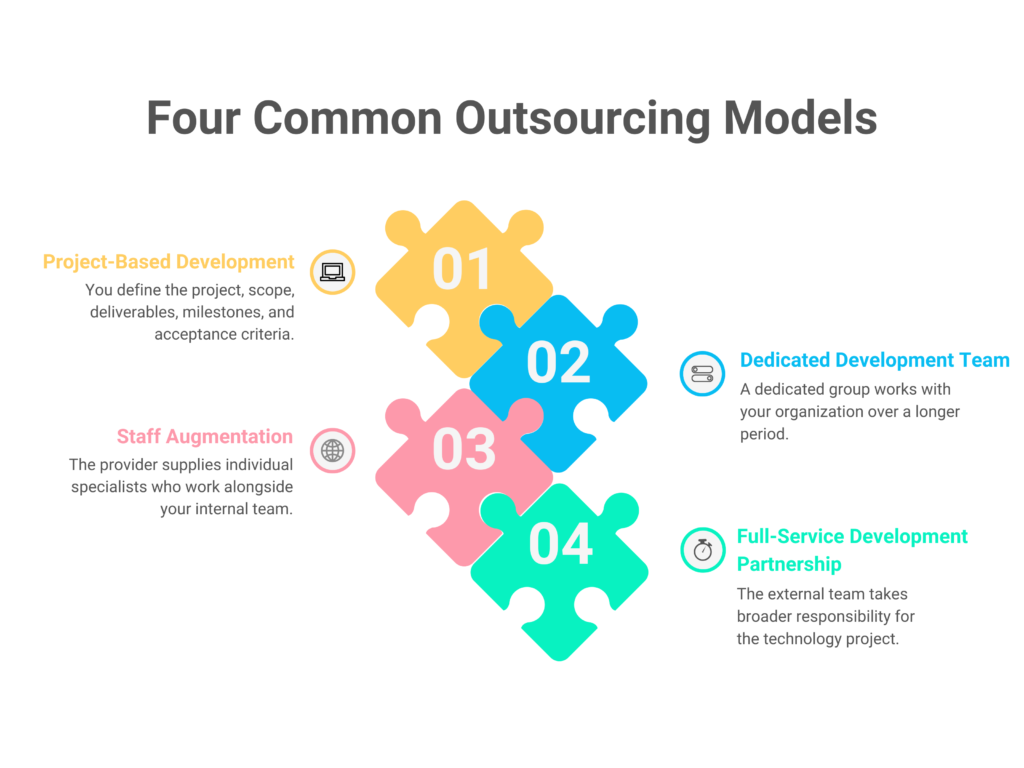
There is no single outsourcing structure.
- Project-Based Development
You define the project, scope, deliverables, milestones, and acceptance criteria.
The vendor delivers the agreed project.
This works well for:
- Corporate websites
- Website redesigns
- Platform migrations
- E-commerce projects
- Defined web applications
- Dedicated Development Team
A dedicated group works with your organization over a longer period.
This model suits businesses with a continuing development roadmap rather than one isolated project.
- Staff Augmentation
The provider supplies individual specialists who work alongside your internal team.
For example:
Your team has a project manager, designer, and two developers. You need another PHP developer and QA specialist for four months.
Staff augmentation fills those specific gaps without transferring complete project ownership.
- Full-Service Development Partnership
The external team takes broader responsibility for the technology project.
That may include:
Discovery → Architecture → Design collaboration → Development → QA → Deployment → Monitoring → Maintenance
This model requires more trust because the provider carries more responsibility.
Before hiring a web development outsourcing company in India, determine which of these relationships matches your internal capabilities.

Need a Web Development Partner You Can Trust?
Build a website that supports your business goals with MindCentrix. From web development and technical SEO to analytics, integrations, and long-term support, we help you create digital infrastructure that works beyond launch.
How to Evaluate a Development Partner
A portfolio tells you what a company has displayed.
It doesn’t necessarily tell you how that company works.
Use the following criteria to evaluate the actual partnership.
Business understanding
A strong development conversation should include business questions before technical recommendations.
The provider should understand:
- Who your customers are
- What the website needs to achieve
- How leads or sales are generated
- Which systems need integration
- What isn’t working today
- What the platform needs to support later
If the first meeting is entirely about programming languages, something is missing.
Technical capability
Look for relevant experience rather than an enormous list of technologies.
Ask about projects involving:
- Your CMS or framework
- Similar integrations
- Comparable traffic
- Similar user journeys
- Migration requirements
- Custom functionality
- Performance constraints
Then ask the provider to explain its decisions.
“Why did you choose this architecture?” is often a better question than “Do you know React?”
Communication
Define the operating model before development begins.
Who approves work?
Who makes technical decisions?
Where are tasks tracked?
How frequently are updates delivered?
What happens when something blocks development?
An outsourcing relationship becomes difficult when every decision requires another meeting just to determine who owns it.
Security
Security requirements should be established before development, particularly when the project involves customer information, payments, proprietary systems, or internal business data.
Discuss:
- Access control
- Authentication
- Credentials
- API security
- Database access
- Backups
- Production access
- Dependency updates
- Deployment procedures
Ownership
Your agreement should clearly establish ownership of:
- Source code
- Repository
- Website
- Database
- Design files
- Documentation
- Hosting
- Domain
- Cloud infrastructure
- Third-party accounts
This is one of the simplest ways to avoid a painful vendor transition later.
The Cheapest Quote Can Become the Most Expensive Project
Here’s a common scenario.
A company receives three proposals for a website.
Vendor | Initial Quote | Included |
Vendor A | $12,000 | Development |
Vendor B | $17,000 | Development + QA + analytics + documentation |
Vendor C | $22,000 | Strategy + development + QA + launch support |
Vendor A appears to offer the obvious financial advantage.
Then the project starts.
Analytics wasn’t included.
Several integration requirements weren’t clearly defined.
Testing is limited.
The internal marketing team has to coordinate technical fixes.
After launch, additional development is required.
The final cost is no longer $12,000.
This example is hypothetical, but the underlying lesson is important:
Compare scope, not just price.
A proposal should tell you what you’re buying, what isn’t included, what assumptions were made, and how changes will affect cost.
Think in terms of total cost of ownership
A more useful model is:
Total Cost = Development + Management + Rework + Infrastructure + Maintenance + Internal Time
The lowest development rate can still produce the highest overall cost when the project requires excessive supervision or repeated fixes.
That doesn’t mean the most expensive vendor is the right choice.
It means the invoice should be evaluated alongside the delivery model.
A Website Migration Example
Consider a hypothetical B2B company with an established website containing 400 indexed URLs.
The business wants a new platform.
The development team starts designing the new website immediately.
The old URL structure is ignored until the final week.
At launch, 70 old URLs disappear.
Some pages have new URLs.
Others are consolidated.
Several old URLs now return 404 responses.
The new website looks better.
The migration has still created an avoidable SEO problem.
A better process begins much earlier.
Before development:
- Crawl the existing website
Identify URLs, metadata, status codes, canonical tags, internal links, and important landing pages.
- Identify valuable pages
Not every URL deserves identical treatment. Organic traffic, backlinks, conversions, rankings, and business importance should inform the migration plan.
- Map old URLs to new URLs
Create the redirect mapping before launch.
- Build the new architecture
Make sure the new structure supports users and search engines.
- Test on staging
Check links, redirects, metadata, structured data, forms, analytics, and technical elements.
- Monitor after launch
Review indexing, crawl errors, organic traffic, conversions, and technical issues.
The point isn’t that every website migration requires exactly the same process.
The point is that development decisions can have consequences outside development.
This is why businesses should choose a web development outsourcing company in India that understands how technical implementation connects with SEO and measurement.
SEO and Analytics Must Start Before Development
A common organizational mistake is dividing the project into separate boxes:
Developer: Build the website.
SEO team: Optimize it later.
Marketing team: Add analytics afterward.
Sales team: Figure out the CRM integration later.
That sequence creates unnecessary friction.
A better approach is to identify the requirements together.
SEO requirements
Development should account for:
- URL structure
- Redirects
- Crawlability
- Indexation
- Canonical URLs
- XML sitemaps
- Robots.txt
- Structured data
- Mobile usability
- Page performance
- JavaScript rendering
- Internal linking
Analytics requirements
The website may also need to support:
- GA4
- Google Tag Manager
- Form tracking
- Conversion events
- CRM integrations
- E-commerce tracking
- Call tracking
- Marketing automation
- Attribution
Consider a B2B contact form.
The job isn’t finished when the visitor clicks Submit.
The system may need to:
Capture the form → validate the submission → send it to the CRM → attribute the source → record the conversion → notify the sales team
If those requirements aren’t discussed during development, the business can end up with a beautiful website and unreliable data.
Development Should Serve the Customer Journey
Think beyond individual pages.
A website is part of a journey.
For a B2B company:
Search → Content → Landing Page → Form → CRM → Sales
For e-commerce:
Search → Category → Product → Cart → Checkout → Purchase
For SaaS:
Search → Landing Page → Signup → Product → Subscription
The development architecture should support the journey.
This is one of the reasons a web development outsourcing company in India should be evaluated on its ability to understand integrations and business workflows—not simply its ability to write code.
How to Compare Vendors
Once you’ve shortlisted three or four providers, give each company the same project brief.
Then compare the responses using a consistent framework.
Evaluation Area | What to Examine |
Business understanding | Did they identify the real problem? |
Technical approach | Does the architecture fit the requirement? |
Scope | Are inclusions and exclusions clear? |
SEO | Are migration and technical requirements addressed? |
Analytics | Is measurement planned? |
Security | Are access and security responsibilities defined? |
Ownership | Is source-code ownership clear? |
Communication | Is there a defined operating process? |
QA | Is testing explicitly included? |
Support | What happens after launch? |
Cost | Can you understand the full financial commitment? |
A simple vendor test
Ask every provider:
“What do you think we’re missing from our current requirements?”
This is a useful test because it forces the vendor to think rather than simply repeat your project brief.
A development partner should be able to identify technical dependencies, risks, unanswered questions, and assumptions.
Questions to Ask Before Signing
Instead of asking only “How much does it cost?”, ask:
Business and strategy
- What do you need to understand about our business before starting?
- What assumptions are included in your proposal?
- What risks do you see in our project?
Technical
- Why are you recommending this technology stack?
- How will the platform support future development?
- How will integrations be built and maintained?
- What happens when requirements change?
SEO and analytics
- How will you protect existing SEO during development?
- How will redirects and URL changes be handled?
- How will conversion tracking be implemented?
Security and ownership
- Who owns the source code?
- Where will the repository be hosted?
- Who controls hosting and infrastructure?
- How are credentials managed?
Delivery
- Who is responsible for project management?
- How will QA be performed?
- What happens after launch?
The answers are more important than whether the vendor says “yes” to every question.
What Your Outsourcing Agreement Should Cover
A professional agreement should make responsibilities explicit.
At minimum, document:
- Scope
- Deliverables
- Milestones
- Payment terms
- Acceptance criteria
- Change requests
- Intellectual property
- Confidentiality
- Data responsibilities
- Source-code ownership
- Third-party licenses
- Security responsibilities
- QA
- Bug-fix period
- Maintenance
- Support
- Termination
- Handover
- Documentation
Don’t forget the exit plan
This is one of the most overlooked parts of vendor management.
Ask:
“If we stop working together in 18 months, what exactly happens?”
You should be able to receive the necessary source code, credentials, documentation, infrastructure information, and other assets required for another team to take over.
A good partnership doesn’t depend on making the client unable to leave.
When Outsourcing Makes Sense
Outsourcing is worth considering when your business:
- Needs specialized development expertise
- Has limited internal development capacity
- Is planning a website redesign
- Needs a platform migration
- Requires complex integrations
- Needs additional development resources
- Wants ongoing technical support
- Is modernizing legacy technology
It isn’t automatically the right model for every organization.
If your website or application is a core proprietary product requiring constant internal engineering decisions, an internal team may provide stronger day-to-day ownership.
A hybrid model can also work.
Your internal team can retain product and business ownership while an external partner provides specialist development capacity.
How MindCentrix Approaches Web Development
At MindCentrix, we look at web development from a broader perspective.
A website doesn’t operate in isolation.
It connects with search, content, analytics, CRM systems, conversion paths, paid acquisition, and the broader digital infrastructure of the business.
That influences how we approach development projects.
For example, when rebuilding a website, we don’t want the conversation to stop at:
“Which pages should we build?”
We also want to understand:
“How will people find these pages?”
“What should visitors do?”
“How will those actions be measured?”
“Where should the lead data go?”
“What happens when the business needs another integration?”
“How will the website be maintained after launch?”
This integrated perspective is particularly useful for companies that need development alongside digital growth work.
MindCentrix supports projects involving:
- WordPress development
- Custom PHP development
- E-commerce development
- Website redesign
- Technical SEO
- GA4
- Google Tag Manager
- Analytics implementation
- Marketing integrations
- Conversion-focused improvements
- Digital transformation
The objective isn’t to add services simply for the sake of adding services.
It’s to make sure the technology supports the business systems around it.
What Makes a Strong Development Partnership?
A strong relationship usually has five characteristics.
Clear ownership
Everyone knows who is responsible for what.
Transparent scope
Both sides understand what’s included and what’s outside the project.
Technical accountability
The development team can explain its architectural decisions and take responsibility for implementation.
Business context
Developers understand the purpose behind the features they’re building.
Long-term thinking
The team considers what happens after launch, not just how to reach launch day.
That’s the difference between buying development capacity and building a development partnership.
Final Thoughts
A web development outsourcing company in India should be evaluated as a potential technology partner—not simply as a supplier of development hours.
Look beyond the hourly rate.
Look beyond the portfolio.
Look beyond the number of developers on the team.
Instead, examine how the company approaches your business problem.
Can it explain its technical decisions?
Can it communicate clearly?
Can it protect your source-code ownership?
Can it account for SEO?
Can it implement reliable analytics?
Can it document what it builds?
Can another team take over if circumstances change?
And can the technology continue supporting the business after the initial project is complete?
Those questions will tell you much more than a pricing table.
For businesses that need web development, SEO, analytics, and digital growth to work together, MindCentrix takes an integrated approach to building and improving digital infrastructure.
The goal is straightforward:
Build technology that works for the business-not technology that simply works.
Questions? We've got answers.
Everything you need to know about web development outsourcing in India and choosing the right technical partner.
A web development outsourcing company in India provides website or web application development services through an external technical team. Depending on the engagement, services can include development, redesigns, migrations, integrations, testing, maintenance, and ongoing technical support.
Businesses outsource to India to access technical expertise, development capacity, and specialized skills without building every capability internally. The right outsourcing decision should consider expertise, communication, ownership, security, quality, and total cost—not price alone.
There is no universal price. Costs depend on project complexity, technology, design, integrations, development model, testing, timeline, and support requirements. A detailed scope is necessary before comparing quotes meaningfully.
Compare providers based on technical experience, business understanding, communication, security, ownership, SEO knowledge, analytics, QA, scalability, documentation, and post-launch support. Ask each shortlisted provider to respond to the same project brief so you can compare their approaches consistently.
The common models are project-based development, dedicated development teams, staff augmentation, and full-service development partnerships. The appropriate model depends on how much technical capacity and project ownership your organization needs.
Check the provider's relevant experience, development methodology, communication structure, security practices, source-code ownership, QA process, SEO capabilities, analytics approach, maintenance model, and contractual terms.
Ownership depends on the contract. Businesses should explicitly establish ownership and access to the source code, repositories, hosting, infrastructure, design assets, documentation, and third-party accounts before development begins.
Yes. External developers can work alongside internal developers, marketers, product managers, designers, and other teams. Staff augmentation and hybrid development models are designed specifically for this type of collaboration.
It can. Development decisions affect URL structures, redirects, crawlability, indexation, page performance, structured data, mobile usability, and other technical SEO elements. SEO requirements should be considered during development rather than after launch.
There isn't a universal requirement to use one company. However, having development and SEO capabilities within the same partner can simplify coordination when technical architecture, migrations, performance, structured data, and search visibility overlap.
MindCentrix approaches web development alongside SEO, analytics, digital marketing, conversion, and digital transformation. The objective is to connect the website with the broader systems that drive customer acquisition, measurement, and business growth.
Yes. MindCentrix provides web development support including WordPress, custom PHP, e-commerce, website redesign, integrations, technical SEO, analytics implementation, and digital transformation services.
Bhavishya K
About MindCentrix


Boost Your Brand Visibility 🚀
Get personalized digital strategies that drive growth and engagement.
Let’s Talk📬 Stay Updated
Get the latest insights and guides delivered right to your inbox.
🔗 Related Topics
- Loading related posts...
Insights to help you
grow smarter.
Practical strategies, expert perspectives, and fresh ideas to help your business navigate the digital world.
Loading latest insights...