Generative AI vs. Agentic AI:
The Enterprise Architecture and Risk Guide
- 1Generative AI produces content, code, and analysis from prompts.
- 2Agentic AI plans, reasons, uses tools, and completes multi-step workflows.
- 3Greater autonomy increases productivity but also security, cost, and operational risks.
Every CTO conversation about AI strategy eventually hits the same wall: someone in the room says “agentic AI” and someone else says “isn’t that just AI that can use tools?” and the meeting spends the next twenty minutes going in circles.
It’s a fair confusion, because the two technologies look similar from a distance. Both are powered by the same large language models. Both write text. Both can sound equally confident whether they’re right or wrong. But the moment you put either one in charge of something that touches your production database, your customer’s money, or your CI/CD pipeline, the resemblance stops mattering and the architecture underneath becomes the only thing that matters.
This guide gives you the decision framework first, then the depth. No 3,000-word wind-up before you get to something useful.
The Direct Answer
Generative AI is a reactive creation engine. It runs on a single-pass inference model – prompt in, LLM reasoning, output out – synthesizing text, code, or images in direct response to a human instruction. It doesn’t remember what happened five minutes ago unless you feed that context back in, and it doesn’t do anything you didn’t explicitly ask for.
Agentic AI is an autonomous orchestration engine. It wraps that same LLM inside a loop of persistent memory, state tracking, and tool-calling: perceive the environment, plan a path to the goal, act by calling real tools and APIs, then reflect on what happened and correct course. It keeps going until the goal is met or it hits a guardrail.
The strategic shift is simple to state and easy to underestimate: generative AI produces informational drafts that reduce creation labor. Agentic AI executes operational workflows that reduce procedural friction. One gives you a better first draft. The other gives you a system that acts on your behalf while you’re not watching.
That’s also exactly why the trade-off isn’t free. Moving from generative to agentic AI trades cheap, predictable token costs for autonomy – and along with that autonomy comes operational risk, compounding latency, and token consumption that can climb far faster than most budgeting models expect. The rest of this guide is about how to make that trade-off deliberately instead of by accident.
The A.R.O. Risk & Autonomy Matrix™: Where Do You Start?
Before any architecture discussion, most enterprise teams need one question answered: should this specific task even be agentic in the first place?
We built the A.R.O. (Autonomy, Risk, Oversight) Matrix to answer that in under a minute, because the honest answer is often “no, not yet” – and that’s a perfectly good answer.
Walk through it like this:
Does the task require multi-step system actions? If no – you’re drafting, summarizing, or generating a single piece of content – stop here. Deploy generative AI. Copilots and drafting assistants solve this well, cheaply, and predictably.
If yes, ask the harder question: what does failure cost?
- High risk (the task touches financial systems, writes to a production database, or can’t be easily undone) → route it through a human-in-the-loop agentic workflow. The agent plans and proposes; a person approves the state-changing step.
- Low risk (read-only API calls, sandboxed operations, reversible actions) → a fully autonomous agentic workflow with automated governance and kill-switch oversight is appropriate – policy-gated automation with active circuit breakers watching for anomalies, not a human reviewing every step.
That decision tree maps onto three classes of system, and knowing which class you’re building (or buying) changes almost everything downstream – your security review, your budget, and who signs off on deployment.
The point of naming these classes explicitly is that most enterprise AI failures aren’t failures of the model – they’re failures of matching the wrong oversight model to the wrong autonomy class. A Class 3 system running under Class 1 assumptions is where things go wrong quietly, for weeks, before anyone notices.
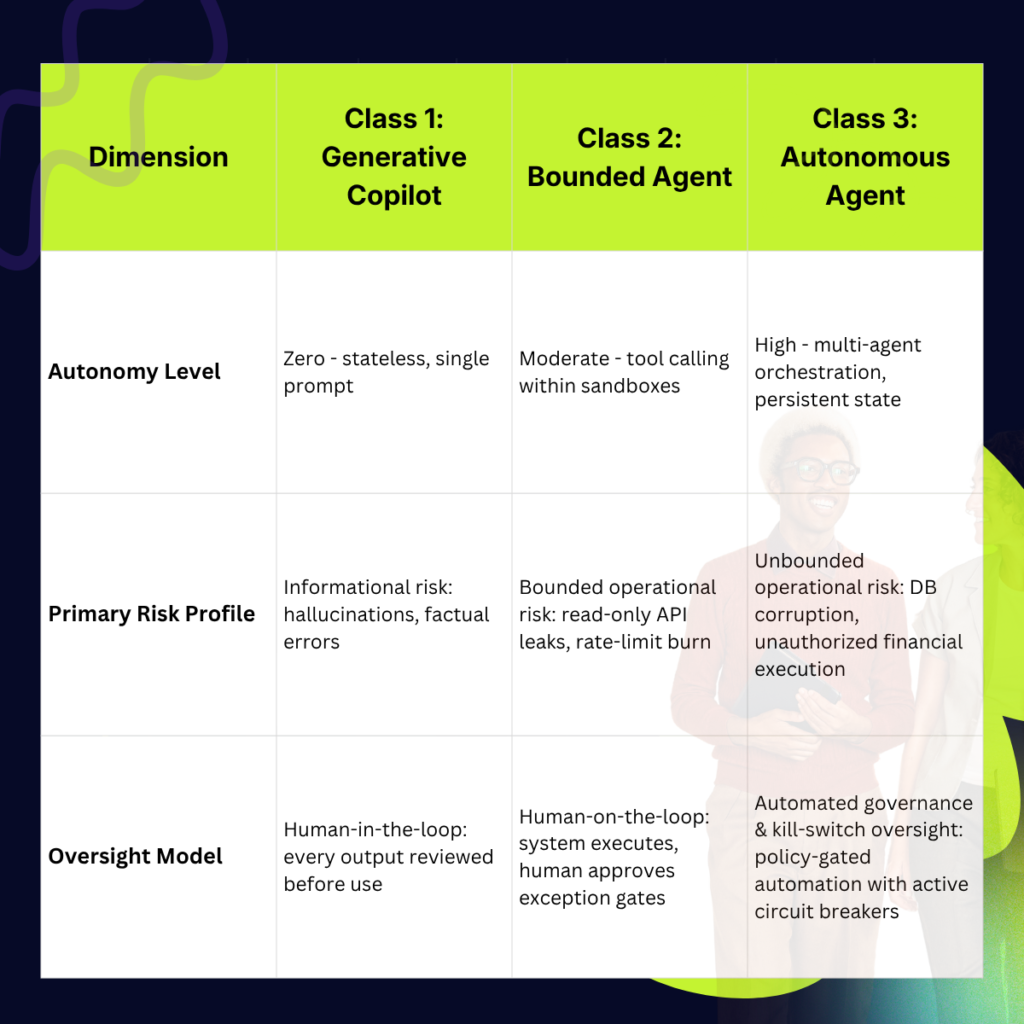
| Dimension | Class 1: Generative Copilot | Class 2: Bounded Agent | Class 3: Autonomous Agent |
|---|---|---|---|
| Autonomy Level | Zero – stateless, single prompt | Moderate – tool calling within sandboxes | High – multi-agent orchestration, persistent state |
| Primary Risk Profile | Informational risk: hallucinations, factual errors | Bounded operational risk: read-only API leaks, rate-limit burn | Unbounded operational risk: database corruption, unauthorized financial execution |
| Oversight Model | Human-in-the-loop: every output reviewed before use | Human-on-the-loop: system executes while humans approve exception gates | Automated governance and kill-switch oversight with policy-gated automation and active circuit breakers |
The point of naming these classes explicitly is that most enterprise AI failures aren’t failures of the model – they’re failures of matching the wrong oversight model to the wrong autonomy class. A Class 3 system running under Class 1 assumptions is where things go wrong quietly, for weeks, before anyone notices.
The 4-Phase Agentic Adoption Framework™: How to Actually Get There
Knowing which class you need is one thing. Getting your organization there without a costly false start is another. Almost every enterprise team that has successfully adopted agentic AI moved through the same four phases – and almost every team that got burned tried to skip one.
Phase 1 – Static Copilot (Informational Value) Scope: document summarization, code-generation assistance, content drafting. Zero write permissions to any external infrastructure. The metric that matters here is simple: time saved per draft.
Phase 2 – Hybrid Deterministic Automation (Bounded Execution) Scope: hardcoded if/then workflow logic, with the LLM doing parsing work at text boundaries only. A human still triggers execution. Target workflow reliability above 99.5% before moving further – this phase is where you build trust in the underlying logic before handing over any autonomy.
Phase 3 – Bounded Agentic Systems (Monitored Autonomy) Scope: dynamic goal decomposition, read-only API access, sandboxed code execution. This is where agentic behavior actually begins – the system can plan its own path to a goal – but every state-changing call still requires human approval, and API rate-limiting keeps the blast radius small if something goes wrong.
Phase 4 – Multi-Agent Mesh Architecture (Full Autonomy) Scope: domain-specialized sub-agents – a code reviewer agent, a QA testing agent, a deployment agent – coordinated by a supervisor agent. Real-time circuit breakers and end-to-end task resolution monitoring aren’t optional at this stage; they’re the only thing standing between “autonomous system” and “autonomous incident.”
The teams that skip from Phase 1 straight to Phase 4 because a vendor demo looked impressive are, almost without exception, the same teams writing the incident postmortems six months later.
Get an Expert Google Ads Audit for Your Business
Uncover wasted spend, fix performance gaps, and scale ROI with certified Google Ads specialists.
Under the Hood: How the Two Actually Work
It helps to see the mechanical difference laid out plainly.
Generative AI runs a single-inference pipeline: input prompt → transformer self-attention → token generation. One pass, one output, done.
Agentic AI runs what’s often called the Perceive-Plan-Act-Reflect loop:
Goal → Decomposition → Tool Invocation → State Observation → Self-Correction
That loop repeats – sometimes dozens of times – until the goal is satisfied or a limit is hit. Every one of those iterations is a fresh opportunity for the system to call a tool wrong, misread an API response, or take longer than expected. Which brings us to the numbers that actually matter for budgeting and risk planning.
The Benchmarks, and Why the "Harness" Matters More Than the Model
Enterprise architects evaluating agentic tools tend to fixate on model choice. The current evidence says that’s the wrong lever to obsess over.
On software engineering tasks: <cite index=”20-1″>back when the original SWE-bench Pro benchmark launched, even top models like GPT-5 and Claude Opus 4.1 – which scored above 70% on the older, easier SWE-bench Verified – dropped to only around 23% on Pro’s harder, contamination-resistant task set</cite>. As of Q2/Q3 2026, top agentic models have pushed Verified scores into the 80%–88% range, but on unseen enterprise codebases the same models still fall to roughly 54%–59% under standardized evaluation harnesses, and lower still on private commercial repositories. The gap between “benchmark score” and “your actual codebase” hasn’t closed – it’s just moved to a harder benchmark.
That gap traces back to a baseline worth remembering: in the original SWE-bench research, non-agentic single-shot retrieval baselines resolved a mere 1.96% of real GitHub issues. The entire agentic architecture – planning, tool use, iteration – is what took that number from under 2% to over 80%. That’s the actual case for agentic AI, in one comparison.
But here’s the nuance most vendor pitches leave out: the orchestration harness matters as much as the underlying model. <cite index=”12-1″>In one February 2026 evaluation of 731 real problems, three different agent frameworks running the exact same underlying model scored 17 issues apart – enough to reshuffle the rankings entirely</cite>. A benchmark score attached to a model name is really a benchmark score attached to that model plus that specific scaffold. Swap the scaffold, and the same model can look meaningfully better or worse. If your vendor evaluation only compares model names, you’re comparing the wrong variable.
On desktop and multi-step system control: the OSWorld benchmark measures how well agents handle real operating-system tasks – clicking, navigating, executing multi-step GUI workflows. Against a human baseline of 72.4%, top autonomous computer-use agents currently land somewhere between 38% and 65%. Text generation solved itself years ago. Reliably controlling an actual environment is still the harder problem, and it’s the one that determines whether an agent is safe to point at your production tools.
The Trade-Offs Nobody Puts on the Slide
The math behind why long agent chains fail
If a single tool call is 90% reliable – which is a realistic number for a well-built step, not a pessimistic one – a five-step autonomous workflow doesn’t stay at 90%. It compounds:
P(success) = (0.90)⁵ ≈ 59.04%
Push that to a ten-step chain and it drops further:
P(success) = (0.90)¹⁰ ≈ 34.86%
That’s not a flaw in any particular model. It’s arithmetic. A workflow with real dependency chains is only as reliable as the product of every step in it, which is exactly why deterministic schema validation and hard error-recovery bounds aren’t nice-to-haves in agentic systems – they’re the only thing preventing a chain of decent individual steps from becoming an unreliable whole.
Token economics and latency, honestly stated
A single generative prompt costs roughly one token pass. An agent that hits a failed tool call and has to re-plan can burn 15x to 30x the tokens working through that recovery loop. Multiply that across a multi-step workflow and the cost curve stops looking like a rounding error.
The same compounding shows up in latency. A generative query that would return in about 1.5 seconds can become a 25-to-45-second asynchronous pipeline once it’s wrapped in sequential tool calls, each waiting on the last. If your product experience assumes sub-second response times, that’s a constraint that rules out full autonomy before you’ve even discussed risk.
The security model changes, not just the size of the risk
A generative AI prompt injection produces bad text. Someone reads it, catches it, moves on. An agentic system with the same vulnerability doesn’t just produce bad text – it can act on it. That’s the difference the OWASP Top 10 for Agentic Applications was built to address, and four of its risk categories are worth knowing by name before you deploy anything with tool access:
- ASI01 – Agent Goal Hijack: a malicious instruction buried in a retrieved web page or document quietly redirects the agent’s actual objective.
- ASI02 – Tool Misuse & Exploitation: the agent uses a legitimate tool in a destructive way it was never meant for – an SQL interface used to run a DROP TABLE, for instance.
- ASI03 – Identity & Privilege Abuse: an agent inherits broad human credentials instead of narrow, short-lived, non-human identity scope – meaning one compromised agent can act with far more authority than the task required.
- ASI08 – Cascading Failures: one corrupted sub-agent propagates bad state across an entire multi-agent mesh before anyone catches it.
None of these exist in a purely generative system, because a purely generative system doesn’t act on anything. That’s the entire reason “informational risk vs. operational risk” isn’t just a tidy phrase – it’s the line that should decide who reviews your deployment and how tightly it’s scoped.


Boost Your Brand Visibility 🚀
Get personalized digital strategies that drive growth and engagement.
Let’s Talk📬 Stay Updated
Get the latest insights and guides delivered right to your inbox.
🔗 Related Topics
- Loading related posts...