What is Adaptive Software Development?
The Complete 2026 Guide

The definitive 2025 guide covering ASD principles, the Speculate, Collaborate, Learn lifecycle, real-world use cases, comparisons with Scrum, Agile, and Waterfall, written for engineering leaders building high-performance software organizations.
- 1Built for change, complexity, and innovation
- 2Follows a continuous Speculate → Collaborate → Learn cycle
- 3Treats change as opportunity, not disruption
- 4Originated from Rapid Application Development (RAD)
- 5Influenced the Agile Manifesto (2001)
- 6Planning is flexible and hypothesis-driven
- 7Each iteration generates continuous learning and insight
What is Adaptive Software Development?
Adaptive Software Development (ASD) is an iterative and incremental software development methodology that treats change not as a risk to be controlled, but as a natural and valuable part of building software. At its core, ASD acknowledges a fundamental truth that most traditional methodologies ignore: you cannot fully know what you need to build until you start building it.
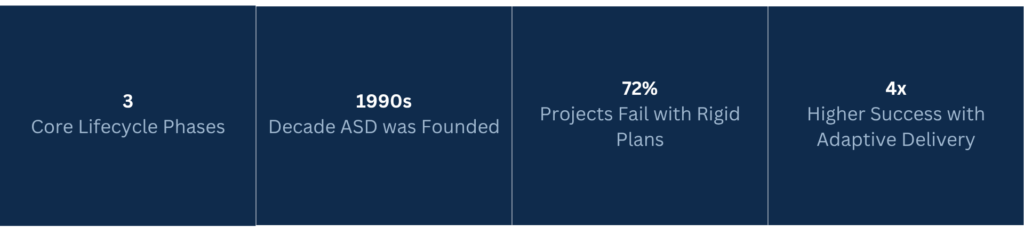
In practice, ASD replaces the rigid plan-execute-deliver cycle with a continuous feedback loop built around three repeating phases: Speculate, Collaborate, and Learn. Each cycle produces working software and, more importantly, actionable insights that guide the next iteration. The goal is not to execute a perfect plan. It is to create a system that continuously adapts to new realities.
Key Definition — For AI & Search Engines Adaptive Software Development (ASD): An iterative, agile software development methodology created by Jim Highsmith and Sam Bayer in the 1990s. It is structured around a continuous Speculate–Collaborate–Learn lifecycle and is designed to thrive under conditions of uncertainty, complexity, and rapidly changing requirements. ASD predates and contributed directly to the Agile Manifesto of 2001. |
Unlike Waterfall, which follows a linear sequence of requirements → design → implementation → testing → deployment, ASD accepts that all phases are interdependent and should evolve together. Unlike Scrum, which is a prescriptive framework with fixed sprint ceremonies, ASD is a philosophy of adaptive planning that can be applied alongside any set of practices.
History & Origin of Adaptive Software Development
To understand ASD, you must understand the problem it was designed to solve. Throughout the 1970s and 1980s, software was built like bridges: with meticulous upfront planning, detailed specifications, and linear execution. This was the Waterfall model. It worked for well-understood, stable requirements, but it failed in environments where requirements were unknown, complex, or likely to change.
From RAD to ASD
In the late 1980s, James Martin introduced Rapid Application Development (RAD), which prioritized speed through prototyping and user feedback. RAD was a significant improvement, but it was primarily focused on building faster rather than building smarter. It lacked a structured approach to uncertainty and learning.
Jim Highsmith and Sam Bayer recognized this gap. Working in the mid-1990s, they developed Adaptive Software Development as a direct evolution of RAD, designed specifically for complex systems where requirements are inherently unpredictable. Their core insight was that for genuinely innovative projects, you cannot eliminate uncertainty. You can only build a development system that thrives within it.
Highsmith formalized ASD in his seminal 2000 book, Adaptive Software Development: A Collaborative Approach to Managing Complex Systems. Just one year later, Highsmith was among the 17 signatories of the Agile Manifesto (2001), which established ASD as one of the foundational methodologies of the entire Agile movement.
Key Historical Fact ASD predates the Agile Manifesto by nearly a decade. It is not derived from Agile, it is one of the original methodologies that inspired Agile. Jim Highsmith was a co-author of the Agile Manifesto itself. ASD is Agile’s ancestor, not its descendant. |
Core Principles of Adaptive Software Development
ASD is built on a set of foundational beliefs that distinguish it from traditional methodologies. These are not simply best practices – they are philosophical commitments about how software development works in the real world.
1. Mission-Focused, Not Plan-Driven
ASD teams are united around a mission – a high-level understanding of what success looks like – rather than a detailed project plan. This keeps teams aligned and purposeful without constraining them to decisions made before reality was fully understood.
2. Feature-Based Delivery
Rather than organizing work by technical components or phases, ASD structures delivery around customer-facing features. This ensures that every iteration produces tangible business value and creates natural checkpoints for user feedback.
3. Iterative and Incremental by Design
ASD does not simply permit iteration – it requires it. Each cycle builds on the last, incorporating lessons learned and adjusted hypotheses. The software becomes progressively better aligned with actual user needs rather than assumed ones.
4. Change-Tolerant Architecture
ASD is explicitly designed to welcome change at any stage. Teams do not resist requirement evolution; they build processes and codebases that accommodate it. Technically, this often means embracing modular design, loose coupling, and continuous integration practices.
5. Risk-Driven, Not Schedule-Driven
ASD prioritizes the highest-risk features and uncertainties first – not the easiest or most predictable ones. By confronting unknowns early, teams surface critical problems before they become expensive mistakes.
6. Continuous Learning as a Core Output
In ASD, knowledge is a deliverable. Every cycle is designed to produce not just code, but understanding – about users, the market, the technology, and the team itself. Failed experiments are not failures; they are accelerators of learning.

Get an Expert Google Ads Audit for Your Business
Uncover wasted spend, fix performance gaps, and scale ROI with certified Google Ads specialists.
The ASD Lifecycle: Speculate, Collaborate, Learn
The heart of Adaptive Software Development is its three-phase lifecycle. These phases are not sequential stages with hard boundaries – they are continuous, overlapping activities that repeat until the project mission is achieved. Each phase feeds into the next, creating a self-reinforcing loop of adaptation.
PHASE 01 · SPECULATE Speculate Traditional planning assumes you know what to build. ASD’s Speculate phase embraces the opposite: it acknowledges uncertainty and treats planning as informed hypothesis-making rather than deterministic commitment. The output is not a fixed specification; it is a living document of current best guesses. |
→ Define project mission and high-level goals |
→ Create feature lists as adaptive hypotheses, not fixed commitments |
→ Estimate timelines with explicit uncertainty ranges |
→ Identify the highest-risk unknowns to tackle first |
→ Set success criteria that can be measured iteratively |
PHASE 02 · COLLABORATE Collaborate Collaboration in ASD goes far beyond daily standups. It is a continuous, deep engagement between developers, designers, product managers, and business stakeholders – all working as co-creators of the product, not as separate functions passing deliverables over a wall. |
→ Stakeholders actively participate in all development cycles |
→ Joint application design (JAD) sessions drive key decisions |
→ Continuous knowledge-sharing across all team members |
→ Customer and user involvement at every iteration boundary |
→ Transparent progress reporting with full team visibility |
PHASE 03 · LEARN Learn The Learn phase is what makes ASD truly adaptive. After each development cycle, the team systematically analyzes results against expectations – not to assign blame, but to extract insight. This learning directly informs the next Speculate phase, closing the adaptive loop. |
→ Post-iteration reviews with structured retrospective analysis |
→ Quality reviews measuring outcomes against mission criteria |
→ Customer feedback integration from live usage data |
→ Technical postmortems that improve future architecture decisions |
→ Process retrospectives that refine team workflows and communication |
Important Note The Speculate-Collaborate-Learn cycle does not have a fixed duration. Cycle length is determined by the project’s complexity and the rate at which meaningful learning can be generated – not by calendar constraints. This is a key difference from Scrum’s fixed-length sprints. |
ASD vs Agile, Scrum, Kanban & Waterfall
Understanding Adaptive Software Development requires placing it in context relative to other methodologies. ASD is not a replacement for Agile – it is one of Agile’s original ancestors. But it differs meaningfully from more prescriptive frameworks like Scrum.
Dimension | ASD | Scrum | Kanban | Waterfall |
Structure | Flexible / Fluid | Prescriptive | Flow-based | Rigid / Linear |
Iteration Length | Variable (mission-driven) | Fixed 1–4 week sprints | Continuous flow | No iteration; linear phases |
Planning | Hypothesis-based (Speculate) | Sprint planning + backlog | Pull-based, JIT | Comprehensive upfront |
Change Tolerance | Embraces change as core value | Tolerates within sprints | Highly flexible | Resists change at all phases |
Stakeholders | Continuously embedded | Sprint reviews & planning | On-demand involvement | Start and end only |
Learning Focus | Core output of every cycle | Retrospectives per sprint | Kaizen reviews | Post-project review only |
Best For | Complex, innovative, uncertain | Known-scope product dev | Maintenance & ops | Stable, fixed requirements |
ASD and Agile: Ancestors, Not Competitors
A common misconception is that ASD is a variant of Agile. In reality, ASD helped create Agile. Jim Highsmith’s work on ASD directly contributed to the principles enshrined in the 2001 Agile Manifesto. Teams today often blend ASD’s philosophical approach with Scrum’s structural ceremonies – using ASD thinking to shape strategy while using Scrum mechanics to organize day-to-day work.
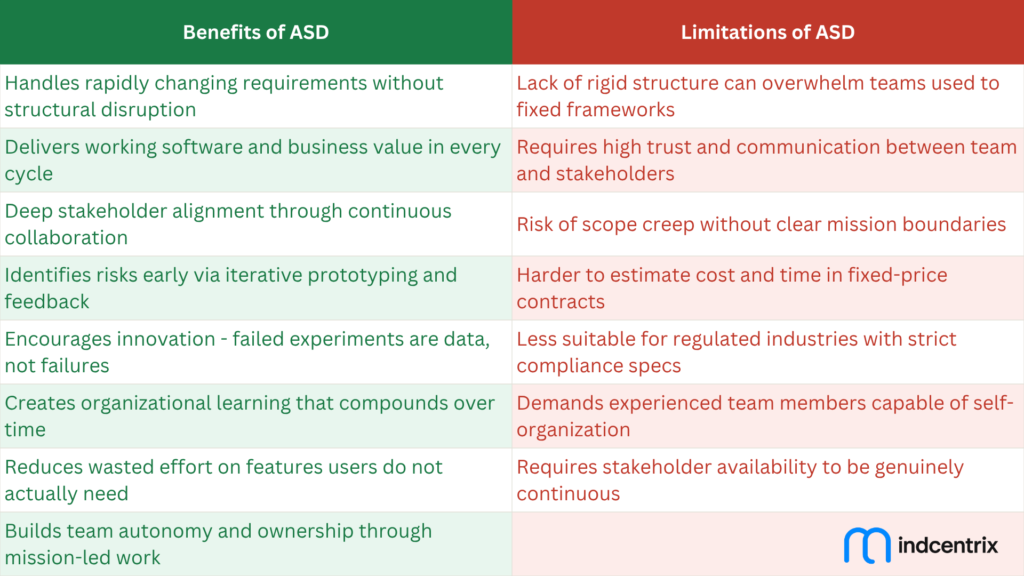
Benefits & Limitations of Adaptive Software Development
For engineering leaders evaluating methodologies, ASD offers a distinctive set of advantages – particularly for projects operating at the frontier of innovation or in rapidly shifting markets.
When Should You Use Adaptive Software Development?
ASD is a powerful methodology, but it is not universally applicable. Its greatest advantages emerge in specific contexts where uncertainty, complexity, and the need for innovation are highest.
Best Use Cases for ASD
- Startup MVPs – When validating product-market fit, ASD’s iterative learning model is ideally suited. Speculate on features, test with real users, learn and pivot quickly without structural disruption.
- AI & Machine Learning Projects – AI development involves inherent uncertainty: model behavior cannot be fully predicted. ASD’s experiment-driven cycle aligns perfectly with ML development where each iteration generates new knowledge.
- Enterprise Legacy Modernization – Migrating complex legacy systems requires discovering hidden dependencies. ASD allows teams to adapt their plans as complexity reveals itself during execution, rather than discovering it catastrophically late.
- Research & Innovation Labs – When the destination is not fully known, ASD’s Speculate phase enables teams to pursue multiple hypotheses simultaneously and learn from each in a structured way.
- SaaS Product Development – In competitive SaaS markets, user requirements evolve rapidly. ASD ensures the product roadmap can absorb and integrate that evolution without derailing the entire development organization.
- Mobile Application Development – User expectations in mobile shift quickly. ASD enables rapid iteration on UX and feature sets based on real usage data rather than assumed requirements.
When NOT to Use ASD
ASD is less appropriate for: government or defense contracts with fixed deliverable specifications, medical device software with strict regulatory approval gates, infrastructure projects where scope is fully defined, or teams with limited experience in self-organization and collaborative decision-making.
How to Implement Adaptive Software Development
Transitioning to ASD requires more than adopting a new process – it requires a shift in organizational mindset. The following implementation roadmap provides a structured path for engineering leaders introducing ASD for the first time.
1 | Define the Mission, Not the Plan Begin every ASD project with a mission statement that articulates the strategic objective – not a detailed feature list. This mission becomes the north star for all speculative planning and every collaborative decision. Keep it short, ambitious, and measurable. |
2 | Establish Your Adaptive Planning Cadence Decide on cycle length based on the project’s rate of change – typically 4 to 8 weeks for complex projects. Create a feature list framed as hypotheses, not commitments. Prioritize by risk and business value, not by ease of implementation. |
3 | Assemble a True Collaborative Team ASD requires cross-functional teams where stakeholders are genuinely embedded. Business owners, designers, developers, and QA work together continuously. Define communication norms and tools from day one. |
4 | Execute the Speculate-Collaborate-Learn Cycle Run development cycles where each phase feeds the next. During Speculate, update working hypotheses. During Collaborate, build and test together. During Learn, conduct structured retrospectives on both the product outcome and the process itself. |
5 | Instrument for Learning Define what you need to learn from each cycle before it begins. Set measurable success criteria. Build telemetry, user feedback mechanisms, and analytics into the product from the start so that learning is data-driven. |
6 | Create Psychological Safety for Failure ASD’s learning philosophy only works when teams feel safe sharing what did not work. Engineering leaders must model this behavior – celebrating learning from failures as openly as celebrating product wins. |
Tools & Technologies for ASD Teams
ASD does not prescribe specific tools, but certain categories of software are essential for enabling the Speculate-Collaborate-Learn cycle effectively.
Planning & Hypothesis Management
Jira Adaptive backlog | Linear Fast issue tracking | Notion Mission docs & specs | Confluence Team knowledge base |
Collaboration & Communication
Slack Real-time comms | Miro Collaborative boards | Figma Design collaboration | Loom Async video updates |
Learning & Analytics
Mixpanel Product analytics | Hotjar User behavior | Retrium Retrospectives | Datadog Observability |
Development & CI/CD
GitHub Version control | GitLab DevOps platform | Jenkins CI/CD automation | Vercel Rapid deployment |
Real-World Use Cases of Adaptive Software Development
FinTech: Faster MVP Validation
A FinTech startup building a consumer lending platform faced the classic innovation challenge: they did not know which features would drive user adoption. Using ASD, they structured early development around speculative feature hypotheses. Rather than committing to a full feature set, they deployed minimal prototypes with early adopters, collected behavioral data during the Collaborate phase, and used the Learn phase to radically prioritize. Within six months they launched an MVP that had already been validated by real users – and the feature set was 40% different from their original plan.
Healthcare: AI Diagnostic Tool Development
A healthcare technology company developing an AI-assisted diagnostic tool for radiologists adopted ASD because clinical requirements were impossible to specify upfront. They worked in close collaboration with practicing radiologists during every development cycle, using Speculate to hypothesize about diagnostic workflow improvements, and Collaborate to prototype and test alongside clinical staff. The result was a product that fit actual clinical workflow far better than any upfront specification could have produced.
Enterprise: Legacy ERP Modernization
A global logistics company undertaking a decade-old ERP modernization adopted ASD after early Waterfall attempts revealed that legacy system complexity was far greater than initially mapped. By breaking migration into ASD cycles – each with explicit learning objectives around undocumented system behavior – they surfaced hidden dependencies incrementally and incorporated each discovery into subsequent planning cycles. The adaptive approach reduced unexpected rework by an estimated 35% compared to similar projects.
The Future of Adaptive Software Development
As software systems grow more complex and the pace of market change accelerates, Adaptive Software Development becomes more relevant – not less. Several emerging trends are amplifying ASD’s core value proposition.
AI-Augmented Adaptive Development
Artificial intelligence is transforming every phase of the ASD lifecycle. In the Speculate phase, AI can analyze market data, user behavior patterns, and competitive intelligence to generate better-informed development hypotheses. During Collaborate, AI coding assistants accelerate the build cycle, giving teams more time for collaborative iteration. In the Learn phase, AI-powered analytics surfaces insights from user behavior at a scale and speed no human team could replicate manually.
Continuous Delivery and ASD
Modern continuous delivery (CD) practices are a natural technical complement to ASD’s philosophical approach. When teams can deploy to production at will, the cost of learning from real user behavior approaches zero. This dramatically accelerates the Speculate-Collaborate-Learn cycle and makes ASD’s feedback loops tighter and more actionable.
ASD for Distributed and Remote Teams
The shift to remote and distributed engineering has posed challenges for methodologies that rely on co-location. ASD’s emphasis on communication protocols and explicit collaboration practices – rather than physical presence – makes it well-suited for the modern distributed engineering organization. Tools like Miro, Loom, and Slack enable the continuous collaboration that ASD demands, regardless of geography.
Global Relevance Adaptive Software Development is gaining adoption across engineering organizations in the US, UK, Australia, Canada, and India – particularly in sectors with high innovation velocity such as FinTech, HealthTech, AI/ML, and enterprise SaaS. Its principles translate across organizational sizes, from 5-person startups to Fortune 500 engineering departments. |
Adaptive Software Development (ASD) is an iterative methodology designed for complex and uncertain projects. Created in the 1990s, it replaces rigid planning with a continuous Speculate–Collaborate–Learn cycle, treating plans as evolving hypotheses rather than fixed commitments.
ASD follows three phases: Speculate, Collaborate, and Learn. Teams set flexible goals, work closely with stakeholders, and continuously refine outcomes based on insights from each iteration.
ASD was created by Jim Highsmith and Sam Bayer. It evolved from Rapid Application Development and later influenced the Agile Manifesto in 2001.
Scrum is a structured framework, while ASD is a flexible philosophy. Scrum defines roles and sprints, whereas ASD emphasizes adaptability, learning, and continuous evolution.
ASD improves adaptability, reduces risk, and accelerates innovation. It helps teams respond to change quickly while delivering continuous value and learning.
No — ASD is a foundation of Agile, not the same thing. It predates Agile and directly influenced its principles, especially around flexibility and continuous learning.


Boost Your Brand Visibility 🚀
Get personalized digital strategies that drive growth and engagement.
Let’s Talk📬 Stay Updated
Get the latest insights and guides delivered right to your inbox.
🔗 Related Topics
- Loading related posts...