AI for Content Marketing:
How Smart Brands Are Scaling Growth Without Losing Their Voice

Quick Insight
AI for content marketing is no longer about automation alone. It is about building intelligent content systems that combine data, creativity, and performance tracking. Brands that use AI strategically are improving content ROI, accelerating production, and maintaining strong brand voice. The real advantage comes from blending AI efficiency with human-led strategy and governance.
Introduction: The Real Problem Isn’t Content Volume
Most leadership teams are not struggling with content creation anymore. They are struggling with content effectiveness.
More blogs are being published. More campaigns are being launched. Yet, the impact often feels disconnected from business outcomes.
We have seen this pattern repeatedly at MindCentrix. Teams scale content production, but ROI does not scale with it.
This is where AI for content marketing changes the equation.
It shifts content from being an activity to becoming a measurable growth system driven by insights, automation, and continuous optimization.
What is AI for Content Marketing
AI for content marketing is the use of artificial intelligence to plan, create, optimize, and analyze content based on real data instead of assumptions.
But at a strategic level, it is more than just tools.
It is about building a system where:
- Content decisions are backed by data
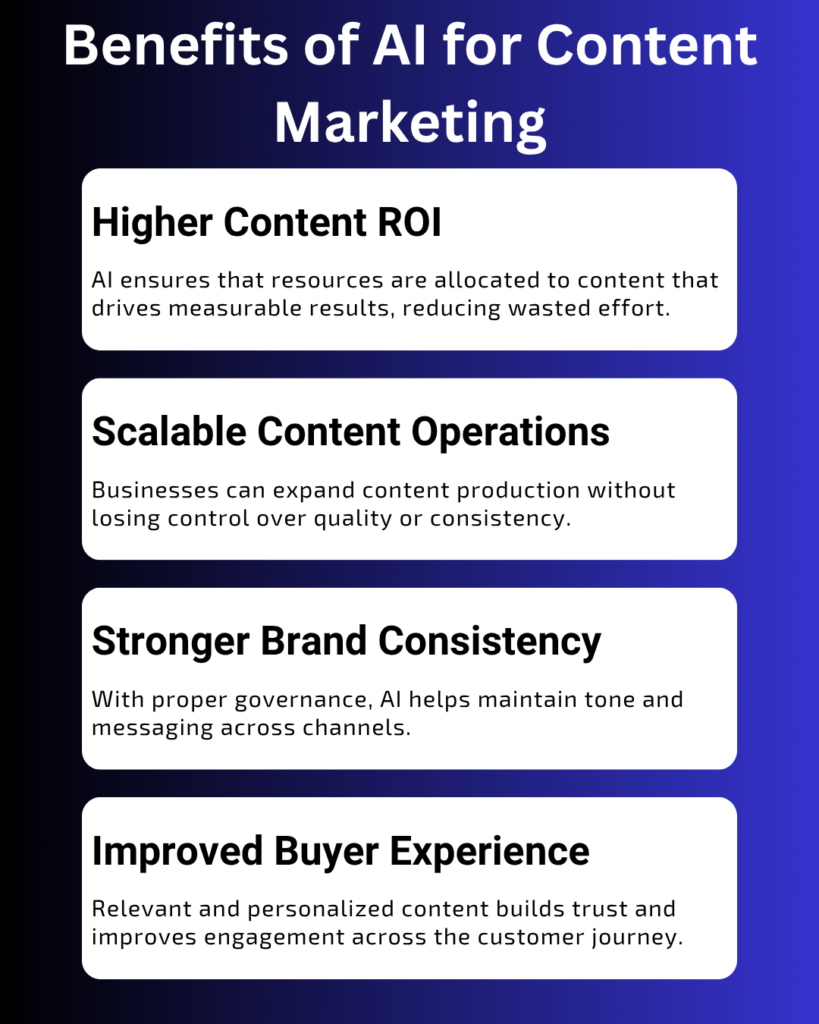
- Execution is faster and more consistent
- Performance is continuously optimized
At MindCentrix, we treat AI not as a shortcut but as an operational layer that enhances content strategy.
Why AI for Content Marketing is Now a Leadership Priority
Moving from Content Production to Content ROI
One of the biggest shifts we see in B2B organizations is the move from volume-based KPIs to outcome-based KPIs.
AI helps leadership teams answer critical questions:
- Which content is actually driving pipeline
- Which topics influence decision-makers
- Where content is underperforming
This makes content marketing accountable to revenue, not just traffic.
Faster Execution with Strategic Control
AI can significantly reduce production time, but speed without control creates inconsistency.
At MindCentrix, we have found that using AI for content structuring and first drafts, while keeping human oversight for strategic messaging, reduces turnaround time by nearly 40 percent without compromising quality.
This balance is where most brands fail and where the real advantage lies.
Personalization That Reflects Buyer Intent
Modern B2B buyers expect relevance at every stage of their journey.
AI enables segmentation based on:
- Behavior
- Engagement patterns
- Industry-specific signals
This allows brands to deliver content that aligns with buyer intent rather than pushing generic messaging.
Predictive Content Strategy
Instead of reacting to trends, AI allows businesses to anticipate them.
By analyzing search patterns and engagement signals, companies can invest in topics before they become saturated.
This positions the brand as a category leader rather than a follower.
Get an Expert Google Ads Audit for Your Business
Uncover wasted spend, fix performance gaps, and scale ROI with certified Google Ads specialists.
Key Applications of AI for Content Marketing
Content Ideation Based on Market Demand
Content ideation becomes more strategic when driven by data.
Instead of brainstorming in isolation, AI identifies:
- Search demand trends
- Competitor gaps
- High-intent query clusters
For example, in one of our B2B projects, shifting from generic topics to AI-driven content ROI-focused topics improved qualified traffic significantly within one quarter.
This approach ensures that every piece of content has a clear purpose.
AI-Assisted Content Creation with Human Refinement
AI can generate drafts quickly, but raw output is rarely enough.
The real impact comes from layering:
- Brand voice
- Industry insights
- Strategic positioning
At MindCentrix, every AI-generated draft goes through a brand voice audit layer, ensuring it aligns with the client’s positioning.
This directly addresses a major concern among senior leaders, which is losing brand identity.
SEO, AEO, and SGE Optimization
Search is no longer limited to traditional engines. Content now needs to perform across:
- Search engines
- Answer engines
- AI-generated search environments
AI helps structure content for:
- Semantic relevance
- Conversational queries
- Featured snippet visibility
We also integrate schema-driven optimization, including our proprietary schema generation approach, which improves how content is interpreted by search engines.
This is particularly valuable for businesses targeting high-intent B2B keywords such as:
- B2B content operations automation
- AI-driven content ROI
- Enterprise content marketing systems
Content Personalization at Scale
AI allows brands to move beyond static content.
Content can now adapt based on:
- User behavior
- Previous interactions
- Stage in the funnel
This creates a more engaging experience and improves conversion rates.
Performance Analytics and Predictive Insights
Traditional analytics tell you what happened. AI tells you why it happened and what to do next.
For one of our service-based clients, refining content strategy using AI-driven insights led to a noticeable improvement in lead quality, not just traffic volume.
This shift from quantity to quality is critical for long-term growth.
Challenges You Should Not Ignore
Risk of Generic Output
Without human oversight, AI-generated content can feel repetitive and lack depth.
Over Automation
Excessive reliance on AI can weaken strategic thinking and reduce differentiation.
Data Dependency
Poor data quality leads to poor insights, which directly impacts performance.
Brand Voice Dilution
This is one of the biggest concerns for leadership teams.
At MindCentrix, we address this by implementing strict brand voice validation frameworks, ensuring AI output aligns with brand identity.
Best Practices for Implementing AI in Content Marketing
Keep Strategy Human Led
AI should support execution, not replace strategic thinking.
Build a Content Governance Model
Define how AI will be used, where human input is required, and how quality will be maintained.
Focus on High Impact Areas First
Start with areas like:
- Content planning
- SEO optimization
- Performance analytics
Continuously Optimize
AI systems improve over time, but only with regular monitoring and refinement.
AI for Content Marketing in B2B Growth
B2B marketing is complex, with longer sales cycles and multiple decision-makers.
AI helps by:
- Delivering personalized content across touchpoints
- Supporting lead nurturing with relevant insights
- Aligning marketing efforts with sales outcomes
This is why AI for content marketing is becoming a core part of B2B content operations automation strategies.
How MindCentrix Builds AI-Driven Content Systems
At MindCentrix, AI is not used in isolation. It is integrated into a broader system that includes:
- Data-driven content planning
- AI-assisted execution with human refinement
- Advanced SEO and schema implementation
- Brand voice governance frameworks
We also leverage our proprietary schema generation capabilities to ensure content is optimized for search visibility and structured data performance.
This approach ensures that content is not just created but continuously improved.
Conclusion: From Content Creation to Content Intelligence
AI for content marketing is not just about doing things faster. It is about doing the right things with clarity and consistency.
The brands that will lead are not the ones producing the most content, but the ones building intelligent content systems.
If your content production is increasing but ROI is not, the problem is not effort. It is strategy.
At MindCentrix, we help businesses transition from scattered content efforts to structured, AI-driven growth systems.
Next Step
If you are evaluating how AI fits into your content strategy, start with a simple question:
Is your content driving business outcomes or just activity?
If you want a clearer answer, you can map your current approach against an AI-readiness framework or explore how structured content systems can improve performance across your funnel.
Frequently Asked Questions
What is AI for content marketing
AI for content marketing is the use of artificial intelligence to create, optimize, and analyze content based on data-driven insights.
How does AI improve content ROI
AI improves ROI by focusing on high-performing topics, optimizing content for search, and providing actionable insights for continuous improvement.
Is AI suitable for B2B content marketing
Yes, AI is highly effective in B2B environments as it helps manage complex buyer journeys and improve personalization.
Can AI replace human marketers
No, AI enhances efficiency, but human creativity and strategy remain essential for impactful content.
How does AI help with SEO and AEO
AI improves semantic optimization, keyword targeting, and content structuring for better visibility across search and answer engines.
What is the biggest risk of AI in content marketing
The biggest risk is losing brand voice and originality, which can be managed with proper governance and human oversight.


Boost Your Brand Visibility 🚀
Get personalized digital strategies that drive growth and engagement.
Let’s Talk📬 Stay Updated
Get the latest insights and guides delivered right to your inbox.
🔗 Related Topics
- Loading related posts...