Real Estate Social Media Marketing Agency:
How Modern Real Estate Brands Turn Social Media Into a Predictable Lead Generation Engine
Real estate buyers have changed dramatically over the past few years. They no longer rely on a single advertisement, property portal, or agent recommendation to make purchasing decisions. Instead, they move through a complex digital journey that includes search engines, social media, online reviews, video platforms, AI-powered search experiences, and conversations with friends and family before they ever schedule a property visit.
As buyer behavior evolves, many real estate businesses are still relying on outdated marketing strategies. They're publishing property listings without context. Measuring success through likes and followers. Running paid campaigns without understanding buyer intent. Treating social media as a separate activity instead of integrating it with SEO, CRM systems, analytics, lead nurturing, and sales.
The businesses seeing the strongest results are taking a different approach. They're building trust before asking for inquiries. They're educating buyers instead of simply promoting listings. They're using social media to answer questions, reduce uncertainty, demonstrate expertise, and guide prospects through every stage of the buying journey.
- 1How modern property buyers research before making decisions.
- 2Why many social media campaigns fail despite significant investment.
- 3The biggest mistakes limiting lead quality and marketing ROI.
- 4Platform-specific strategies for Instagram, Facebook, LinkedIn, YouTube, WhatsApp, and more.
- 5How AI-powered search is reshaping real estate marketing.
- 6Which KPIs matter most when measuring marketing success.
- 7What to look for when choosing a real estate social media marketing agency.
- 8Practical strategies to build a marketing system focused on long-term business growth-not vanity metrics.
There was a time when real estate marketing was surprisingly predictable.
A newspaper advertisement, a roadside billboard, a few listings on property portals, and a sales team ready to answer calls were often enough to generate consistent inquiries.
Then social media arrived.
For a while, simply posting attractive property photos on Facebook or Instagram gave businesses a competitive advantage. The platforms were less crowded, organic reach was high, and buyers were eager to explore listings online.
That world no longer exists.
Today’s property buyers don’t make decisions based on a single advertisement or a beautifully designed Instagram feed. Before they fill out a contact form or speak with an agent, they often spend days-or even weeks-researching.
They compare multiple developers. They read online reviews. They watch property walkthroughs on YouTube. They explore neighborhood videos on Instagram. They search Google for market insights. Increasingly, they’re even asking AI-powered platforms like ChatGPT and Google AI Overviews to help them shortlist builders, brokerages, and investment opportunities.
In other words, buyers don’t simply search for properties anymore-they investigate brands.
This shift has fundamentally changed what successful real estate marketing looks like.
Unfortunately, many businesses haven’t adapted.
Their social media strategy still revolves around posting property images with captions like “Luxury 3 BHK Apartments Available” or “Book Your Site Visit Today.”
The result?
Their pages look almost identical to every competitor in their market.
When every business publishes the same listings, uses the same promotional language, and targets the same audience with similar advertisements, buyers have little reason to remember one brand over another.
The problem isn’t a lack of effort.
The problem is that today’s buyers expect something different.
They want education before promotion.
They want transparency before persuasion.
They want confidence before commitment.
Most importantly, they want to trust the people they’re buying from.
That’s especially true in real estate, where purchasing a home or investing in commercial property is often one of the biggest financial decisions a person will ever make.
Trust isn’t created by advertising alone.
It’s built through consistent expertise, valuable content, authentic customer experiences, social proof, and meaningful conversations across multiple digital touchpoints.
This is where social media becomes much more than a marketing channel.
Used strategically, it becomes a bridge between curiosity and confidence.
It helps potential buyers understand your market expertise, explore your projects, learn from your team, discover your brand values, and gain enough confidence to take the next step.
But that only happens when social media is treated as part of a complete marketing ecosystem-not as a standalone content calendar.
Throughout this guide, we’ll explore what that ecosystem looks like.
You’ll learn:
- Why many real estate social media campaigns fail to generate qualified buyers.
- How buyer psychology has changed over the last few years.
- What type of content builds trust instead of simply attracting views.
- How different social platforms contribute to the buying journey.
- Why AI-powered search is changing digital discovery.
- Which metrics actually indicate business growth.
- How to evaluate whether your current marketing strategy is helping-or quietly holding your business back.
Whether you’re a property developer, brokerage, luxury real estate brand, commercial real estate company, or independent consultant, this guide is designed to help you make smarter marketing decisions in an increasingly competitive digital landscape.
Because in 2026, success isn’t determined by who posts the most content.
It’s determined by who earns the most trust.
Key Statistics at a Glance
Before diving deeper, here are several trends shaping the future of real estate marketing.
📊 Buyers begin their journey online.
The majority of home buyers use the internet as a primary source during their property search, making a strong digital presence essential rather than optional.
📱 Social media influences purchasing decisions.
Consumers increasingly use social platforms to research brands, explore communities, watch video tours, and validate trust before contacting businesses.
🎥 Video continues to dominate engagement.
Short-form videos, virtual property walkthroughs, neighborhood tours, and educational content consistently outperform static property images across most major social platforms.
⭐ Online reputation matters.
Reviews, testimonials, ratings, and client experiences play a significant role in shaping buyer confidence during high-value purchase decisions.
🤖 AI-powered discovery is growing rapidly.
More consumers are using AI assistants and AI-enhanced search experiences to compare businesses, summarize information, and evaluate buying options before reaching out.
📈 Organic visibility alone is no longer enough.
The strongest-performing real estate brands combine SEO, social media, paid advertising, email marketing, CRM automation, and analytics into a connected marketing system.
⚡ Speed influences conversions.
Businesses that respond quickly to inquiries are generally more likely to convert prospects into appointments and customers than those with delayed follow-up processes.
🏘️ Local expertise builds trust.
Neighborhood insights, school information, lifestyle content, infrastructure updates, and community-focused storytelling often outperform purely promotional property posts.
🔄 Buyers engage with multiple touchpoints before converting.
A single social media post rarely drives a purchase. Buyers typically interact with multiple channels over time before making contact.
📊 Marketing accountability is increasing.
Business owners and decision-makers are placing greater emphasis on measurable outcomes such as qualified leads, appointments, customer acquisition cost, and return on investment rather than engagement metrics alone.
💡 Content that answers questions consistently outperforms content that only promotes properties.
Educational, transparent, and problem-solving content helps reduce buyer uncertainty and strengthens long-term brand authority.
These trends form the foundation of everything we’ll explore throughout this guide-and explain why successful real estate marketing today is less about posting more content and more about building lasting trust at every stage of the buyer journey.
The Reality of Real Estate Marketing in 2026
Why This Guide Exists
There is no shortage of advice on real estate social media marketing.
Search Google, scroll through LinkedIn, or watch a few YouTube videos, and you’ll quickly find countless articles telling you to post more consistently, use trending audio, run Facebook ads, or upload more Reels.
While none of this advice is inherently wrong, it rarely answers the questions that business owners, marketing directors, and sales leaders actually care about.
Questions like:
- Why are we generating inquiries but not qualified buyers?
- Why are our competitors getting more engagement with similar properties?
- Why does our cost per lead keep increasing every quarter?
- Why do some campaigns generate appointments while others barely produce conversations?
- Why do buyers spend time on our social media but never contact us?
- How do we measure whether social media is actually contributing to revenue?
These are business questions-not social media questions.
And that’s where many real estate marketing guides fall short.
They focus on tactics instead of strategy.
They explain how to create content without explaining why buyers engage with it.
They recommend advertising without discussing attribution.
They celebrate likes, comments, and follower growth while ignoring the metrics that actually determine whether marketing contributes to business growth.
Real estate has never been just another industry.
People aren’t purchasing a ₹50 product or signing up for a monthly subscription.
They’re making one of the biggest financial and emotional decisions of their lives.
Whether it’s a first home, an investment property, a luxury villa, or a commercial office, buyers naturally spend more time researching, comparing, validating, and questioning their options.
That means marketing needs to do much more than generate awareness.
It needs to reduce uncertainty.
It needs to answer questions before they’re asked.
It needs to demonstrate expertise before a salesperson enters the conversation.
It needs to create confidence long before a site visit is scheduled.
That’s the real purpose of modern real estate marketing.
This guide was created to help you understand that shift.
Rather than giving you another checklist of “30 Instagram Ideas for Realtors,” we’ll explore the psychology behind buying decisions, the systems that generate consistent leads, and the marketing strategies that build long-term trust.
More importantly, we’ll connect the dots between social media, SEO, AI-powered search, content marketing, paid advertising, CRM automation, analytics, and sales-because buyers don’t experience these channels separately.
They experience your brand as one connected journey.
If there’s one takeaway we hope you remember after reading this guide, it’s this:
Successful real estate marketing isn’t about creating more content. It’s about creating more confidence.
Who Should Read This Guide?
Real estate is a broad industry, and every business faces different marketing challenges.
A residential developer launching a township has different objectives than a luxury broker selling premium villas.
A commercial real estate consultant operates differently from a property management company.
However, they all share one common challenge:
Winning trust before winning business.
This guide is designed for professionals responsible for generating leads, building brand authority, and driving business growth.
Property Developers
Launching a project is no longer enough to attract buyers.
Today’s buyers want to understand the vision behind a development, the credibility of the builder, construction progress, neighborhood growth, financing options, and long-term investment potential.
We’ll explore how social media can help developers educate buyers, strengthen brand trust, and generate higher-quality inquiries throughout the project lifecycle.
Realtors & Independent Real Estate Agents
For many buyers, the agent becomes the face of the transaction.
That means people aren’t just evaluating the property-they’re evaluating the person representing it.
We’ll discuss how agents can build authority through educational content, market expertise, local insights, and authentic storytelling rather than relying solely on listing posts.
Real Estate Brokerages
Brokerages often manage multiple agents, projects, and marketing campaigns simultaneously.
Consistency becomes one of the biggest challenges.
This guide explains how to create a unified digital strategy that supports both brand awareness and individual agent credibility while improving lead management across the organization.
Luxury Real Estate Brands
Luxury buyers expect more than premium visuals.
They expect exclusivity, expertise, personalized experiences, and a brand that reflects the lifestyle they’re investing in.
We’ll explore why storytelling, cinematic content, reputation management, and relationship-driven marketing matter far more than promotional messaging in the luxury segment.
Commercial Real Estate Firms
Commercial buyers make highly rational, research-intensive decisions.
Investment analysis, market trends, infrastructure development, tenant demand, and financial projections often carry more weight than emotional appeals.
This guide explains how thought leadership, LinkedIn content, market reports, webinars, and educational resources can position commercial firms as trusted advisors rather than sales organizations.
Property Consultants & Investment Advisors
Investors aren’t looking for more listings.
They’re looking for clarity.
Whether they’re purchasing rental properties, land, or commercial assets, they want reliable information that helps them evaluate risk and opportunity.
We’ll discuss how content can answer investment questions before consultations even begin, making conversations more productive and improving lead quality.
Marketing Leaders & Decision Makers
If you’re responsible for marketing strategy, reporting, or budget allocation, this guide will help you move beyond vanity metrics and evaluate marketing through the lens of business outcomes.
You’ll discover how to align marketing with sales, improve attribution, and build systems that support sustainable growth.
Get an Expert Google Ads Audit for Your Business
Uncover wasted spend, fix performance gaps, and scale ROI with certified Google Ads specialists.
The State of Real Estate Marketing in 2026
The real estate industry isn’t facing a marketing crisis.
It’s experiencing a buyer behavior revolution.
Many businesses assume declining engagement or rising advertising costs are the biggest challenges.
In reality, those are symptoms.
The deeper change is happening in the way buyers discover, evaluate, and trust brands.
Let’s explore the five trends reshaping real estate marketing.
- Buyer Behavior Has Fundamentally Changed
A decade ago, many buyers contacted an agent early in their research process.
Today, they often arrive at that conversation after completing significant independent research.
Before reaching out, buyers may:
- Search Google for market trends.
- Explore developer websites.
- Watch YouTube walkthroughs.
- Read online reviews.
- Browse Instagram and Facebook profiles.
- Compare multiple projects.
- Read local news.
- Ask friends for recommendations.
- Use AI-powered search tools to summarize options.
By the time they contact your sales team, they’ve already formed opinions about your brand.
Marketing is no longer about generating awareness.
It’s about influencing the research process.
- AI Has Changed How Buyers Discover Businesses
Search is evolving beyond ten blue links.
Platforms like Google AI Overviews, ChatGPT, Perplexity, Gemini, and other AI-powered assistants increasingly summarize information, recommend businesses, and answer buying questions.
Instead of searching:
“Best apartments in Dubai.”
A buyer may ask:
“Which developers have a strong reputation for family-friendly communities?”
Or:
“Which real estate companies are known for transparent customer communication?”
These questions require more than SEO.
They require authority.
Brands that consistently publish helpful content, earn positive reviews, appear in trusted publications, maintain accurate business information, and demonstrate expertise across multiple channels are more likely to be referenced by AI systems.
In other words, your social media activity, website, public reputation, and industry authority now work together to influence digital discovery.
- Attention Spans Are Shorter-But Research Journeys Are Longer
This may sound contradictory, but both are true.
People spend only a few seconds deciding whether a piece of content deserves attention.
Yet they may spend weeks-or even months-researching before making a property purchase.
That’s why every interaction matters.
A short Instagram Reel might introduce your brand.
A YouTube video could answer detailed questions.
A Google review might reinforce trust.
A market report might convince an investor.
Each piece of content serves a different purpose within the buying journey.
The goal isn’t simply to capture attention.
It’s to keep earning it over time.
- Competition Has Exploded
Social media has made marketing more accessible than ever.
Every developer, brokerage, and independent agent can now publish professional-looking content.
That’s good for the industry.
But it also creates a challenge.
When every brand posts polished property photos, drone videos, and promotional offers, visual quality alone is no longer a competitive advantage.
The businesses that stand out are those that educate, inform, and genuinely help buyers make better decisions.
In a crowded market, trust becomes your greatest differentiator.
- Trust Now Matters More Than Advertising
Advertising may generate awareness.
Trust generates action.
A buyer considering a multi-million-dollar investment doesn’t simply click “Book Now.”
They look for reassurance.
They ask:
- Can I trust this developer?
- What do previous buyers say?
- Does this company understand my concerns?
- Are they transparent?
- Do they consistently share valuable insights?
- Will they support me after the purchase?
Every review, educational article, customer testimonial, neighborhood guide, project update, and social media interaction contributes to answering these questions.
That’s why the most successful real estate brands don’t treat marketing as promotion.
They treat it as trust-building.
And trust compounds over time.
Just like investing.
Real estate marketing has entered a new era.
Success is no longer determined by who publishes the most content or spends the largest advertising budget.
It’s determined by who helps buyers make informed decisions with confidence.
Throughout the rest of this guide, we’ll explore how buyer psychology, platform strategy, content marketing, AI-powered search, analytics, and integrated marketing systems work together to create a sustainable lead generation engine.
Because when you understand how modern buyers think, you stop chasing attention-and start earning trust.
Curious How Your Marketing Compares?
Every real estate business has blind spots.
Sometimes it’s inconsistent messaging.
Sometimes it’s weak follow-up.
Sometimes it’s investing heavily in content without understanding what’s actually driving qualified inquiries.
If you’re wondering where your current strategy stands, a structured marketing review can reveal opportunities that aren’t always visible in day-to-day operations.
Understanding the Modern Property Buyer
If there is one mistake that holds back more real estate marketing campaigns than any other, it’s this:
Businesses spend too much time thinking about how to sell properties and too little time understanding how people actually buy them.
The difference may seem subtle, but it changes everything.
Marketing teams often ask:
- Which platform should we advertise on?
- How many posts should we publish each week?
- Should we create more Reels?
- Which campaign objective should we choose?
Buyers, on the other hand, are asking completely different questions.
- Is this developer trustworthy?
- Is this property worth the investment?
- Will this location grow over the next five years?
- What hidden costs should I know about?
- Can I really see myself living here?
- What happens after I make the payment?
Until your marketing starts answering the buyer’s questions instead of promoting your business, it will always struggle to convert attention into meaningful conversations.
This chapter explores the psychology behind modern property buying and explains why understanding your audience is far more valuable than chasing the latest social media trend.
How Buyers Actually Research Properties Today
Buying a property is one of the most considered purchasing decisions people make.
Unlike buying clothes, electronics, or even a car, purchasing real estate often involves years of savings, financial planning, family discussions, legal verification, and emotional commitment.
That naturally changes how people make decisions.
Very few buyers discover a property on Instagram in the morning and book a site visit that afternoon.
Instead, they move through a series of research stages, collecting information, comparing alternatives, reducing uncertainty, and gradually building confidence.
Think about your own buying decisions.
When you’re considering an expensive purchase, you probably don’t trust the first advertisement you see.
You compare options.
You read reviews.
You ask friends.
You watch videos.
You search Google.
You look for independent opinions.
Real estate buyers behave the same way-only the stakes are much higher.
Today’s buyers rarely rely on a single source of information.
Instead, they build confidence by gathering signals from multiple places.
A typical research journey might look like this:
- They notice a project through an Instagram Reel.
- Later, they search Google to learn more about the developer.
- They browse the company’s website.
- They read Google reviews.
- They watch a YouTube walkthrough.
- They compare pricing with competing projects.
- They explore nearby schools, hospitals, and infrastructure.
- They ask family members for advice.
- They save the property for future comparison.
- Only after completing much of this research do they contact the sales team.
Notice something important?
Social media rarely closes the sale.
Instead, it introduces the relationship.
Every channel plays a different role.
Your website answers detailed questions.
Your reviews reduce uncertainty.
Your videos create emotional connection.
Your blog demonstrates expertise.
Your social media keeps your brand visible throughout the decision process.
Successful marketing isn’t about making every channel do everything.
It’s about helping every channel perform its specific role exceptionally well.
The Digital Trust Journey
One of the biggest shifts in modern real estate marketing is that buyers don’t just evaluate properties anymore.
They evaluate businesses.
Years ago, buyers mainly judged:
- Location
- Price
- Amenities
Today, they also evaluate:
- Brand reputation
- Online reviews
- Social proof
- Project transparency
- Construction updates
- Customer service
- Educational content
- Community engagement
- Responsiveness
Every digital interaction contributes to trust.
Imagine discovering two developers offering similar apartments at comparable prices.
Developer A has:
- An outdated Facebook page
- Inconsistent branding
- Few reviews
- Little educational content
- Generic listing posts
Developer B has:
- Helpful market insights
- Project progress videos
- Customer testimonials
- Neighborhood guides
- Active community engagement
- Transparent communication
Which business feels more trustworthy?
Neither property has changed.
Only the buyer’s confidence has.
That confidence often determines who receives the inquiry.
The New Property Buyer Journey
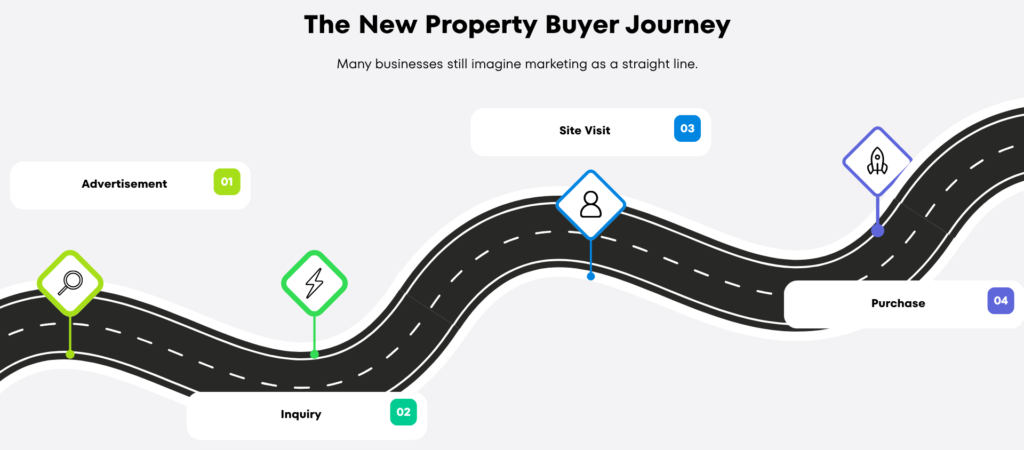
In reality, today’s buyer journey looks much more like a network than a straight road.
Every buyer enters at a different stage, consumes different content, and moves at a different pace.
A more realistic journey looks like this:
Stage 1: Awareness
The buyer realizes they may need a new home, investment property, office space, or commercial location.
At this stage, they’re not looking for a specific project.
They’re exploring possibilities.
Questions they ask:
- Is now a good time to buy?
- Which cities are growing?
- Should I invest or wait?
- What type of property fits my goals?
Marketing that works here:
- Educational blogs
- Market reports
- Instagram Reels
- YouTube Shorts
- Local area content
- Trend analysis
The goal isn’t selling.
The goal is becoming discoverable.
Stage 2: Research
Once interest develops, buyers begin collecting information.
This is where Google searches increase dramatically.
They’re looking for facts rather than promotions.
Typical searches include:
- Best residential projects in Dubai
- Luxury apartments in Gurgaon
- Property investment opportunities
- Best developers near me
- Real estate market forecast
- Builder reviews
At this stage, your expertise matters more than your advertisements.
Buyers reward businesses that answer questions honestly.
Stage 3: Validation
Validation is where many businesses quietly lose potential customers.
The buyer already knows your brand.
Now they’re asking:
“Can I trust them?”
They start looking for evidence.
That evidence may include:
- Google Reviews
- Video testimonials
- Construction progress
- Awards
- Industry recognition
- Social media consistency
- Press coverage
- Project delivery history
This stage is emotional.
People want reassurance that they’re making a safe decision.
Marketing isn’t convincing anymore.
It’s confirming.
Stage 4: Comparison
Almost every buyer compares alternatives.
Even if they’ve already shortlisted your project.
They’re comparing:
- Price
- Amenities
- Payment plans
- Location
- Builder reputation
- Appreciation potential
- Maintenance
- Customer experience
If your marketing only talks about your own project, you leave buyers searching elsewhere for comparison information.
Smart brands educate buyers about how to evaluate options objectively-even when that means discussing competitors or explaining trade-offs.
Transparency builds credibility.
Stage 5: Inquiry
Only after moving through the previous stages do many buyers finally submit a form, send a WhatsApp message, or schedule a consultation.
By this point, they’re not looking for a sales pitch.
They’re looking for clarity.
Questions become more specific.
- Can I visit this weekend?
- Are there financing options?
- Which units are available?
- What’s included in the price?
- What’s the possession timeline?
Your sales team performs best when marketing has already answered the broader questions.
Instead of starting from zero, conversations begin with informed, confident prospects.
Stage 6: Property Visit
Contrary to popular belief, the property visit doesn’t create trust.
It verifies trust.
If expectations built online match the real experience, confidence increases.
If they don’t, buyers become skeptical.
Consistency matters.
Your messaging, visuals, pricing, amenities, and customer experience should align across every touchpoint.
The property visit should reinforce the promises made throughout your marketing-not contradict them.
Stage 7: Purchase
The purchase is not the end of the buyer journey.
It’s the beginning of a long-term relationship.
Satisfied buyers often become your strongest marketing asset.
They leave reviews.
Share recommendations.
Refer friends.
Post photos.
Create testimonials.
Every positive customer experience becomes future marketing content.
The businesses with the strongest reputations don’t just market well.
They consistently deliver experiences worth talking about.
Why Buyers Ignore Most Property Posts
Open Instagram or Facebook and search for real estate businesses.
You’ll quickly notice a pattern.
Most posts look almost identical.
Beautiful building.
Drone shot.
Price.
Location.
“Book Your Site Visit.”
Repeat.
The problem isn’t that these posts are poorly designed.
Many are visually impressive.
The problem is that they don’t answer the question buyers are actually asking:
“Why should I care?”
People don’t wake up hoping to see another apartment listing in their social feed.
They scroll because they’re looking for information, inspiration, entertainment, or solutions.
When every property post looks the same, the brain treats them as background noise.
This is known in behavioral psychology as habituation-our tendency to stop noticing stimuli that are repeated over and over again.
The more similar your content is to everyone else’s, the easier it becomes to ignore.
But psychology goes much deeper than that.
Real estate decisions are driven by several emotional factors that listing posts rarely address.
Loss Aversion
Research consistently shows that people fear making a bad decision more than they desire making a good one.
Buyers worry about:
- Overpaying.
- Choosing the wrong location.
- Hidden legal issues.
- Poor construction quality.
- Low resale value.
- Delayed possession.
Your content should reduce those fears-not simply showcase amenities.
Trust
Trust isn’t built by saying:
“We’re the best.”
It’s built by demonstrating expertise consistently.
Educational videos.
Construction updates.
Client interviews.
Transparent communication.
Helpful advice.
These create confidence over time.
Lifestyle
People rarely buy square footage.
They imagine a future.
Morning walks.
Children playing safely.
Weekend cafés.
Nearby schools.
Easy commuting.
Community events.
Great marketing helps buyers picture life after the purchase-not just the property itself.
Community
One of the strongest emotional drivers in real estate is belonging.
People want to know:
“Will I fit here?”
Highlighting neighborhoods, local businesses, schools, parks, and resident stories helps buyers visualize themselves becoming part of a community rather than simply purchasing a building.
Social Proof
When uncertainty is high, people naturally look at the decisions of others.
Testimonials.
Case studies.
Customer interviews.
Resident experiences.
Google Reviews.
Project handover stories.
These often influence buying confidence more than another promotional advertisement.
The most successful real estate brands understand one simple truth:
People don’t buy because you keep talking about your properties.
They buy because your content consistently helps them feel informed, confident, and ready to make one of the biggest decisions of their lives.
Friction-Reduction Content: The Missing Piece in Most Real Estate Marketing Strategies
Imagine you’re planning to buy your first home.
You already have a shortlist of projects. You’ve compared prices, watched a few YouTube videos, and even followed a couple of developers on Instagram.
But one question keeps running through your mind:
“What if I make the wrong decision?”
That single question is responsible for delaying thousands of property purchases every day.
Not because buyers don’t want to purchase.
But because they’re trying to reduce risk.
This is where most real estate marketing fails.
Businesses assume buyers need more reasons to buy.
In reality, buyers often need fewer reasons not to buy.
Every concern, every unanswered question, and every uncertainty creates friction.
And friction slows decisions.
The role of great marketing isn’t simply to create demand.
It’s to remove hesitation.
We call this Friction-Reduction Content.
Instead of asking,
“How can we promote this property?”
Ask,
“What questions, fears, or uncertainties are stopping someone from moving forward today?”
When your content consistently answers those questions, buyers begin trusting your expertise long before they speak with your sales team.
What Is Friction-Reduction Content?
Friction-Reduction Content is educational content designed to remove uncertainty at every stage of the buyer journey.
Instead of focusing on your business, it focuses on your buyer’s decision.
It answers questions before they’re asked.
It simplifies complex topics.
It builds confidence through education instead of persuasion.
This type of content doesn’t just generate engagement.
It generates trust.
And trust generates qualified inquiries.
The Biggest Difference Between Average and High-Performing Real Estate Brands
Many companies believe they’re creating valuable content.
In reality, they’re creating promotional content.
There’s a difference.
Listing Content
This type of content focuses on the property.
Examples include:
- New project launch
- 3 BHK apartment available
- Limited-time offer
- Premium amenities
- Book your site visit
- Luxury lifestyle visuals
- Construction updates without context
Listing content has an important role.
Buyers need to know what you’re selling.
But if this is all you publish, you’re speaking only to people who are already ready to buy.
Everyone else keeps scrolling.
Decision Content
Decision Content focuses on helping buyers make informed choices.
It educates before it sells.
It answers the questions buyers are already searching for on Google, YouTube, Reddit, and AI-powered search platforms.
Examples include:
- 7 Mistakes First-Time Home Buyers Make
- How to Compare Two Property Developers
- Questions to Ask Before Booking a Site Visit
- Fixed vs. Floating Home Loan: Which Is Better?
- Understanding RERA and Why It Matters
- Hidden Costs Buyers Often Miss
- How to Evaluate Future Infrastructure Growth
- Is It Better to Buy Ready-to-Move or Under-Construction Property?
- What Makes a Neighborhood a Good Long-Term Investment?
Notice something?
None of these posts directly promote a project.
Yet every one of them builds authority.
And authority influences buying decisions.
Listing Content vs. Decision Content
Listing Content | Decision Content |
Promotes the property | Educates the buyer |
Focuses on features | Focuses on decisions |
Talks about the brand | Talks about customer challenges |
Generates awareness | Builds trust |
Short-term engagement | Long-term authority |
Often ignored by early-stage buyers | Valuable throughout the buying journey |
Easy for competitors to copy | Difficult to replicate without expertise |
Ends with “Book Now” | Ends with greater buyer confidence |
The highest-performing real estate brands don’t replace listing content.
They balance it with educational content that helps buyers move confidently through their decision-making process.
The Questions Buyers Are Already Asking
One of the easiest ways to create better content is to stop brainstorming topics and start collecting questions.
Every conversation your sales team has is a content opportunity.
Every objection is a future article.
Every hesitation is a future video.
Think about the questions your prospects ask every week.
Questions like:
- Is now the right time to buy?
- Should I wait for prices to fall?
- Which location has better appreciation potential?
- How much down payment do I actually need?
- What legal documents should I verify?
- What’s the difference between carpet area and super built-up area?
- Which builder has a better delivery record?
- Is this project suitable for families?
- How safe is this neighborhood?
- What schools and hospitals are nearby?
Now imagine if every one of those questions had already been answered on your website, YouTube channel, Instagram, LinkedIn page, or Google Business Profile.
Instead of convincing buyers, you’d simply be helping them continue the conversation.
The Decision Content Framework
Here’s a practical framework your marketing team can use when planning content.
Instead of asking,
“What should we post this week?”
Ask,
“Which buyer question are we answering this week?”
Your content should fall into one of these categories.
1. Education
Teach buyers something valuable.
Examples:
- Understanding home loan eligibility.
- How property appreciation works.
- Residential vs. commercial investment.
2. Transparency
Reduce uncertainty through honesty.
Examples:
- Explaining construction timelines.
- Sharing project updates.
- Discussing approval processes.
- Clarifying payment schedules.
3. Comparison
Help buyers evaluate options objectively.
Examples:
- Apartment vs. villa.
- Ready-to-move vs. under-construction.
- City Center vs. suburban locations.
4. Local Expertise
Demonstrate knowledge beyond the property.
Examples:
- Best schools nearby.
- Future metro developments.
- Healthcare facilities.
- Lifestyle attractions.
- Infrastructure projects.
You’re no longer selling buildings.
You’re helping buyers understand the area they’ll live in.
5. Social Proof
Show real experiences.
Examples:
- Customer interviews.
- Family success stories.
- Project walkthroughs.
- Community events.
- Resident testimonials.
Trust grows faster when buyers hear from other buyers.
6. Authority
Position your brand as a trusted advisor.
Examples:
- Market forecasts.
- Investment reports.
- CEO insights.
- Industry trends.
- Regulatory updates.
- Expert Q&A sessions.
Authority compounds over time.
Every helpful piece of content becomes another reason for buyers to trust your business.
From Promotional Calendar to Buyer Journey Calendar
Many marketing calendars look like this:
Monday – Project Photo
Wednesday – Offer
Friday – Amenities
Repeat.
Instead, organize your content around the buyer journey.
Buyer Stage | Content Goal | Example Content |
Awareness | Spark curiosity | “Top Emerging Real Estate Markets to Watch This Year” |
Research | Build understanding | “How to Compare Two Builders Before Investing” |
Validation | Strengthen trust | Customer testimonials, project updates, certifications |
Comparison | Reduce uncertainty | “Apartment vs. Villa: Which Offers Better Long-Term Value?” |
Inquiry | Encourage action | Site visit guide, financing FAQs, consultation process |
Post-Purchase | Build advocacy | Homeowner stories, community events, referral programs |
When your content aligns with how buyers actually make decisions, marketing becomes significantly more effective.
Why This Matters for AI Search
This shift isn’t just good for buyers.
It’s also good for search visibility.
AI-powered search engines increasingly prioritize content that answers complete questions instead of repeating keywords.
A page titled:
“Luxury Apartments in Gurgaon”
may attract some visitors.
But a guide titled:
“How to Choose the Right Luxury Apartment in Gurgaon: 10 Questions Every Buyer Should Ask”
is more likely to answer conversational search queries, appear in AI-generated summaries, and earn trust from readers.
That’s because AI systems aren’t looking for the loudest promotional message.
They’re looking for the most helpful answer.
Businesses that consistently publish educational, experience-driven, and trustworthy content are better positioned to become part of those answers.
In other words:
When you create content that genuinely helps people make better decisions, you’re not only improving the buyer experience-you’re also increasing the likelihood that search engines and AI assistants will recognize your brand as a reliable source.
Modern buyers don’t follow a straight path from advertisement to purchase.
They move through a journey shaped by curiosity, research, validation, comparison, and trust.
The businesses that succeed are not necessarily the ones producing the most content.
They’re the ones producing the most useful content.
If your social media only showcases listings, you’ll mostly reach buyers who are already close to making a decision.
But if your content educates, reassures, and removes uncertainty, you’ll influence buyers much earlier in their journey-and remain top of mind when they’re finally ready to take action.
The question every real estate business should ask is no longer:
“How can we get more people to see our content?”
Instead, ask:
“How can our content make it easier for buyers to make confident decisions?”
That single shift in thinking often transforms social media from a promotional channel into one of the strongest drivers of long-term brand trust and qualified lead generation.
Why Most Real Estate Social Media Strategies Fail
If you ask most real estate businesses why their social media isn’t generating enough leads, you’ll hear familiar answers.
“Instagram’s algorithm has changed.”
“Facebook ads have become too expensive.”
“Organic reach is dead.”
“There are simply too many competitors.”
While these factors can influence performance, they are rarely the real reason campaigns struggle.
In our experience, the biggest challenge isn’t the platform.
It’s the strategy behind it.
Many businesses invest thousands of dollars every month creating content, running advertisements, and hiring agencies. Yet after months of effort, they’re still asking the same question:
“Why aren’t we seeing better business results?”
The answer usually has very little to do with social media itself.
Instead, it comes down to how marketing is planned, measured, and integrated with the rest of the business.
High-performing real estate brands don’t think in terms of individual posts.
They think in terms of systems.
Every campaign, every video, every blog, every paid advertisement, and every follow-up message is designed to move buyers one step closer to making a confident decision.
That’s the difference between being active on social media and using social media as a growth engine.
In this chapter, we’ll examine the most common reasons real estate marketing underperforms and explore what successful businesses do differently.
Why Beautiful Content Doesn't Sell Properties
One of the biggest misconceptions in real estate marketing is that better design automatically leads to better results.
Professional photography matters.
Drone footage matters.
High-quality video matters.
Strong branding matters.
But none of these things guarantee more qualified buyers.
Imagine two Instagram accounts.
The first publishes stunning visuals of luxury apartments every day.
Every image is professionally edited.
Every video looks cinematic.
The captions highlight amenities, square footage, and payment plans.
The content is visually impressive.
The second account is simpler.
It shares educational market insights, explains financing options, interviews satisfied homeowners, answers buyer questions, showcases neighborhood developments, and occasionally features available properties.
Which account is more likely to earn a buyer’s trust?
For many businesses, the answer is surprising.
People don’t remember content simply because it looks beautiful.
They remember content because it helps them.
That’s an important distinction.
Beautiful content attracts attention.
Helpful content earns trust.
And trust drives inquiries.
The Problem With Feature-First Marketing
Most property advertisements focus on features.
- 3 BHK Apartments
- Smart Home Technology
- Swimming Pool
- Clubhouse
- Covered Parking
- Modern Architecture
There’s nothing wrong with highlighting features.
The problem is that features don’t answer buying questions.
A buyer looking at a swimming pool isn’t wondering whether the water looks clean.
They’re thinking:
“Is this community suitable for my family?”
“Will this property appreciate in value?”
“Is the builder reliable?”
“Can I comfortably afford this investment?”
Features describe the property.
Great marketing explains why those features matter in the buyer’s life.
Instead of saying:
“Landscaped Gardens.”
Explain:
“A safe outdoor space where children can play every evening without leaving the community.”
Instead of:
“Co-working Space.”
Say:
“Designed for professionals who work remotely and want to avoid long daily commutes.”
You’re no longer selling amenities.
You’re helping buyers imagine a better future.
Information Alone Doesn't Create Confidence
Many businesses believe that giving buyers more information automatically increases conversions.
That’s rarely true.
Adding another brochure, another floor plan, or another specification sheet doesn’t necessarily reduce uncertainty.
Confidence comes from clarity.
The best-performing real estate brands simplify complex decisions.
They explain legal processes in plain language.
They compare financing options objectively.
They discuss both the advantages and limitations of different property types.
They answer difficult questions instead of avoiding them.
When buyers feel informed, they’re more likely to trust your recommendations.
The Difference Between Attention and Intention
One of the biggest reasons marketing teams become frustrated is that they confuse engagement with buying intent.
A Reel might receive 100,000 views.
That doesn’t mean 100,000 people are interested in purchasing property.
Similarly, a highly qualified investor might quietly read five of your blog articles, watch two YouTube videos, visit your website several times, and then request a consultation without ever liking a single Instagram post.
From a reporting perspective, that person appears almost invisible.
From a business perspective, they’re exactly the audience you want.
That’s why measuring marketing solely through likes, followers, or reach creates a misleading picture.
Real success isn’t about attracting the largest audience.
It’s about attracting the right audience.
The Biggest Mistakes Real Estate Businesses Make
Most underperforming campaigns don’t fail because of one major mistake.
They fail because of dozens of small decisions that gradually weaken buyer confidence.
Some mistakes reduce visibility.
Others reduce trust.
Many reduce conversion rates without businesses even realizing it.
The following table highlights some of the most common issues we encounter and practical ways to address them.
Mistake | Why It Happens | Business Impact | Better Approach |
Posting without a documented strategy | Focus is on consistency rather than purpose | Inconsistent messaging and weak results | Build a content strategy aligned with the buyer journey |
Publishing only property listings | Easy to produce and commonly used | Low engagement and limited trust | Balance promotional posts with educational content |
Measuring success by likes and followers | Vanity metrics are easy to track | Misleading understanding of ROI | Focus on qualified leads, appointments, and revenue contribution |
Ignoring buyer questions | Marketing and sales teams operate separately | Buyers leave to find answers elsewhere | Turn FAQs into blogs, videos, and social posts |
Inconsistent branding across platforms | Different teams manage different channels | Reduced credibility | Maintain a consistent visual identity and messaging |
Treating every platform the same | Content is copied and pasted | Lower engagement | Tailor content to the strengths of each platform |
Posting irregularly | Lack of planning | Reduced visibility and audience trust | Follow a structured publishing calendar |
Using stock visuals excessively | Faster than creating original content | Brand feels generic | Showcase real projects, people, and communities |
Talking only about features | Focus remains on the property | Buyers struggle to connect emotionally | Explain benefits and real-life outcomes |
Ignoring Google Business Profile | Social media receives all the attention | Missed opportunities for local discovery | Keep business information, reviews, and updates current |
The list doesn’t stop there.
In the second half of this chapter, we’ll explore additional mistakes that are often harder to recognize-including poor attribution, disconnected marketing systems, weak follow-up processes, and the growing gap between marketing and sales.
These are the issues that quietly reduce return on investment, even when campaigns appear successful on the surface.
A Common Pattern We See
Many real estate businesses invest heavily in content creation while expecting social media to carry the entire marketing strategy.
When leads don’t increase, they often assume they need:
- More posts.
- More advertising budget.
- More followers.
- More video production.
But quantity rarely fixes a systems problem.
Marketing becomes significantly more effective when every channel works together.
Social media creates awareness.
Search engines answer questions.
Your website builds confidence.
Your CRM nurtures relationships.
Your sales team provides personalized guidance.
Each component supports the next.
When one part is disconnected, the entire buyer experience suffers.
That’s why successful real estate marketing isn’t built around a content calendar.
It’s built around a customer journey.
Most real estate marketing strategies don’t fail because businesses aren’t working hard enough.
They fail because they’re optimizing the wrong things.
Beautiful visuals cannot replace buyer confidence.
More content cannot compensate for unclear strategy.
High engagement cannot guarantee qualified leads.
The businesses that consistently generate results understand one important principle:
Marketing isn’t about publishing more content. It’s about creating a connected system that helps buyers move confidently from curiosity to commitment.
The Biggest Mistakes Real Estate Businesses Make
The first ten mistakes focused on strategy and content.
The next ten are operational mistakes-the kind that quietly reduce marketing performance even when campaigns appear successful on paper.
These are often harder to identify because they happen behind the scenes.
Yet they’re frequently the difference between businesses that consistently generate qualified opportunities and those that constantly struggle with lead quality.
Mistake | Why It Happens | Business Impact | Better Approach |
Ignoring lead follow-up speed | Sales teams are overloaded or lack clear processes | Qualified buyers lose interest or contact competitors | Define response-time SLAs and automate first responses |
Not nurturing leads after the first inquiry | Marketing assumes every lead is ready to buy | Lower conversion rates and wasted ad spend | Build structured email, WhatsApp, and CRM nurturing sequences |
Running paid ads without clear audience segmentation | Broad targeting feels safer | Higher cost per lead and poor lead quality | Create campaigns based on buyer intent, location, budget, and lifecycle stage |
Not integrating social media with the website | Platforms operate independently | Buyers encounter disconnected experiences | Ensure messaging, CTAs, and landing pages align across channels |
Ignoring customer reviews | Businesses focus only on acquiring new leads | Reduced credibility during the validation stage | Encourage satisfied buyers to share authentic reviews and testimonials |
No CRM tracking | Leads are managed manually | Difficult to measure conversion performance | Use a CRM to track every inquiry from first touch to sale |
Not repurposing high-performing content | Teams constantly create from scratch | Lower content efficiency | Turn blogs into videos, carousels, newsletters, and short-form clips |
Inconsistent reporting | Different teams use different metrics | Leadership lacks a clear view of performance | Standardize dashboards and reporting cadence |
Treating marketing as a cost center | ROI isn’t clearly measured | Reduced investment in long-term growth | Connect marketing activity to pipeline, revenue, and customer lifetime value |
Failing to adapt to changing buyer behavior | Teams rely on outdated playbooks | Gradual decline in competitiveness | Review buyer insights regularly and update strategy based on data |
Organic vs. Paid Social Media: Which Delivers Better Results?
This is one of the most common questions we hear from real estate businesses.
Should we focus on organic content or invest more in paid advertising?
The honest answer is:
Neither works well in isolation.
Organic and paid marketing solve different business problems.
Understanding that distinction helps you invest your budget more effectively.
Organic Social Media
Organic content helps buyers discover your expertise over time.
Its primary purpose is to build awareness, authority, and trust.
It works particularly well for:
- Educational content
- Community building
- Thought leadership
- Customer stories
- Project updates
- Brand visibility
- Search visibility through indexed content
The biggest advantage of organic marketing is that its value compounds.
A helpful article, YouTube video, or LinkedIn post can continue generating traffic and inquiries long after it’s published.
The downside?
It requires consistency and patience.
Trust isn’t built overnight.
Paid Social Media
Paid campaigns accelerate visibility.
Instead of waiting for people to discover your content naturally, advertising places your message in front of targeted audiences immediately.
Paid campaigns work well for:
- New project launches
- Lead generation campaigns
- Retargeting previous website visitors
- Event registrations
- Limited-time offers
- Brand awareness in new markets
Paid advertising generates faster results.
However, it also stops producing results the moment campaigns end.
Without a strong brand and useful content supporting those campaigns, advertising costs often increase over time.
The Smartest Strategy Isn't Choosing One
The strongest-performing real estate brands combine both approaches.
Think of it this way:
- Organic marketing builds reputation.
- Paid marketing accelerates reach.
- Organic marketing answers buyer questions.
- Paid marketing introduces buyers to those answers.
- Organic marketing earns trust.
- Paid marketing creates opportunities to earn that trust faster.
When these two strategies support each other, marketing becomes significantly more efficient.
Organic vs. Paid: A Practical Comparison
Area | Organic Social Media | Paid Social Media |
Primary Objective | Build trust and authority | Generate immediate visibility |
Time to Results | Medium to long term | Short term |
Cost Structure | Content investment | Ongoing advertising budget |
Best For | Education, brand awareness, community | Lead generation, launches, promotions |
Sustainability | High | Depends on continued spend |
Impact on SEO | Strong | Indirect |
AI Search Value | High when content is authoritative | Limited unless supported by quality content |
The goal isn’t to replace one with the other.
It’s to create a marketing system where each strengthens the other.
Why Attribution Matters More Than Ever
Imagine this scenario.
A potential buyer discovers your company through an Instagram Reel.
A few days later, they search your business on Google.
They read two blog articles.
They watch a YouTube walkthrough.
They compare your project with competitors.
They return to your website.
A week later, they send a WhatsApp message.
After several conversations, they schedule a site visit.
Three weeks later, they purchase a property.
Now ask yourself a simple question.
Which marketing channel generated the sale?
Instagram?
Google Search?
YouTube?
WhatsApp?
The website?
Your sales team?
The answer is:
All of them.
Yet many businesses still credit only the final interaction.
That’s like giving the winning goal all the credit while ignoring every pass that created the opportunity.
This is why attribution matters.
Modern buyers interact with multiple touchpoints before making a decision.
Ignoring those interactions leads to poor marketing decisions.
A Typical Real Estate Attribution Journey
Most buyers don’t convert after a single interaction.
Their journey often looks something like this:
↓
Website
↓
Google Search
↓
Blog Articles
↓
YouTube Property Tour
↓
Google Reviews
↓
WhatsApp Conversation
↓
CRM Follow-up
↓
Property Visit
↓
Purchase
Every step contributes to buyer confidence.
If you’re only measuring the last click, you’re missing the bigger picture.
Why Last-Click Attribution Is Misleading
Suppose your CRM reports that most conversions come from Google Search.
At first glance, it may seem logical to reduce your social media budget.
But what if social media introduced those buyers to your brand in the first place?
Without Instagram or LinkedIn, they may never have searched for your business.
Marketing channels rarely compete.
They collaborate.
The goal isn’t to identify one “winning” platform.
It’s to understand how platforms work together.
Measure the Journey, Not Just the Destination
Instead of asking:
“Which channel generated this lead?”
Ask:
- Which channel created awareness?
- Which channel answered key questions?
- Which channel built trust?
- Which channel encouraged inquiry?
- Which channel helped close the sale?
That perspective changes marketing conversations entirely.
Instead of arguing over attribution, teams begin optimizing the entire customer journey.
Why Marketing and Sales Must Work Together
One of the biggest gaps we see in real estate organizations isn’t between platforms.
It’s between departments.
Marketing celebrates campaign performance.
Sales complains about lead quality.
Marketing says:
“We generated 500 leads this month.”
Sales replies:
“Only 20 were genuinely interested.”
Who’s right?
Often…
Both.
Marketing and sales are usually measuring different definitions of success.
Marketing focuses on volume.
Sales focuses on quality.
Neither metric tells the complete story.
Shared Goals Create Better Results
High-performing organizations align marketing and sales around common business outcomes.
Instead of asking:
“How many leads did we generate?”
They ask:
- How many qualified inquiries did we generate?
- How many site visits were booked?
- How many proposals were requested?
- How many opportunities entered the sales pipeline?
- How many buyers actually purchased?
Those metrics create accountability across both teams.
Marketing Should Prepare the Conversation
The purpose of marketing isn’t simply to generate inquiries.
It’s to prepare buyers for meaningful conversations.
By the time someone contacts your sales team, they should already understand:
- Your brand.
- Your expertise.
- Your projects.
- Your process.
- Your credibility.
That allows sales professionals to spend less time answering basic questions and more time helping buyers make informed decisions.
Sales Should Improve Marketing
The relationship works both ways.
Sales teams hear buyer objections every day.
Those conversations contain valuable marketing insights.
Every frequently asked question.
Every concern.
Every misconception.
Every hesitation.
Can become future content.
When marketing and sales share information consistently, content becomes more relevant and conversion rates improve naturally.
Most real estate marketing challenges aren’t caused by changing algorithms or increasing competition.
They’re caused by disconnected systems.
Businesses often focus on producing more content when they should be improving the customer journey.
They celebrate impressions instead of measuring buyer confidence.
They evaluate channels individually instead of understanding how those channels work together.
The brands achieving sustainable growth approach marketing differently.
They integrate organic and paid strategies.
They measure complete buyer journeys instead of isolated interactions.
They connect marketing with sales.
Most importantly, they recognize that every piece of content has one job:
Help buyers move one step closer to making a confident decision.
When that becomes your guiding principle, social media stops being a publishing schedule.
It becomes a measurable business asset.
Ready to See What's Holding Your Marketing Back?
Sometimes the biggest opportunities aren’t obvious.
A disconnected customer journey.
Slow lead response times.
Weak attribution.
Content that attracts attention but not qualified buyers.
Small issues like these can quietly reduce marketing performance month after month.
That’s why we offer a complimentary Real Estate Marketing Audit.
Instead of focusing only on your social media profiles, we review your broader digital ecosystem-including your content strategy, website experience, lead journey, platform integration, messaging consistency, and opportunities to improve buyer trust.
By the end of the review, you’ll have a clearer understanding of what’s working, what isn’t, and where to focus your efforts for the greatest business impact.
Building a Modern Real Estate Marketing Engine
If the previous chapters answered why most real estate marketing strategies fail, this chapter answers the next logical question:
“So what should we do instead?”
For years, businesses have treated digital marketing as a collection of independent activities.
One person manages Instagram.
Another runs Facebook Ads.
The website is handled by a different agency.
SEO is outsourced.
Sales use a CRM that marketing rarely opens.
Customer reviews are collected only when someone remembers to ask.
On paper, everything seems to be in place.
In reality, every department is working in isolation.
The result is exactly what you’d expect:
- Buyers receive inconsistent experiences.
- Marketing struggles to prove ROI.
- Sales question lead quality.
- Leadership isn’t sure where revenue is actually coming from.
The businesses growing consistently in 2026 aren’t necessarily spending the most money.
They’re building connected marketing systems where every platform has a clear purpose, every piece of content supports the buyer journey, and every interaction moves prospects one step closer to becoming customers.
Think of your marketing like constructing a modern building.
You wouldn’t invest heavily in beautiful interiors while ignoring the foundation.
Similarly, posting on social media without a strategy that connects SEO, content, paid advertising, CRM, analytics, and sales creates a fragile marketing system.
One campaign might perform well.
But long-term growth becomes difficult.
The solution isn’t another platform.
It’s a better system.
At MindCentrix, we’ve found that successful real estate brands don’t try to be everywhere.
Instead, they build marketing around four simple principles that ensure every activity contributes to measurable business growth.
We call this the R.E.A.L.™ Framework.
The MindCentrix R.E.A.L.™ Framework
Every successful real estate marketing strategy should answer four fundamental questions:
- How will people discover us?
- Why should they trust us?
- How do we turn interest into conversations?
- How do we continuously improve results?
The R.E.A.L.™ Framework was developed around those questions.
Rather than chasing trends or platform updates, it helps businesses build a sustainable marketing engine that grows stronger over time.
R – Reach the Right Audience
Marketing begins with visibility.
But visibility without relevance is expensive.
Instead of trying to reach everyone, focus on reaching the people who are most likely to become qualified buyers.
That means understanding:
- Buyer personas.
- Investment goals.
- Geographic targeting.
- Property preferences.
- Budget ranges.
- Buying stage.
- Digital behavior.
A luxury villa investor and a first-time apartment buyer may both use Instagram.
But they consume different content, respond to different messaging, and make decisions differently.
Effective marketing starts with audience precision-not audience size.
E – Educate Before You Sell
Trust grows through education.
The brands that consistently answer buyer questions become trusted advisors rather than just another developer or brokerage.
Educational content includes:
- Market insights.
- Investment guides.
- Home-buying checklists.
- Financing explainers.
- Neighborhood guides.
- Legal updates.
- Construction progress.
- Expert interviews.
Education doesn’t reduce sales.
It removes hesitation.
When buyers understand the decision they’re making, they’re more likely to move forward with confidence.
A – Automate & Attribute Every Interaction
Modern buyers interact with your business dozens of times before purchasing.
Without automation and attribution, those interactions become difficult to manage and even harder to measure.
Automation helps businesses:
- Respond faster.
- Nurture leads consistently.
- Personalize communication.
- Reduce manual tasks.
- Improve customer experience.
Attribution helps answer a different question:
Which marketing activities actually influence revenue?
Businesses that understand both automation and attribution make significantly better investment decisions because they’re optimizing the complete customer journey-not isolated campaigns.
L – Leverage Data for Continuous Growth
Marketing isn’t a one-time project.
It’s an ongoing process of learning and improving.
Data helps answer questions like:
- Which content attracts qualified buyers?
- Which platform generates the highest-quality inquiries?
- Which campaigns produce appointments instead of just clicks?
- Which channels contribute most to revenue?
The businesses that grow consistently don’t guess.
They measure.
Then they improve.
Over time, those small improvements create a significant competitive advantage.
Choosing the Right Platform for the Right Purpose
One of the biggest misconceptions in digital marketing is that every platform should be treated the same.
In reality, every social platform attracts different audiences, supports different content formats, and influences different stages of the buyer journey.
That’s why copying the same post across every platform rarely delivers the best results.
Instead of asking:
“Which social media platform is best for real estate?”
Ask:
“Which platform best supports this stage of my buyer’s journey?”
Let’s look at how each major platform contributes to a modern real estate marketing strategy.
Instagram: Building Aspirational Brand Experiences
Instagram has evolved far beyond a photo-sharing platform.
For many buyers, it’s the first visual introduction to a real estate brand.
But here’s where many businesses go wrong.
They treat Instagram like an online property brochure.
Every post showcases another apartment.
Another villa.
Another launch.
Another promotional offer.
Eventually, everything begins to look the same.
Successful real estate brands use Instagram differently.
They tell stories.
They showcase lifestyles.
They introduce people behind the projects.
They answer buyer questions through short-form videos.
They make neighborhoods feel alive.
Instead of only showing buildings, they help buyers imagine living there.
Content That Performs Well
- Property walkthrough Reels.
- Construction progress updates.
- Neighborhood lifestyle videos.
- Before-and-after transformations.
- Client success stories.
- “Day in the Life” videos.
- Behind-the-scenes content.
- Frequently asked buyer questions.
- Myth-busting posts.
- Investment tips.
Common Mistakes
- Publishing only listing posts.
- Using generic captions.
- Ignoring comments and direct messages.
- Prioritizing aesthetics over education.
- Posting inconsistently.
Success Metrics
Rather than focusing only on followers, monitor:
- Profile visits.
- Website clicks.
- Saved posts.
- Direct messages.
- Qualified inquiries.
- Appointment requests.
Instagram should inspire curiosity.
Not close sales.
Facebook: Building Local Communities and Generating Leads
Although many marketers claim Facebook is declining, it remains one of the most effective platforms for community engagement and paid lead generation in real estate.
Particularly for local markets.
Facebook Groups continue to influence neighborhood discussions.
Community recommendations.
Local events.
Family conversations.
These interactions often create stronger buying signals than traditional advertising.
Best Uses
- Community updates.
- Project launches.
- Local events.
- Customer testimonials.
- Educational live sessions.
- Facebook Lead Ads.
- Event registrations.
- Open house promotions.
Common Mistakes
- Treating Facebook exactly like Instagram.
- Ignoring community conversations.
- Publishing sales-heavy content.
- Running broad, untargeted advertising.
Success Metrics
Measure:
- Qualified leads.
- Cost per lead.
- Event registrations.
- Messenger conversations.
- Website traffic.
- Community engagement.
Remember:
People don’t join Facebook communities to be sold to.
They join to learn, ask questions, and connect.
Businesses that contribute genuine value naturally earn greater visibility.
LinkedIn: Where Trust Meets Thought Leadership
Many real estate companies overlook LinkedIn because they associate it exclusively with recruitment.
That’s a costly mistake.
LinkedIn has become one of the strongest platforms for:
- Commercial real estate.
- Luxury developments.
- Investment properties.
- Institutional buyers.
- Corporate leasing.
- Industry networking.
- Executive branding.
Decision-makers don’t just evaluate projects.
They evaluate expertise.
Publishing thoughtful content consistently positions your organization as a trusted voice within the industry.
High-Value LinkedIn Content
- Market trend analysis.
- Infrastructure developments.
- Investment insights.
- Regulatory updates.
- Case studies.
- Project success stories.
- CEO perspectives.
- Industry forecasts.
- Research reports.
- Educational carousels.
This isn’t the place for repetitive promotional graphics.
It’s where your expertise becomes your competitive advantage.
Common Mistakes
- Posting only company announcements.
- Sharing promotional brochures.
- Ignoring employee advocacy.
- Publishing without engaging in conversations.
LinkedIn rewards meaningful discussions.
Businesses that participate consistently often build stronger credibility than those publishing one-way promotional content.
Success Metrics
Track:
- Profile views.
- Content engagement.
- Decision-maker interactions.
- Website visits.
- Speaking opportunities.
- Partnership inquiries.
- Commercial leads.
For commercial real estate firms and investment-focused businesses, LinkedIn often generates fewer leads than other platforms-but significantly higher-quality conversations.
That’s an important distinction.
Marketing success isn’t measured by the number of inquiries.
It’s measured by the quality of opportunities entering your sales pipeline.
MindCentrix Insight
Every social media platform plays a different role in the buyer journey.
Instagram creates aspiration.
Facebook builds community.
LinkedIn establishes authority.
Trying to make every platform do everything usually leads to average results everywhere.
The strongest real estate marketing strategies don’t ask, “What should we post today?”
They ask,
“What does our buyer need to see on this platform to take the next step with confidence?”
That shift in thinking transforms social media from a publishing schedule into a strategic business asset.
Building a Modern Real Estate Marketing Engine
YouTube: The Platform Where Buyers Build Confidence
If Instagram captures attention, YouTube builds confidence.
Real estate is one of the few industries where buyers genuinely want long-form content before making a decision.
Think about your own behavior before making a significant purchase.
You don’t stop after seeing a 30-second Reel.
You look for deeper information.
Property buyers do exactly the same thing.
They’re searching for:
- Complete property walkthroughs
- Neighborhood tours
- Construction progress
- Investment analysis
- Home-buying guides
- Developer reviews
- Legal advice
- Financing explanations
- Market predictions
These aren’t entertainment searches.
They’re decision-making searches.
This makes YouTube one of the most valuable platforms for businesses that want to educate buyers while building long-term trust.
Content That Performs Well
- Complete project walkthroughs
- Drone tours of neighborhoods
- “Day in the Community” videos
- Investment analysis
- Market update series
- Customer interviews
- Construction progress reports
- Expert Q&A sessions
- Home-buying educational series
- Property comparison videos
Common Mistakes
- Treating YouTube like a video gallery.
- Uploading only promotional advertisements.
- Ignoring search optimization.
- Creating videos without answering buyer questions.
- Inconsistent publishing schedules.
Success Metrics
Instead of focusing only on views, measure:
- Watch time
- Audience retention
- Subscribers gained
- Website visits
- Qualified inquiries
- Consultation requests
The businesses that win on YouTube aren’t always the ones with the highest production budgets.
They’re the ones answering the most valuable questions.
WhatsApp: Where Conversations Become Conversions
Very few platforms influence real estate conversions as directly as WhatsApp.
Especially in markets like India, the UAE, Saudi Arabia, Singapore, and many other regions where buyers naturally prefer messaging over email.
By the time someone sends a WhatsApp message, they’re rarely discovering your business for the first time.
They’re looking for answers.
Quickly.
That means response quality often matters more than response speed alone.
How High-Performing Teams Use WhatsApp
Instead of treating WhatsApp as a messaging app, they use it as a relationship platform.
Examples include:
- Appointment confirmations
- Property brochures
- Virtual tour links
- Site visit reminders
- Payment milestone updates
- Construction updates
- Customer support
- Personalized recommendations
The goal isn’t sending more messages.
It’s creating smoother conversations.
WhatsApp Automation Done Right
Automation should make communication easier-not less personal.
Useful automations include:
- Instant acknowledgment after inquiry
- Appointment scheduling
- FAQ responses
- Document sharing
- Lead routing
- Follow-up reminders
- CRM synchronization
Automation should never replace human interaction.
It should simply remove unnecessary waiting.
Common Mistakes
- Broadcasting promotional messages.
- Delayed responses.
- Generic copy-paste replies.
- No CRM integration.
- Losing conversation history.
Success Metrics
Monitor:
- Response time
- Appointment bookings
- Conversation completion
- Qualified consultations
- Conversion rate
For many real estate businesses, WhatsApp is where marketing hands the conversation over to sales.
That handoff should feel seamless.
Pinterest: The Overlooked Platform for Long-Term Discovery
Pinterest rarely appears in real estate marketing conversations.
That’s a missed opportunity.
Unlike many social platforms, Pinterest behaves much more like a visual search engine.
Users actively search for inspiration.
Home design.
Interior ideas.
Architecture.
Lifestyle.
Investment inspiration.
That means content often continues generating traffic months or even years after publication.
Best Content
- Interior design inspiration
- Luxury home collections
- Smart home ideas
- Home office inspiration
- Outdoor living spaces
- Community lifestyle boards
- Home-buying checklists
- Renovation guides
Pinterest isn’t usually the best platform for immediate lead generation.
But it can become a valuable source of long-term organic visibility.
TikTok: Building Awareness Through Authentic Storytelling
TikTok changed how people consume content.
Real estate brands that succeed here understand one simple rule:
People open TikTok to be entertained, educated, or inspired.
Not to browse listings.
Successful content includes:
- Property myths
- Neighborhood tours
- Behind-the-scenes construction
- Quick investment tips
- Home-buying mistakes
- Agent day-in-the-life videos
- Market updates
- Before-and-after transformations
Notice the pattern?
Education.
Not advertising.
Common Mistakes
- Uploading polished commercials.
- Copying television advertisements.
- Ignoring trends completely.
- Publishing only listing videos.
TikTok rewards authenticity.
Professional doesn’t have to mean overly polished.
Success Metrics
Evaluate:
- Video completion rate
- Shares
- Saves
- Comments
- Profile visits
- Website clicks
Qualified inquiries
Google Business Profile: Your Most Important Local Trust Signal
Many businesses think of Google Business Profile as simply a business listing.
It’s much more than that.
For local real estate searches, your Google Business Profile often becomes the first impression buyers have of your company.
Before they visit your website…
Before they explore your Instagram…
They may already be reading reviews.
Looking at photos.
Checking office hours.
Evaluating credibility.
A well-maintained profile strengthens trust before the first conversation ever happens.
Best Practices
- Keep business information updated.
- Upload recent office and project photos.
- Publish weekly updates.
- Respond professionally to reviews.
- Encourage satisfied customers to leave detailed feedback.
- Answer common questions.
Google Business Profile also supports local SEO and increasingly contributes to the broader digital trust signals that influence AI-powered search experiences.
Building a Content Strategy That Buyers Actually Want
Many marketing calendars begin with the wrong question.
“What should we post this week?”
Instead, ask:
“What does our buyer need to know this week?”
That small shift changes everything.
Your content strategy should educate buyers throughout their journey-not simply promote your projects.
A balanced content mix might look like this:
Content Type | Purpose | Example |
Educational | Build trust | “How to Choose the Right Builder” |
Market Insights | Demonstrate expertise | Quarterly market reports |
Community Content | Lifestyle | Schools, parks, infrastructure |
Customer Stories | Social proof | Buyer testimonials |
Project Updates | Transparency | Construction milestones |
Behind the Scenes | Humanize the brand | Meet the architects and engineers |
Interactive Content | Engagement | Polls, Q&A sessions, quizzes |
Investment Content | Authority | ROI analysis and forecasts |
One helpful rule is the 70–20–10 Content Model:
- 70% Educational and trust-building content
- 20% Brand stories and community engagement
- 10% Direct promotional content
Businesses that constantly promote themselves eventually lose attention.
Businesses that consistently help people earn attention naturally.
Paid Advertising: Accelerating the Right Opportunities
Paid advertising isn’t a shortcut.
It’s an amplifier.
If your messaging is weak, advertising amplifies weakness.
If your buyer journey is confusing, advertising sends more people into that confusion.
But when your marketing foundation is strong, paid campaigns can dramatically accelerate growth.
Where Paid Advertising Delivers the Most Value
Use paid campaigns strategically for:
- New project launches
- Open house events
- Webinar registrations
- Luxury developments
- Lead generation
- Retargeting previous visitors
- Location-specific campaigns
- Brand awareness in new markets
The Importance of Retargeting
One of the biggest mistakes businesses make is expecting buyers to convert after a single visit.
Real estate rarely works that way.
Someone who visits your website today may not purchase for another three months.
Retargeting helps keep your brand visible throughout that research period.
Instead of chasing new audiences constantly, you’re nurturing people who’ve already shown interest.
Often, these campaigns produce significantly better return on investment than cold advertising.
Measure More Than Cost Per Lead
Many businesses optimize campaigns around the lowest possible cost per lead.
That’s understandable.
But low-cost leads aren’t always high-quality leads.
Instead, evaluate:
- Cost per qualified lead
- Cost per booked site visit
- Cost per sales opportunity
- Cost per closed customer
- Customer acquisition cost
- Return on advertising spend
A campaign generating fewer but highly qualified inquiries often creates significantly more business value than one producing hundreds of low-intent leads.
MindCentrix Insight
Every platform has a different responsibility within your marketing ecosystem.
YouTube builds confidence.
WhatsApp nurtures conversations.
Google Business Profile strengthens local trust.
Pinterest inspires long-term discovery.
TikTok expands awareness.
Paid advertising accelerates momentum.
When every platform performs the role it was designed for-and all of them are connected through a unified content strategy-you stop thinking in terms of individual campaigns.
You start building a marketing engine that consistently earns attention, builds trust, and generates qualified opportunities over time.
Building a Modern Real Estate Marketing Engine
Marketing Automation: Scaling Relationships Without Losing the Human Touch
As your real estate business grows, so does the number of conversations.
More inquiries.
More follow-ups.
More property visits.
More documentation.
More customer questions.
Trying to manage this manually may work when you’re handling a handful of leads each week.
It becomes unsustainable when you’re managing hundreds.
This is where many businesses make a costly mistake.
They think marketing automation exists to replace people.
It doesn’t.
Great automation doesn’t replace relationships-it removes repetitive tasks so your team can spend more time building relationships.
Imagine two real estate businesses receiving the same inquiry.
Business A
- Inquiry submitted.
- No confirmation email.
- No acknowledgment message.
- Sales team notices the lead several hours later.
- Follow-up happens the next day.
- The prospect has already contacted three competitors.
Business B
- Inquiry submitted.
- Instant personalized confirmation.
- Property brochure delivered automatically.
- Relevant project video shared.
- Appointment scheduling link provided.
- Sales representative notified immediately.
- Follow-up occurs within minutes.
Both businesses had the same opportunity.
Only one created a better customer experience.
That difference often determines who wins the business.
What Should Be Automated?
Automation should simplify the buyer journey-not complicate it.
High-impact automation opportunities include:
Lead Capture
- Website inquiry forms
- Facebook Lead Ads
- Instagram Lead Forms
- Google Ads
- Landing pages
All inquiries should flow into one centralized system.
Lead Qualification
Instead of asking your sales team to manually identify serious buyers, automation can collect useful information such as:
- Budget range
- Preferred location
- Property type
- Investment timeline
- Financing requirements
This helps prioritize conversations without creating friction for buyers.
Appointment Scheduling
Reduce unnecessary back-and-forth communication.
Allow buyers to:
- Select available meeting times.
- Book virtual consultations.
- Schedule site visits.
- Receive calendar confirmations automatically.
Convenience improves conversion.
Follow-Up Sequences
Not every buyer is ready today.
Some purchase in three weeks.
Others in six months.
Consistent follow-up keeps your brand visible without overwhelming prospects.
Examples include:
- Market updates
- Construction progress
- Investment insights
- New inventory alerts
- Educational newsletters
The objective isn’t constant selling.
It’s staying relevant.
Customer Communication
Automation can also improve the experience after purchase.
Examples include:
- Documentation reminders
- Payment notifications
- Possession updates
- Community announcements
- Referral requests
- Review invitations
Marketing shouldn’t stop after the sale.
Satisfied buyers become powerful advocates.
CRM: Where Marketing and Sales Finally Meet
A Customer Relationship Management (CRM) system isn’t just software.
It’s the bridge between marketing activity and business growth.
Without a CRM, valuable information gets scattered across:
- Email inboxes
- WhatsApp conversations
- Excel spreadsheets
- Sticky notes
- Individual sales representatives
As your business grows, this creates inconsistency.
Leads are forgotten.
Follow-ups are delayed.
Performance becomes difficult to measure.
A CRM solves these problems by creating a single source of truth.
What a CRM Should Help You Answer
Instead of asking:
“How many leads did we generate?”
A well-configured CRM helps answer more meaningful questions:
- Which campaigns generate the highest-quality buyers?
- Which projects convert best?
- How long does the average sales cycle take?
- Where are buyers dropping off?
- Which sales representatives close the most opportunities?
- Which marketing channels contribute most to revenue?
These insights help leadership make smarter investment decisions.
CRM Is More Than Sales Software
Many organizations treat CRM as a sales tool.
In reality, it benefits every department.
Marketing
- Campaign attribution
- Audience segmentation
- Lead nurturing
- ROI measurement
Sales
- Pipeline management
- Follow-up reminders
- Buyer history
- Appointment tracking
Leadership
- Revenue forecasting
- Conversion analysis
- Performance reporting
- Budget planning
When marketing and sales share the same data, conversations become more productive and decisions become more objective.
AI Search Is Changing How Buyers Discover Real Estate Brands
For years, digital marketing followed a relatively predictable path.
People searched on Google.
They clicked websites.
They filled out inquiry forms.
Today, discovery is becoming far more conversational.
Buyers increasingly ask AI-powered platforms questions such as:
- Which real estate developers have the best reputation?
- What are the best neighborhoods for families?
- Which commercial property investment offers long-term growth?
- What should I know before buying an apartment?
- Which agencies specialize in luxury real estate marketing?
Instead of returning ten blue links, AI platforms increasingly summarize information from trusted sources.
That shift changes how businesses earn visibility.
It’s no longer enough to rank for keywords.
Your business must also demonstrate credibility, consistency, and expertise across the web.
The Digital Trust Graph™: How AI Evaluates Your Brand
One of the biggest misconceptions about AI search is that it relies on a single ranking factor.
It doesn’t.
AI systems evaluate a network of trust signals.
At MindCentrix, we describe this as the Digital Trust Graph™.
Think of it as a connected ecosystem rather than individual marketing channels.
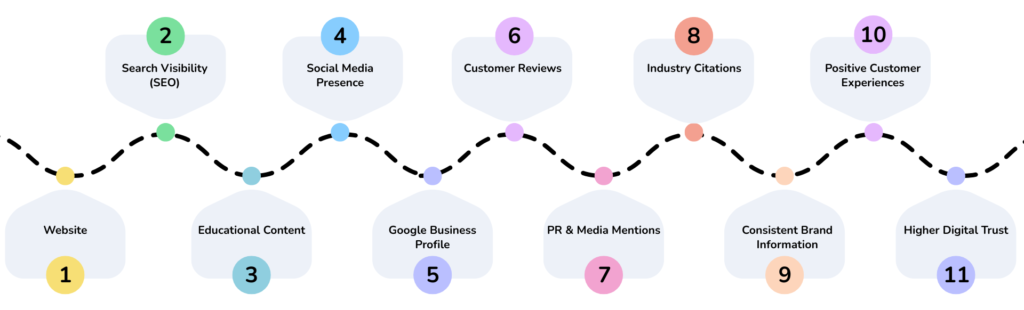
Each element reinforces the others.
A strong website supports your SEO.
Helpful blog content gets shared on social media.
Satisfied customers leave reviews.
Journalists and industry publications mention your brand.
Your Google Business Profile reflects active engagement.
Over time, these signals create a stronger digital reputation.
That reputation influences not only traditional search engines but also AI-powered discovery experiences.
Why Social Media Matters Beyond Social Media
Many businesses still think of social media as a separate marketing activity.
In reality, it contributes to a much larger ecosystem.
Consistent educational content helps:
- Strengthen brand recognition.
- Generate branded searches.
- Encourage backlinks.
- Increase media mentions.
- Build authority.
- Support public trust.
Those outcomes indirectly strengthen your overall digital presence.
Social media isn’t replacing SEO.
It’s strengthening it.
Entity-Based SEO: Building a Recognizable Brand
Search engines and AI platforms increasingly focus on understanding entities rather than just keywords.
An entity is a clearly identifiable business, person, organization, location, or concept.
The stronger your digital footprint, the easier it becomes for search engines to understand who you are and what you specialize in.
For real estate businesses, this means maintaining consistency across every public touchpoint.
Your:
- Website
- Social profiles
- Google Business Profile
- Business directories
- Industry listings
- Press mentions
- Review platforms
Should communicate the same identity.
Consistency strengthens trust.
Conflicting information weakens it.
Analytics: Turning Data Into Better Decisions
Marketing without analytics is like selling property without visiting the site.
You’re making assumptions instead of informed decisions.
The purpose of analytics isn’t collecting more reports.
It’s improving decisions.
Ask questions such as:
- Which content generates qualified inquiries?
- Which platform produces the highest appointment rate?
- Which campaigns influence revenue?
- Which locations perform best?
- Which buyer personas convert faster?
- Which projects require stronger nurturing?
Good analytics don’t simply explain the past.
They improve the future.
Build Dashboards That Leadership Actually Uses
Avoid dashboards filled with dozens of disconnected metrics.
Focus on business outcomes.
A useful executive dashboard might include:
Marketing
- Website traffic
- Organic search growth
- Social engagement quality
- Paid campaign performance
Lead Generation
- Qualified inquiries
- Cost per qualified lead
- Appointment bookings
- Lead response time
Sales
- Site visits
- Opportunity pipeline
- Conversion rate
- Revenue generated
Customer Experience
- Google Review growth
- Customer satisfaction
- Referral rate
- Repeat engagement
When leadership can connect marketing activity directly to business performance, digital marketing becomes easier to justify-and easier to scale.
Platform Snapshot: Choosing the Right Platform for the Right Objective
Rather than trying to maximize every platform equally, align each one with its strongest business purpose.
No platform is inherently “better.”
Each contributes differently to the buyer journey.
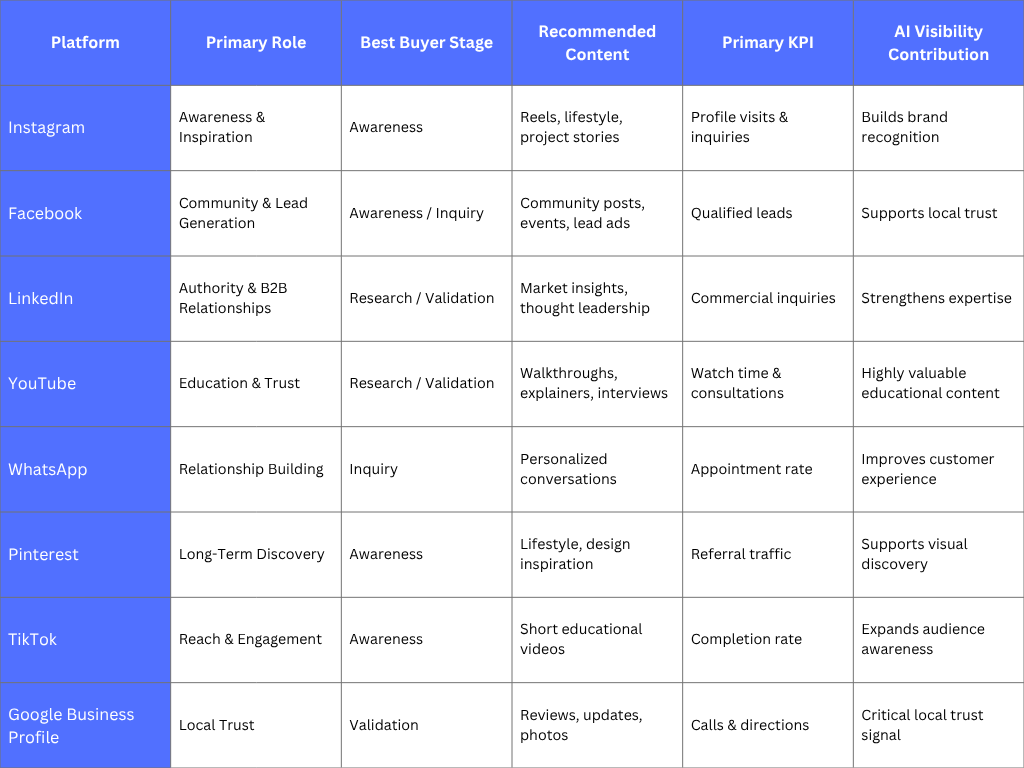
No platform is inherently “better.”
Each contributes differently to the buyer journey.
Successful real estate marketing is no longer about mastering one platform.
It’s about building an ecosystem where every channel supports the next.
- Social media creates awareness.
- Educational content builds confidence.
- Automation improves responsiveness.
- CRM connects marketing with sales.
- Analytics reveal opportunities.
- SEO strengthens discoverability.
- Reviews reinforce credibility.
AI search rewards businesses that demonstrate consistent expertise across every touchpoint.
The businesses leading the market in the years ahead won’t necessarily publish the most content.
They’ll build the most trusted digital presence.
And trust-more than technology, advertising, or algorithms-will remain the strongest competitive advantage.
Ready to Build a Real Estate Marketing Engine That Drives Growth?
If your marketing channels feel disconnected, you’re not alone.
Many real estate businesses invest in social media, SEO, paid advertising, websites, and CRM platforms-but never connect them into a unified growth system.
That’s where meaningful results are often lost.
At MindCentrix, we help developers, brokerages, real estate consultants, and commercial property businesses build integrated marketing ecosystems designed to generate qualified opportunities, strengthen digital trust, and improve long-term marketing ROI.
Whether you’re launching a new project, expanding into new markets, or looking to improve the performance of your existing marketing efforts, the first step is understanding where your biggest opportunities lie.
👉 Book a Strategy Session with MindCentrix to receive a personalized review of your current digital presence, buyer journey, and growth opportunities-and discover how a connected marketing engine can help your business attract better-qualified buyers in an increasingly AI-driven world.
Measuring What Actually Matters in Real Estate Marketing
“Our social media engagement has doubled.”
“We reached over one million people last month.”
“Our latest campaign generated 2,500 leads.”
At first glance, these sound like impressive achievements.
But here’s a question every business owner should ask:
Did any of those metrics generate more revenue?
This is where many real estate marketing strategies begin to lose direction.
Teams celebrate numbers that look good in presentations but reveal very little about business growth.
A post receiving thousands of likes doesn’t necessarily create qualified buyers.
A campaign generating hundreds of leads may still fail if most inquiries never become property visits.
The purpose of marketing isn’t to produce impressive reports.
It’s to generate measurable business outcomes.
That means focusing on the metrics that influence pipeline, revenue, customer experience, and long-term growth-not just visibility.
In this chapter, we’ll explore the KPIs that matter most, how to interpret them correctly, and how to build reporting systems that help leadership make better decisions.
Vanity Metrics vs. Business Metrics
Not every number deserves equal attention.
Some metrics tell you people noticed your content.
Others tell you whether your marketing is actually contributing to revenue.
Understanding the difference is essential.
Vanity Metrics
These metrics are useful for monitoring reach and awareness, but they rarely tell the whole story.
Examples include:
- Followers
- Likes
- Impressions
- Video views
- Page likes
- Post reach
These numbers aren’t meaningless.
However, they should never be the primary measure of marketing success.
A post with 100,000 views that generates no qualified inquiries is less valuable than a post with 2,000 views that results in five serious property consultations.
Business Metrics
Business metrics connect marketing activity to commercial outcomes.
Examples include:
- Qualified leads
- Appointment requests
- Property visits
- Sales opportunities
- Conversion rate
- Customer acquisition cost
- Revenue influenced
- Return on advertising spend (ROAS)
- Customer lifetime value (CLV)
These metrics help answer the questions leadership actually cares about:
- Is marketing producing better buyers?
- Which campaigns generate revenue?
- Where should we invest next?
Which channels deserve more budget?
The KPIs Every Real Estate Business Should Track
No two businesses are identical.
A luxury developer, a commercial brokerage, and a residential consultant will naturally have different objectives.
However, the following KPIs provide a practical foundation for most real estate organizations.
KPI | Excellent | Good | Average | Needs Improvement |
Engagement Rate (Organic Social)* | Above 5% | 3–5% | 1–3% | Below 1% |
Click-Through Rate (CTR)* | Above 3% | 2–3% | 1–2% | Below 1% |
Landing Page Conversion Rate* | Above 10% | 6–10% | 3–6% | Below 3% |
Lead Response Time | Under 5 minutes | 5–15 minutes | 15–60 minutes | Over 1 hour |
Appointment Booking Rate* | Above 35% | 25–35% | 15–25% | Below 15% |
Qualified Lead Rate* | Above 60% | 45–60% | 30–45% | Below 30% |
Property Visit Rate* | Above 50% | 35–50% | 20–35% | Below 20% |
Sales Conversion Rate* | Above 8% | 5–8% | 2–5% | Below 2% |
Google Review Rating | 4.8–5.0 | 4.5–4.8 | 4.2–4.5 | Below 4.2 |
Return on Ad Spend (ROAS)* | 6x+ | 4–6x | 2–4x | Below 2x |
Editorial Note: These ranges are illustrative benchmarks based on commonly observed digital marketing performance across industries and should be interpreted in the context of your market, property type, sales cycle, and campaign objectives. Your ideal benchmarks may vary depending on geography, pricing, and audience.
Looking at one KPI in isolation rarely tells the complete story.
Strong marketing balances multiple performance indicators.
Beyond Cost Per Lead: Measuring Lead Quality
One of the biggest mistakes in real estate marketing is optimizing campaigns for the lowest possible Cost Per Lead (CPL).
Lower isn’t always better.
Consider two campaigns.
Campaign A
- Cost Per Lead: ₹300
- 500 leads generated
- 20 qualified buyers
- 3 property sales
Campaign B
- Cost Per Lead: ₹950
- 120 leads generated
- 65 qualified buyers
- 18 property sales
On paper, Campaign A appears more efficient.
In reality, Campaign B generated significantly more business value.
The goal isn’t to buy cheap leads.
It’s to acquire buyers who are genuinely ready to move forward.
Instead of asking,
“How much did each lead cost?”
Ask,
“How much did each customer cost to acquire?”
That single question often changes marketing priorities.
Build Dashboards That Decision-Makers Actually Use
Many organizations invest in sophisticated analytics platforms.
Then create dashboards nobody looks at.
Why?
Because they measure everything.
When every metric is important, none of them are.
Instead, build dashboards around business questions.
Executive Dashboard
Leadership wants quick answers.
Include metrics such as:
- Marketing-qualified leads (MQLs)
- Sales-qualified leads (SQLs)
- Cost per qualified lead
- Revenue influenced by marketing
- Return on marketing investment
- Conversion rate
- Sales pipeline value
This dashboard should answer one question:
“Is marketing helping the business grow?”
Marketing Dashboard
Marketing teams need operational insights.
Track:
- Organic traffic
- Paid traffic
- Social engagement quality
- Landing page performance
- Content performance
- Email engagement
- Campaign ROI
- Attribution by channel
These metrics help optimize campaigns before problems become expensive.
Sales Dashboard
Sales teams need visibility into buyer progression.
Monitor:
- Inquiry volume
- Follow-up response time
- Appointment bookings
- Property visits
- Proposal requests
- Deal stage progression
- Closing ratio
This helps identify bottlenecks within the sales process.
Customer Experience Dashboard
The customer journey doesn’t end after the sale.
Measure:
- Google Review growth
- Customer satisfaction
- Referral rate
- Response time
- Support resolution time
- Repeat engagement
Satisfied customers become your most credible marketing channel.
Reporting: Focus on Insights, Not Just Numbers
Monthly reports often become long lists of statistics.
Traffic increased.
Followers increased.
Clicks increased.
But numbers without context don’t drive better decisions.
Every report should answer three questions.
1. What happened?
Present the data clearly.
Example:
Website traffic increased by 28%.
2. Why did it happen?
Explain the underlying drivers.
Example:
Organic traffic increased because educational content targeting first-time home buyers ranked higher in search results and generated increased visibility through AI-powered search summaries.
3. What should we do next?
Transform reporting into action.
Example:
Expand educational content around financing, legal documentation, and investment planning because these topics generated the highest engagement and strongest conversion rates.
This approach turns reports into strategic planning tools.
Measuring ROI Across the Entire Buyer Journey
One of the biggest mistakes businesses make is expecting every channel to generate immediate sales.
Different channels contribute differently.
For example:
- Instagram introduces your brand.
- YouTube builds trust.
- Blogs answer questions.
- Google Business Profile validates credibility.
- WhatsApp supports conversations.
- Sales teams close opportunities.
Trying to judge each platform by the same metric leads to poor investment decisions.
Instead, evaluate how every touchpoint contributes to the overall customer journey.
Marketing works best as a connected system-not as isolated channels competing for credit.
Continuous Improvement Beats Occasional Perfection
High-performing marketing teams don’t wait until the end of the year to improve.
They make small adjustments consistently.
Examples include:
- Testing new headlines.
- Refining audience targeting.
- Improving landing page speed.
- Updating older blog content.
- Optimizing call-to-action placement.
- Experimenting with new video formats.
- Improving lead response workflows.
These incremental improvements compound over time.
Marketing excellence is rarely the result of one breakthrough campaign.
It’s usually the outcome of hundreds of thoughtful optimizations.
The most successful real estate businesses don’t measure marketing by how busy their teams are.
They measure it by business outcomes.
Instead of chasing vanity metrics, they focus on:
- Qualified buyers.
- Better conversations.
- Higher appointment rates.
- Stronger conversion rates.
- Greater customer lifetime value.
- Sustainable revenue growth.
They understand that data isn’t collected to impress stakeholders.
It’s collected to make better decisions.
And the businesses that consistently learn from their data are the ones most likely to outperform competitors over the long term.
Want Complete Visibility Into Your Marketing Performance?
If you’re relying on disconnected reports from multiple platforms, you’re only seeing part of the picture.
At MindCentrix, we build custom real estate marketing dashboards that bring together data from your website, CRM, Google Analytics 4, Google Ads, Meta Ads, Search Console, social media platforms, and lead management systems into one unified reporting experience.
Instead of guessing which campaigns are driving growth, you’ll understand exactly how your marketing contributes to qualified leads, appointments, pipeline value, and revenue.
Turn Better Reporting Into Better Decisions
Schedule a complimentary consultation to discover how custom dashboards, GA4 reporting, and actionable analytics can help you make faster, smarter marketing decisions with confidence.
Schedule Your ConsultationHow to Choose the Right Real Estate Social Media Marketing Agency
By now, you’ve probably realized something important.
Successful real estate marketing isn’t about posting more content.
It’s about building a connected system that attracts the right audience, earns trust, nurtures relationships, measures performance, and supports long-term business growth.
That raises an important question.
Who should build and manage that system?
For some organizations, the answer is an in-house marketing team.
For others, it’s a specialized real estate marketing agency.
Many businesses choose a hybrid approach, combining internal knowledge with external expertise.
There isn’t a single right answer.
The best choice depends on your business goals, available resources, internal capabilities, and growth plans.
This chapter isn’t about convincing you to hire an agency.
It’s about helping you make a confident, informed decision-whether that leads you to MindCentrix or another partner.
Because choosing the wrong marketing partner doesn’t just waste budget.
It costs valuable time, missed opportunities, and potential market share.
Should You Hire a Real Estate Social Media Marketing Agency?
Before speaking with agencies, ask yourself a few honest questions.
- Does our current marketing consistently generate qualified inquiries?
- Are our marketing and sales teams aligned?
- Can we accurately measure marketing ROI?
- Is our team producing educational content consistently?
- Are we adapting to AI-powered search and changing buyer behavior?
- Do we have specialists in SEO, paid advertising, analytics, CRM, automation, and content strategy?
If you answered “no” to several of these questions, outside expertise may help accelerate your growth.
That doesn’t necessarily mean replacing your internal team.
The strongest partnerships often strengthen existing teams rather than replace them.
In-House vs. Agency: Which Is Right for You?
Both models have advantages.
The decision should depend on your business priorities-not industry trends.
In-House Team | Specialized Agency |
Deep understanding of company culture | Broad experience across multiple markets |
Faster access to internal stakeholders | Access to specialists across disciplines |
Full-time focus on one business | Exposure to proven frameworks and best practices |
Greater control over daily execution | Faster implementation and scalability |
Builds long-term internal capability | Access to advanced tools and technologies |
May require hiring multiple specialists | One integrated team covering strategy, execution, analytics, SEO, paid media, and automation |
Many growing real estate businesses discover that building an in-house team with the same level of expertise available through an experienced agency can require significant investment in recruitment, training, software, and ongoing development.
Questions Every Business Should Ask Before Hiring an Agency
Choosing a marketing partner shouldn’t feel like choosing a vendor.
It should feel like choosing a long-term business advisor.
The right questions reveal far more than a polished presentation.
1. How do you define success?
Be cautious of agencies that immediately talk about followers, impressions, or viral content.
Strong agencies discuss:
- Qualified leads
- Sales pipeline
- Revenue contribution
- Customer acquisition
- Long-term growth
2. How do you understand our buyers?
Every market is different.
Luxury buyers.
Commercial investors.
First-time homeowners.
Property developers.
Each audience requires different messaging.
Ask how the agency researches buyer behavior before recommending strategies.
3. How do you measure ROI?
A good agency should clearly explain:
- Attribution
- Reporting
- KPIs
- Dashboards
- Revenue tracking
If success can’t be measured, improvement becomes difficult.
4. How do marketing and sales work together?
Marketing doesn’t stop when someone submits an inquiry.
Ask how the agency supports:
- Lead nurturing
- CRM integration
- Sales enablement
- Follow-up strategy
Alignment between marketing and sales often determines campaign success.
5. How do you approach AI-powered search?
Buyer discovery is evolving rapidly.
Ask how the agency approaches:
- AI search optimization
- Entity SEO
- Content authority
- Digital trust
- Brand visibility across AI platforms
An agency focused only on traditional social media may struggle to prepare your business for the future.
6. What experience do you have in real estate?
Industry experience isn’t everything.
But understanding:
- Sales cycles
- Buyer psychology
- Regulatory considerations
- Market dynamics
- Property investment behavior
Can significantly improve strategic recommendations.
Red Flags to Watch Out For
Not every agency is the right fit.
The following warning signs deserve careful consideration.
🚩 Guaranteed Rankings or Guaranteed Leads
No ethical agency can guarantee search rankings or a fixed number of qualified buyers.
Digital marketing depends on numerous factors beyond anyone’s control.
Promises that sound too good to be true usually are.
🚩 One-Size-Fits-All Packages
Every real estate business serves different audiences.
If the same strategy is recommended for a luxury developer, a commercial brokerage, and a local realtor, personalization is probably missing.
🚩 Focus on Activity Instead of Outcomes
Publishing thirty posts every month doesn’t automatically create business growth.
Ask how those activities contribute to measurable commercial objectives.
🚩 No Reporting Transparency
You should always understand:
- What work is being completed.
- Why it’s being completed.
- What results it’s producing.
Transparency builds trust.
🚩 No Strategic Questions
A quality agency spends time understanding your business before recommending solutions.
If the first conversation jumps straight into pricing, strategy may not be the priority.
How We Approach Real Estate Marketing at MindCentrix
Rather than beginning with platforms, campaigns, or advertising budgets, we begin with understanding the business.
Because every property is different.
Every market is different.
Every buyer is different.
That means every strategy should be different too.
Our approach is built around one simple philosophy:
Marketing should help buyers make confident decisions-not pressure them into quick ones.
That philosophy influences everything we do.
We Start With Buyer Understanding
Before discussing content calendars or advertising campaigns, we seek to understand:
- Your ideal customers.
- Their goals.
- Their concerns.
- Their decision-making process.
- Their buying timeline.
- Their preferred communication channels.
Marketing becomes more effective when it’s built around people instead of platforms.
We Build Connected Marketing Systems
We don’t view SEO, social media, paid advertising, analytics, CRM, content marketing, and automation as separate services.
We view them as interconnected components of one growth system.
When these components work together:
- Buyer experiences improve.
- Sales conversations become more productive.
- Marketing becomes easier to measure.
- Investment decisions become more confident.
We Focus on Education Before Promotion
Throughout this guide, you’ve probably noticed a recurring theme.
Trust grows through education.
That’s the same philosophy we apply to our client strategies.
Instead of filling content calendars with promotional posts, we help businesses create resources that answer buyer questions, reduce uncertainty, and demonstrate expertise.
Because businesses that educate consistently are more likely to earn long-term trust.
We Measure What Matters
Rather than celebrating vanity metrics, we focus on outcomes that contribute to business growth.
Including:
- Qualified inquiries.
- Appointment bookings.
- Sales pipeline.
- Conversion rates.
- Revenue attribution.
- Long-term brand visibility.
Marketing should be accountable.
Data helps make that possible.
We Prepare Businesses for the Future
Buyer behavior will continue evolving.
AI-powered discovery.
Voice search.
Entity SEO.
Marketing automation.
First-party data.
Conversational experiences.
These aren’t trends.
They’re shaping the future of digital marketing.
Our goal isn’t simply to improve your marketing today.
It’s to help your business remain competitive tomorrow.
The Future of Real Estate Marketing
Technology will continue changing.
Platforms will continue evolving.
Algorithms will continue update.
Buyer expectations will continue rise.
But one principle will remain constant.
People buy from businesses they trust.
The tools used to build that trust may evolve.
The importance of trust itself won’t.
Looking ahead, successful real estate marketing will increasingly depend on:
AI-Powered Discovery
Buyers will rely more on conversational search experiences than traditional keyword searches.
Businesses with strong educational content and consistent digital authority will become easier to discover.
Voice Search
Questions will become more conversational.
Content written to answer natural-language questions will become increasingly valuable.
Visual Search
Buyers will use images and videos to discover properties and communities more efficiently.
High-quality visual content will play an even larger role.
Hyper-Personalization
Generic campaigns will become less effective.
Buyers will expect content tailored to their interests, investment goals, and stage of the buying journey.
Marketing Automation
Businesses will automate repetitive tasks while preserving meaningful human interactions.
The objective won’t be replacing people.
It will be improving responsiveness and customer experience.
First-Party Data
As privacy expectations continue evolving, businesses will rely more heavily on trusted customer relationships and first-party insights.
Entity SEO & Digital Trust
Brands that demonstrate expertise consistently across websites, reviews, social media, PR, and educational content will be better positioned for both traditional search and AI-powered discovery.
Final Thoughts
Real estate marketing has changed dramatically.
- Not because social media changed.
- Not because algorithms changed.
Because buyers changed.
Today’s buyers expect transparency.
- Fast communication.
- Authentic expertise.
Businesses that continue treating social media as an online brochure will find it increasingly difficult to stand out.
Those that build trust through valuable content, meaningful relationships, measurable systems, and customer-first experiences will be better positioned for sustainable growth.
The future doesn’t belong to the loudest brands.
It belongs to the most trusted ones.
Let's Build a Marketing System That Buyers Trust
Whether you’re a property developer, real estate brokerage, commercial real estate firm, luxury property consultant, or growing agency, sustainable growth starts with understanding your buyers-not chasing algorithms.
At MindCentrix, we partner with businesses that want to build long-term marketing systems rather than short-term campaigns.
If you’re ready to improve lead quality, strengthen your digital presence, prepare for AI-driven search, and create a marketing strategy that supports measurable business growth, we’d love to start the conversation.
Here’s what your strategy session includes:
- A review of your current digital marketing ecosystem.
- An assessment of your buyer journey and content strategy.
- Identification of growth opportunities and conversion gaps.
- Practical recommendations tailored to your business goals.
- Actionable next steps you can implement-whether you work with us or not.
Key Takeaways
If you’ve read this guide from beginning to end, one thing should be clear.
Real estate marketing isn’t becoming more complicated.
It’s becoming more connected.
Successful businesses no longer rely on isolated tactics.
They build systems where:
- Content educates.
- Social media creates awareness.
- SEO improves discoverability.
- Reviews strengthen credibility.
- CRM supports relationships.
- Marketing automation improves responsiveness.
- Analytics guide decisions.
- Sales and marketing work together.
- AI visibility grows naturally through trust.
Technology will continue evolving.
Buyer expectations will continue changing.
But businesses that consistently educate, communicate transparently, and deliver meaningful customer experiences will always have a competitive advantage.
Ready to Turn Your Social Media Into a Revenue Channel?
Thousands of real estate businesses publish content every week.
Very few build marketing systems that consistently generate qualified buyers.
If you’re looking for more than content calendars and campaign reports-if you want a strategy built around buyer psychology, measurable growth, AI-ready visibility, and long-term digital authority-we’d love to help.
Whether you’re a real estate developer, brokerage, luxury property brand, commercial real estate company, or property consultant, our team will analyze your current digital presence, identify growth opportunities, and provide practical recommendations tailored to your business.
Book Your Complimentary Real Estate Growth Strategy Session
Receive personalized recommendations to strengthen your marketing strategy, improve lead quality, optimize your website, and prepare your business for how today's buyers search—including AI-powered search.
No pressure. No generic sales pitch.
Just honest insights that help you make smarter marketing decisions and build a real estate marketing system designed for today's buyers.
Final Editorial Note
This guide was created using industry research, platform documentation, behavioral psychology principles, and practical digital marketing experience. Because digital platforms, algorithms, advertising policies, and buyer behavior continue to evolve, we recommend reviewing and updating this resource regularly to ensure it remains accurate and actionable.
- Build credibility and brand visibility
- Educate buyers and showcase expertise
- Humanize the business
- Generate qualified inquiries
- Stay visible throughout long buying journeys
- Instagram — property showcases and lifestyle content
- Facebook — community engagement and paid lead generation
- LinkedIn — commercial real estate, investor relations, thought leadership
- YouTube — trust-building through educational, long-form video
- WhatsApp — personalized conversations and lead nurturing
- Google Business Profile — local visibility and buyer confidence
Reviewed By
This guide has been editorially reviewed by the senior digital strategy team at MindCentrix to ensure it reflects current marketing best practices, evolving buyer behavior, and the latest developments in AI-powered search, SEO, and digital marketing. Our review process focuses on accuracy, practical insights, and real-world strategies to help business leaders make informed marketing decisions.


Boost Your Brand Visibility 🚀
Get personalized digital strategies that drive growth and engagement.
Let’s Talk📬 Stay Updated
Get the latest insights and guides delivered right to your inbox.
🔗 Related Topics
- Loading related posts...