Google Display Ads as a Growth Engine:
A Strategic Framework for Scaling Marketing Results in 2026
TL;DR (Key Takeaways)
If you’re a founder, CMO, or multi-location decision-maker, here’s what matters:
- How does Google Display Ads grow marketing results for advertisers? It builds demand before search intent exists, lowers acquisition costs over time, and supports full-funnel revenue growth.
- Display is not just awareness — it’s a demand amplification engine.
- A good CTR for Google Display Ads in 2026 is 0.5%–1%, but CTR alone is misleading.
- AI-driven bidding reduces wasted ad spend and improves capital efficiency.
- Display increases assisted conversions and drives incrementality.
- Small businesses must calculate break-even before scaling.
- Improper management silently destroys margin through inefficient targeting and bid misalignment.
Now let’s go deeper.
The Strategic Shift: From “Clicks” to Enterprise Value
For years, advertisers optimized for traffic. Today, sophisticated brands optimize for enterprise value, capital efficiency, and margin protection.
When executives ask, how does Google Display Ads grow marketing results for advertisers, the answer is not “more clicks.” It’s:
- Increased branded search volume
- Lower blended customer acquisition cost (CAC)
- Stronger remarketing pools
- Higher lifetime value (LTV)
Impressions matter. Research consistently shows that users exposed to display ads are more likely to click on branded search ads later. That means Display doesn’t just generate clicks — it influences future behavior.
This is why leading brands treat Display as a demand creation channel, not an ad format.
What Are Google Display Ads? (Infrastructure, Not Just Ads)
Google Display Ads operate across the Google Display Network (GDN), reaching:
- Over 2 million websites
- YouTube placements
- Gmail promotions
- Mobile apps
Unlike Search Ads (which capture intent), Display Ads create intent through visual storytelling and targeted exposure.
Advanced brands use both Search + Display together:
- Display builds awareness
- Search captures demand
- Remarketing closes the loop
When business leaders evaluate how does Google Display Ads grow marketing results for advertisers, they must view it as infrastructure within a full revenue ecosystem.
How Does Google Display Ads Grow Marketing Results for Advertisers?
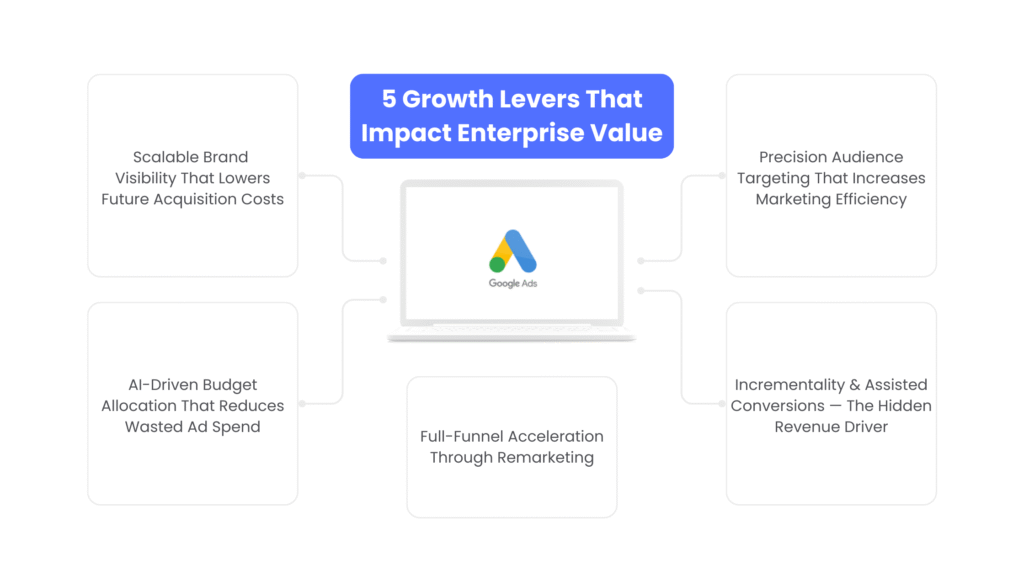
The 5 Growth Levers That Impact Enterprise Value
This is where strategy becomes measurable.
1: Scalable Brand Visibility That Lowers Future Acquisition Costs
The first answer to how does Google Display Ads grow marketing results for advertisers lies in scalable visibility.
Display acts as a demand amplifier. When a regional retail chain runs consistent Display campaigns across 15 cities:
- Branded search volume increases
- CPC on branded terms decreases
- Direct traffic rises
- Conversion rates improve
Over time, this reduces blended CAC.
For multi-location businesses, consistent Display exposure creates brand memory — leading to cheaper future conversions.
2: AI-Driven Budget Allocation That Reduces Wasted Ad Spend
Another key way how does Google Display Ads grow marketing results for advertisers becomes evident is through smart bidding.
Google’s AI bidding strategies:
- Optimize for Target CPA
- Optimize for Target ROAS
- Adjust bids in real time
- Analyze device, time, audience signals
This reduces manual micromanagement and improves capital efficiency.
For enterprises, this means:
- Stabilized CPA
- More predictable forecasting
- Internal teams focusing on strategy instead of spreadsheets
AI bidding is not automation for convenience — it’s automation for margin protection.
3: Precision Audience Targeting That Increases Marketing Efficiency
A core factor in how does Google Display Ads grow marketing results for advertisers is targeting sophistication.
Modern targeting includes:
- In-market audiences (buyers actively researching)
- Custom intent segments
- Lookalike modeling
- Geo-fencing for franchise zones
- B2B account-based targeting
Example: A multi-location dental chain can target users within a 5km radius of each clinic while excluding overlapping zones — ensuring budget precision.
Efficiency equals higher ROI.
4: Incrementality & Assisted Conversions — The Hidden Revenue Driver
This is where many advertisers misunderstand Display.
Incrementality refers to conversions that would NOT have happened without ad exposure.
When evaluating how does Google Display Ads grow marketing results for advertisers, consider assisted conversions:
- A user sees a display ad
- Later searches the brand
- Converts via Search
Display influenced that revenue.
In attribution reports, this appears under Assisted Conversions.
Without Display, that search click may never happen.
This halo effect is measurable. Multi-touch attribution modeling often reveals that Display contributes 20–40% of assisted paths in complex funnels.
5: Full-Funnel Acceleration Through Remarketing
The final growth lever explaining how does Google Display Ads grow marketing results for advertisers is remarketing.
Remarketing allows brands to:
- Recover abandoned carts
- Nurture B2B prospects
- Re-engage inactive customers
- Promote upsells
Example: An eCommerce brand running remarketing ads may see a 30% lift in conversion rate from returning visitors.
Remarketing shortens the buying cycle and increases LTV.
A Good CTR for Google Display Ads in 2026 Is 0.5%–1%
Industry benchmarks suggest:
- Average Display CTR: 0.5%–1%
- Highly optimized campaigns: 1%+
But here’s what executives must understand:
CTR is not revenue.
A campaign with 0.6% CTR but strong ROAS may outperform a 1.2% CTR campaign with poor targeting.
CMOs should track:
- ROAS
- Cost per incremental conversion
- Assisted revenue
- Lifetime value
When asking again, how does Google Display Ads grow marketing results for advertisers, focus on revenue influence — not vanity metrics.
How Can Google Ads Help You Advance Your Business Goals?
- Market Expansion Strategy
Display introduces your brand to new geographies before competitors dominate.
- Multi-Location Brand Dominance
Geo-targeted Display ensures consistent messaging across cities.
- International Growth
Localized creatives with audience segmentation allow scalable global reach.
- Lead Generation at Scale
Display builds remarketing pools that improve Search performance.
- Product Launch Acceleration
New product awareness increases branded search velocity.
Each of these connects back to the core question: how does Google Display Ads grow marketing results for advertisers? By aligning advertising with enterprise growth strategy.
Get a free Google Ads Audit
The Economics of Google Ads for Small Business: Calculating Your Break-Even
Small business owners ask: Do Google Ads work for small business?
The better question is: What is your break-even?
Break-even formula:
Average Sale Value × Profit Margin = Maximum Allowable CPA
Example:
- Average sale: $500
- Profit margin: 40%
- Max CPA: $200
If your Display campaign generates conversions under $200 CPA, you scale.
This financial framing shows precisely how does Google Display Ads grow marketing results for advertisers — by operating within profit boundaries.
Display Strategy for Multi-Location & Enterprise Brands
Enterprise brands must:
- Allocate budget based on location performance
- Use hyperlocal targeting
- Centralize creative control
- Track cross-location attribution
This strategic deployment ensures consistent ROI.
The “Invisible Drain”: 5 Ways Improperly Managed Ads Kill Your Margin
- Poor audience layering → irrelevant impressions
- No incrementality testing → inflated performance assumptions
- Ignoring assisted conversions → undervaluing Display
- Creative fatigue → declining CTR
- No bid calibration → unstable CPA
Each reduces profitability quietly.
Build vs. Buy: Why Specialized Management Outperforms Generalists
DIY management often leads to:
- Time drain
- Under-optimized targeting
- Missed data insights
Specialized teams use:
- Testing frameworks
- Predictive forecasting
- Continuous optimization cycles
At MindCentrix, we approach campaigns as revenue systems — not traffic generators.
The Future: AI, First-Party Data & the Cookieless Growth Model
As privacy evolves:
- First-party data becomes essential
- AI bidding becomes more predictive
- Performance Max complements Display
- Zero-click visibility influences branded search
Businesses that adapt early win long term.
Conclusion: Why Google Display Ads Remain a Strategic Growth Lever
To conclude clearly:
How does Google Display Ads grow marketing results for advertisers?
By:
- Building demand
- Assisting conversions
- Reducing acquisition cost
- Protecting margins
- Scaling enterprise growth
For multi-location brands and ambitious companies, Display is not optional — it’s foundational.
If your organization is evaluating scalable growth, now is the time to build a structured Display framework.
Frequently Asked Questions

Boost Your Brand Visibility 🚀
Get personalized digital strategies that drive growth and engagement.
Let’s Talk📬 Stay Updated
Get the latest insights and guides delivered right to your inbox.
🔗 Related Topics
- Loading related posts...