
Telemarketing Services for 2026:
The Revenue Team’s Playbook for Pipeline Acceleration

For many revenue leaders, one question keeps coming up: how do we generate qualified pipeline faster without relying entirely on inbound marketing?
Despite the rise of automation, email outreach, and social selling, one channel continues to produce consistent results — telemarketing services.
When executed strategically, telemarketing is not simply cold calling. Modern b2b telemarketing services combine data intelligence, CRM integration, and skilled conversation strategies to connect directly with decision-makers.
For organizations with complex sales cycles, outbound telemarketing services remain one of the fastest ways to start meaningful conversations and move prospects into the sales pipeline.
This playbook explains how modern telemarketing works, how revenue teams use it to accelerate pipeline growth, and what decision-makers should know before investing in telemarketing programs.
TL;DR — The 30-Second Telemarketing Playbook
Step | What Modern Telemarketing Teams Do |
1 | Identify ideal customer profiles using intent data and firmographic insights |
2 | Launch targeted outbound telemarketing campaigns |
3 | Qualify prospects using frameworks like BANT or MEDDIC |
4 | Schedule meetings directly into sales calendars |
5 | Sync every conversation into CRM systems |
Modern telemarketing services combine human conversations, data intelligence, and AI-driven analytics to generate qualified pipeline faster than digital channels alone.
Why Telemarketing Still Works in a Digital-First Sales Environment
Senior decision-makers today receive hundreds of emails and LinkedIn messages every week. Most of these communications go unread.
A direct conversation, however, cuts through the noise.
Modern telemarketing services allow companies to reach decision-makers directly, introduce complex solutions, and address questions in real time.
This approach works particularly well for organizations selling high-value products or services where trust and clarity are essential.
Key reasons telemarketing remains effective include:
- Direct communication with decision-makers
- Faster qualification of opportunities
- Immediate feedback from prospects
- Ability to explain complex offerings clearly
For revenue teams managing long sales cycles, b2b telemarketing services provide a structured method to start conversations that digital channels alone cannot deliver.
What Are the 4 Core Deliverables of B2B Telemarketing Services?
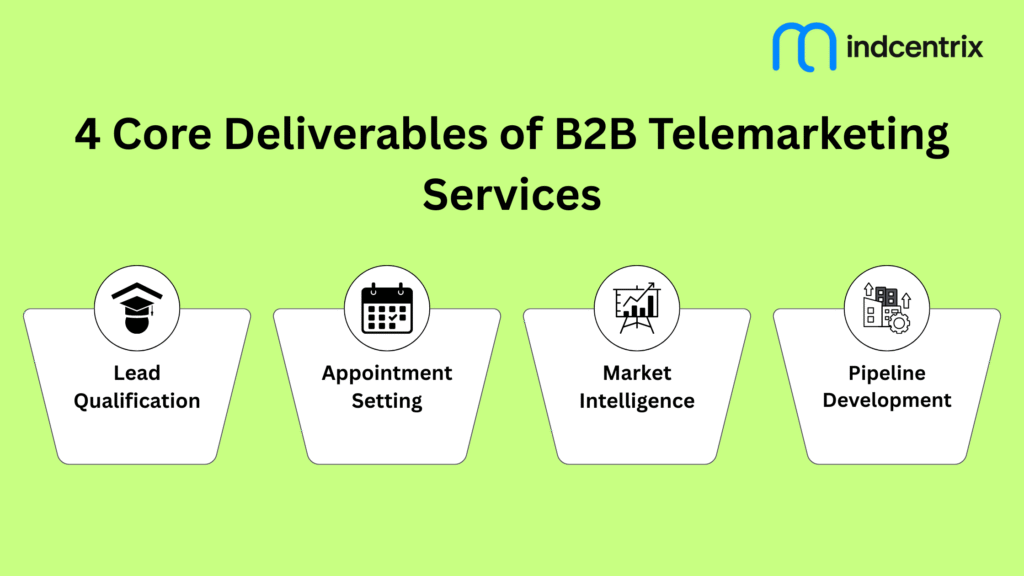
B2B telemarketing services help companies generate qualified opportunities by connecting directly with business decision-makers through structured outreach programs.
These services typically deliver four primary outcomes.
Lead Qualification
Telemarketing teams identify whether prospects match the ideal customer profile and determine their readiness to engage with sales teams.
Agents typically gather information about:
- business needs
- decision authority
- budget availability
- purchasing timeline
This process ensures sales teams focus only on high-potential opportunities.
Appointment Setting
One of the most valuable functions of telemarketing services is scheduling meetings directly for sales teams.
Instead of spending time prospecting, sales representatives receive pre-qualified appointments with prospects who already understand the value proposition.
Market Intelligence
Conversations with prospects provide insights that marketing data cannot always reveal.
Telemarketing campaigns often uncover:
- emerging customer needs
- competitor activity
- industry trends
- pricing expectations
These insights help organizations refine their go-to-market strategies.
Pipeline Development
Many prospects are not ready to purchase immediately.
Through consistent outreach and follow-up calls, telemarketing services help nurture early-stage prospects until they are ready to enter the sales pipeline.
Inside the Data: What B2B Call Analysis Reveals About Modern Telemarketing
Recent industry analyses examining thousands of B2B sales conversations highlight several important patterns.
First, multi-touch engagement significantly improves response rates. Prospects who have already interacted with a company through marketing channels are more likely to respond to calls.
Second, calls supported by intent data and enriched prospect profiles produce higher qualification rates.
Finally, structured conversations that focus on discovery rather than selling generate stronger engagement.
These findings demonstrate why modern telemarketing services focus on meaningful conversations rather than call volume.

Get an Expert Google Ads Audit for Your Business
Uncover wasted spend, fix performance gaps, and scale ROI with certified Google Ads specialists.
The Three Types of Telemarketing Services Used by High-Growth Companies
Different types of telemarketing programs serve different business goals.
Understanding these categories helps revenue leaders design effective outreach strategies.
B2B Telemarketing Services
B2B telemarketing services focus on engaging decision-makers within organizations.
These campaigns are commonly used to:
- generate qualified leads
- schedule executive meetings
- introduce complex solutions
- support account-based marketing strategies
Because B2B sales cycles often involve multiple stakeholders, telemarketing allows organizations to engage prospects earlier in the buying journey.
Outbound Telemarketing Services
Outbound telemarketing services involve proactively contacting potential customers through targeted calling campaigns.
Common use cases include:
- lead generation campaigns
- product introduction calls
- webinar and event invitations
- follow-ups with marketing leads
For organizations seeking predictable pipeline growth, outbound telemarketing services create opportunities instead of waiting for inbound demand.
Inbound Telemarketing Support
Inbound telemarketing focuses on responding to prospects who initiate contact.
These teams typically handle:
- inbound product inquiries
- customer service calls
- upsell opportunities
- sales support activities
Although inbound programs are reactive, they play an important role in converting interested prospects into customers.
Cold Calling vs Modern B2B Telemarketing
Many executives associate telemarketing with outdated cold calling methods. However, modern telemarketing is significantly more sophisticated.
Factor | Legacy Cold Calling | Modern B2B Telemarketing |
Data Source | Static contact lists | Intent data and enriched prospect databases |
Technology | Manual dialing | AI dialers and conversation analytics |
Messaging | Generic scripts | Personalized conversations based on ICP |
Sales Alignment | Isolated outreach | Fully integrated with RevOps and CRM |
Goal | Immediate sales | Qualified pipeline generation |
Modern telemarketing services emphasize strategic outreach rather than random calls.
Where Telemarketing Fits in the Modern Revenue Engine
High-performing companies integrate telemarketing directly into their revenue operations strategy.
The process typically looks like this:
Marketing campaigns generate awareness →
Prospect data identifies high-potential accounts →
Telemarketing teams initiate conversations →
Qualified opportunities enter the sales pipeline.
This approach turns telemarketing services into a bridge between marketing demand and sales conversion.
The Modern Telemarketing Technology Stack
Technology plays a critical role in the effectiveness of telemarketing campaigns.
Modern programs rely on several tools to improve efficiency and insight.
CRM Integration
Every conversation should be automatically logged within CRM systems, ensuring sales teams have complete visibility into prospect interactions.
AI Dialing Systems
Advanced dialing platforms help agents connect with prospects more efficiently while maintaining compliance with calling regulations.
AI Sentiment Analysis
Conversation analytics tools can evaluate tone, engagement levels, and objection patterns during calls.
These insights help organizations improve messaging and train agents more effectively.
Conversation Intelligence
Advanced analytics platforms identify patterns in successful calls, helping companies refine outreach strategies over time.
Predictive Lead Routing
Qualified prospects can be automatically routed to the appropriate sales representative based on industry, company size, or opportunity value.
Telemarketing ROI: How Revenue Teams Measure Success
Executives rarely evaluate telemarketing based on call volume alone.
Instead, they measure its impact on pipeline and revenue.
A simplified ROI model looks like this:
Cost per Lead
→ Conversion Rate to Sales Qualified Lead
→ Average Deal Value
→ Total Pipeline Generated
For example:
- 500 qualified leads
- 20% conversion to opportunities
- $40,000 average deal value
This results in approximately $4 million in potential pipeline value.
Because of this potential impact, many organizations view telemarketing services as a pipeline acceleration strategy rather than a marketing expense.
When Companies Should Outsource Telemarketing Services
Building an internal telemarketing team requires hiring agents, investing in technology, and managing training programs.
For many organizations, outsourcing provides a faster and more scalable alternative.
Common reasons companies outsource telemarketing include:
- rapid campaign deployment
- access to experienced agents
- advanced dialing infrastructure
- scalable outreach capacity
Outsourced providers allow organizations to launch telemarketing campaigns quickly without building internal teams.
The 7 Signals of a High-Performing Telemarketing Partner
Choosing the right partner is essential for success.
Decision-makers should evaluate telemarketing providers based on several key capabilities.
- Clear targeting strategies based on ideal customer profiles
- Experienced agents capable of engaging senior decision-makers
- Integration with CRM and revenue operations systems
- Data enrichment and prospect intelligence capabilities
- Transparent performance reporting
- AI-driven conversation insights
- Strong compliance and data protection standards
Organizations that select partners with these capabilities are more likely to achieve meaningful results from telemarketing services.
Industries Where Telemarketing Delivers the Highest ROI
Telemarketing tends to perform best in industries where sales require consultation and trust.
Examples include:
- SaaS and technology platforms
- professional services
- financial services
- healthcare technology
- manufacturing and industrial solutions
These sectors rely heavily on direct conversations with decision-makers, making telemarketing an effective outreach channel.
People Also Ask
What is the main purpose of telemarketing services?
The main purpose of telemarketing services is to connect businesses with potential customers through direct phone conversations to generate leads, qualify prospects, and schedule meetings for sales teams.
Are telemarketing services effective for B2B companies?
Yes. B2B telemarketing services are particularly effective for industries with complex sales cycles because they enable companies to speak directly with decision-makers and qualify opportunities quickly.
What is the difference between telemarketing and telesales?
Telemarketing focuses on generating leads and scheduling appointments, while telesales involves directly closing deals over the phone.
How do outbound telemarketing services generate leads?
Outbound telemarketing services generate leads by contacting targeted prospects, introducing solutions, qualifying interest, and scheduling meetings for sales teams.
The Future of Telemarketing: AI and Human Conversations
Telemarketing continues to evolve as artificial intelligence becomes more integrated into sales processes.
Emerging innovations include:
- AI-assisted call coaching
- automated conversation analysis
- predictive lead scoring
- real-time objection handling assistance
Despite these advancements, the most successful programs combine human expertise with intelligent technology.
In the coming years, telemarketing will increasingly function as an AI-enhanced conversation strategy for revenue teams.
Key Takeaways for Revenue Leaders
- Telemarketing services remain one of the fastest methods for generating qualified sales pipeline.
- B2B telemarketing services help organizations connect directly with business decision-makers.
- Outbound telemarketing services enable proactive demand generation.
- Modern telemarketing combines human expertise with advanced analytics and automation.
- Companies that integrate telemarketing with sales and marketing operations achieve stronger pipeline outcomes.

Bhavisya
Written by Bhavisya, a Google Ads Certified Specialist at MindCentrix, with 10+ years of hands-on experience managing PPC advertising for lawyers across the United States.
Bhavisya has planned and optimized Google Ads, Local Service Ads (LSAs), and pay-per-click campaigns for divorce lawyers, personal injury attorneys, criminal defense firms, and family law practices in competitive U.S. markets such as California, Texas, Florida, and New York.
Their work aligns strictly with Google Ads policies for legal services, including personal hardship and restricted legal content compliance, ensuring campaigns are both ethical and profitable.

Boost Your Brand Visibility 🚀
Get personalized digital strategies that drive growth and engagement.
Let’s Talk📬 Stay Updated
Get the latest insights and guides delivered right to your inbox.
🔗 Related Topics
- Loading related posts...