Pharma Marketing Guide:
Strategies for Pharmaceutical Growth

- 1Understand what pharmaceutical marketing means in today's digital-first healthcare landscape.
- 2Learn why traditional pharma marketing strategies are no longer enough to reach healthcare professionals and patients.
- 3Discover the biggest marketing challenges pharmaceutical companies face and how to overcome them.
- 4Explore how AI, search engines, and omnichannel marketing are transforming healthcare marketing.
- 5Implement proven strategies to generate qualified leads, build brand authority, and support sustainable business growth.
The Pharmaceutical Industry Has Changed Faster Than Most Companies Realize
Ten years ago, pharmaceutical marketing followed a relatively predictable model.
Medical representatives visited physicians, conferences generated valuable business relationships, journals served as the primary educational resource, and marketing success was often measured by the size of the sales force.
Today, that buying journey looks completely different.
Healthcare professionals begin their research online before speaking with a representative. Hospital decision-makers compare multiple vendors through digital channels. Researchers consume webinars, podcasts, clinical studies, and educational videos. Patients actively search for trusted medical information before consulting their physicians.
The result is a far more informed audience with significantly higher expectations.
Simply having an excellent product is no longer enough to stand out.
Organizations must demonstrate expertise, publish credible educational content, maintain a strong digital presence, and provide accurate information wherever their audience chooses to engage.
This shift isn’t just changing marketing tactics-it’s reshaping how pharmaceutical companies build trust, influence purchasing decisions, and compete in increasingly crowded markets.
Businesses that recognize this transformation early are creating stronger customer relationships, improving commercial outcomes, and establishing themselves as trusted industry authorities.
Those relying solely on traditional marketing approaches are finding it increasingly difficult to capture attention and sustain long-term growth.
What Is Pharma Marketing?
Pharma marketing is the strategic process of promoting pharmaceutical products, healthcare solutions, medical technologies, and related services while maintaining scientific accuracy, regulatory compliance, and patient safety.
Unlike traditional consumer marketing, pharmaceutical marketing isn’t designed simply to sell a product.
Its primary objective is to educate, build trust, support informed decision-making, and create long-term relationships with multiple stakeholders across the healthcare ecosystem.
These stakeholders may include:
- Physicians and healthcare professionals
- Hospitals and healthcare networks
- Pharmacists
- Medical researchers
- Healthcare administrators
- Health information publishers
- Distributors and channel partners
- Patients and caregivers (where regulations allow)
Each audience has different needs, decision-making processes, and information requirements.
A physician may want clinical evidence.
A procurement manager may focus on cost-effectiveness and supply reliability.
Patients often seek understandable, trustworthy health information that helps them have informed conversations with their healthcare providers.
Successful pharma marketing delivers relevant information to each audience while ensuring every communication remains ethical, compliant, and scientifically supported.
Pharma Marketing Is No Longer Just About Promotion
One of the biggest misconceptions in the pharmaceutical industry is that marketing exists primarily to increase product awareness.
In reality, effective pharma marketing serves a much broader business purpose.
Today’s marketing teams help organizations:
- Educate healthcare professionals with evidence-based resources
- Build long-term credibility within the medical community
- Support product launches
- Improve physician engagement
- Strengthen relationships with healthcare institutions
- Generate qualified commercial opportunities
- Increase digital visibility
- Enhance patient education initiatives
- Support sales enablement with high-quality content
- Measure and improve marketing return on investment
Rather than focusing solely on promotional campaigns, modern pharmaceutical organizations invest in educational ecosystems that create value long before a purchasing decision occurs.
This approach not only improves marketing performance but also strengthens brand reputation in an industry where trust is one of the most valuable competitive advantages.
Get an Expert Google Ads Audit for Your Business
Uncover wasted spend, fix performance gaps, and scale ROI with certified Google Ads specialists.
Pharma Marketing vs Healthcare Marketing vs Medical Marketing
Although these terms are often used interchangeably, they represent different areas of specialization.
Area | Primary Focus | Typical Audience | Main Objective |
Pharma Marketing | Pharmaceutical products, therapies, medical innovations | Physicians, hospitals, pharmacists, healthcare organizations, patients | Product adoption, education, commercial growth, scientific credibility |
Healthcare Marketing | Healthcare providers and services | Patients, healthcare consumers, communities | Patient acquisition, engagement, brand awareness |
Medical Marketing | Medical devices, technologies, diagnostics, clinical services | Healthcare professionals, hospitals, specialists | Product awareness, education, lead generation |
Understanding these differences helps organizations develop more targeted marketing strategies rather than applying a one-size-fits-all approach.
Why Pharma Marketing Matters More Than Ever
The pharmaceutical sector has become one of the most competitive and information-driven industries in the world.
New treatments, emerging biotech companies, evolving regulations, and rapidly changing digital technologies have fundamentally altered how organizations compete.
Several major shifts are driving this transformation.
Healthcare Professionals Are More Digitally Connected
Doctors, specialists, pharmacists, and researchers increasingly rely on digital resources to stay informed.
Clinical guidelines, peer-reviewed publications, webinars, online medical communities, and search engines have become essential parts of their daily workflow.
If your organization isn’t visible where these professionals are searching for information, your competitors will be.
Decision-Making Has Become More Complex
Purchasing decisions rarely involve a single stakeholder.
Depending on the product or service, organizations may need approval from clinical teams, procurement departments, financial decision-makers, regulatory specialists, and executive leadership.
Each group evaluates different criteria.
Marketing must support every stage of this complex decision-making journey with relevant, evidence-based content.
Trust Has Become the Ultimate Competitive Advantage
Pharmaceutical companies operate in one of the world’s most highly regulated industries.
Every claim must be supported.
Every communication must be accurate.
Every piece of educational content contributes to-or detracts from-brand credibility.
Organizations that consistently provide transparent, high-quality information become trusted partners rather than just suppliers.
That trust often becomes the deciding factor when multiple companies offer comparable products.
AI Is Reshaping How Healthcare Information Is Discovered
Healthcare professionals and business leaders are no longer relying exclusively on traditional search engines.
Many now use AI-powered platforms to summarize research, compare solutions, and answer complex medical or business questions.
These platforms prioritize organizations that publish structured, authoritative, and trustworthy content.
This means pharmaceutical companies must optimize not only for Google rankings but also for AI-powered search experiences, ensuring their expertise is recognized across emerging discovery channels.
The Biggest Challenges Pharmaceutical Companies Face Today
Despite significant investments in research and product development, many pharmaceutical organizations struggle to achieve consistent marketing performance.
In our experience, the challenge is rarely the quality of the product.
More often, it’s the inability to connect that value with the right audience at the right time.
Let’s examine some of the most common obstacles.
“We Have Innovative Products, But Hardly Anyone Finds Us Online”
Many pharmaceutical companies invest heavily in product development while overlooking digital discoverability.
Without strong search visibility, optimized educational content, and authoritative online resources, even groundbreaking innovations remain hidden from potential customers.
The consequence is clear: competitors with stronger digital strategies capture attention first, regardless of product quality.
“Our Website Looks Professional but Doesn’t Generate Business”
A visually appealing website is important, but design alone doesn’t create commercial outcomes.
Many pharmaceutical websites function as online brochures rather than strategic growth platforms.
They provide information but fail to guide visitors toward meaningful actions, answer critical questions, or demonstrate why the organization should be trusted.
The result is traffic without engagement-and visibility without measurable business impact.
“Our Marketing and Sales Teams Operate Independently”
Marketing generates content.
Sales speaks with customers.
Medical affairs develops scientific resources.
Leadership reviews performance.
Too often, these teams work in isolation.
This disconnect creates inconsistent messaging, duplicated effort, fragmented customer experiences, and missed commercial opportunities.
The most successful pharmaceutical organizations align these functions around a shared customer journey rather than treating them as separate departments.
“We Struggle to Measure Marketing ROI”
Many executives still ask one important question:
“How do we know our marketing investment is actually contributing to business growth?”
Without reliable analytics, attribution models, and performance measurement, answering this question becomes difficult.
Modern pharma marketing requires clear visibility into how content, campaigns, SEO, webinars, paid advertising, and customer engagement contribute to qualified opportunities and revenue growth-not just website traffic.
Building a Modern Pharma Marketing Strategy That Drives Sustainable Growth
Launching campaigns without a clear strategy is one of the biggest reasons pharmaceutical marketing efforts fail.
Many organizations invest in SEO, paid advertising, webinars, email campaigns, social media, and conferences simultaneously, hoping that one channel will generate results. While these activities may create visibility, they rarely produce sustainable business growth unless they’re connected by a unified strategy.
Successful pharmaceutical companies don’t think in terms of individual marketing tactics-they build integrated ecosystems that educate, engage, and nurture their audiences throughout the entire decision-making journey.
Whether your goal is increasing product adoption, strengthening physician engagement, expanding into new markets, or supporting a product launch, every marketing initiative should contribute to measurable business objectives.
Below are the core pillars that define a high-performing pharma marketing strategy in today’s digital-first landscape.
Pillar 1: Understand Every Stakeholder in the Healthcare Ecosystem
Unlike most industries, pharmaceutical companies rarely market to a single audience.
A single purchasing decision may involve physicians, specialists, procurement teams, pharmacists, hospital administrators, researchers, distributors, regulatory teams, and executive leadership.
Each stakeholder has unique priorities.
For example:
Audience | What They Care About |
Physicians | Clinical evidence, treatment outcomes, patient safety |
Hospital Procurement Teams | Pricing, supplier reliability, long-term value |
Pharmacists | Product information, dosage accuracy, safety updates |
Researchers | Scientific data, innovation, published studies |
Healthcare Executives | Business impact, efficiency, ROI, compliance |
Patients | Trustworthy information, accessibility, treatment understanding |
Creating one generic marketing message for all these audiences almost always leads to poor engagement.
Instead, pharmaceutical companies should build audience-specific content journeys that answer the questions each stakeholder is likely to ask at different stages of the buying process.
The more relevant your communication, the stronger your credibility becomes.
Pillar 2: Build Trust Before You Sell
Healthcare decisions carry significant responsibility.
People aren’t purchasing everyday consumer products-they’re making decisions that affect patient outcomes, organizational performance, and public health.
That’s why trust has become the most valuable asset in pharma marketing.
Organizations that consistently educate their audience tend to outperform those focused solely on promotion.
Instead of asking,
“How can we sell this product?”
Ask,
“What information does our audience need before they can confidently make a decision?”
Educational marketing establishes authority long before sales conversations begin.
Examples include:
- Clinical insight articles
- Physician resource centers
- Disease awareness campaigns
- Research summaries
- Interactive treatment guides
- Whitepapers
- Educational webinars
- Industry reports
- Expert interviews
- Frequently Asked Questions
When your audience repeatedly finds valuable, accurate, and unbiased information from your organization, your brand becomes a trusted resource-not just another supplier.
Pillar 3: Make Search Visibility a Business Priority
The way healthcare professionals discover information has fundamentally changed.
Instead of waiting for product brochures or conference presentations, many begin with a search engine or an AI-powered search assistant.
Questions like these are becoming increasingly common:
- Which treatment options have the strongest clinical evidence?
- What pharmaceutical companies specialize in oncology?
- How does Drug A compare with Drug B?
- What are the latest advances in biologics?
- Which pharma marketing agency understands healthcare compliance?
If your organization isn’t visible when these questions are asked, you’re missing opportunities before the sales process even begins.
Search visibility today includes much more than ranking on Google.
Your content should also be discoverable through:
- AI-generated search experiences
- Healthcare knowledge platforms
- Medical directories
- Industry publications
- Featured snippets
- Voice search
- Professional healthcare communities
Organizations that invest in long-term search visibility continue attracting qualified visitors months and even years after content is published.
Pillar 4: Create Content That Solves Real Problems
One of the biggest content mistakes pharmaceutical companies make is producing articles that simply describe their products.
Healthcare professionals aren’t searching for advertisements.
They’re searching for answers.
Effective pharma content addresses real-world challenges before discussing solutions.
Instead of publishing content like:
“Why Our Product Is the Best Choice”
Create resources such as:
- How to improve medication adherence in chronic care
- Emerging trends in oncology treatment
- Challenges hospitals face during digital transformation
- Best practices for pharmaceutical supply chain management
- The future of AI in drug discovery
- How healthcare providers evaluate pharmaceutical partners
This approach naturally builds authority while positioning your products and services within a broader educational context.
The goal isn’t to interrupt the buyer’s journey-it’s to support it.
Pillar 5: Align Marketing With Business Objectives
Marketing should never operate independently of business strategy.
Every campaign should contribute to measurable organizational goals.
Examples include:
Business Goal | Marketing Objective |
Increase product awareness | SEO, educational content, digital PR |
Generate qualified leads | Landing pages, webinars, downloadable resources |
Expand internationally | Multilingual SEO, localized campaigns |
Improve physician engagement | Email nurturing, webinars, thought leadership |
Launch a new product | Omnichannel awareness campaigns |
Strengthen brand authority | Research reports, expert content, speaking opportunities |
When marketing metrics align with business outcomes, leadership gains greater confidence in marketing investments.
The Most Effective Digital Marketing Channels for Pharmaceutical Companies
Every marketing channel serves a different purpose.
Rather than trying to be everywhere, pharmaceutical organizations should invest where their audience actively seeks information.
Search Engine Optimization (SEO)
SEO remains one of the highest-return marketing investments because it attracts people actively searching for information.
A strong pharmaceutical SEO strategy helps organizations:
- Increase qualified organic traffic
- Improve visibility for treatment-related searches
- Build long-term authority
- Generate high-intent business inquiries
- Support AI-powered search experiences
Unlike paid advertising, SEO continues delivering value long after content is published.
Content Marketing
Content marketing is the foundation of modern pharmaceutical communication.
Educational content demonstrates expertise while helping audiences solve problems.
High-performing content formats include:
- Comprehensive guides
- Clinical insights
- Industry reports
- Case studies
- Whitepapers
- Medical infographics
- Video explainers
- Research summaries
- Interactive tools
- FAQ libraries
Consistently publishing valuable content strengthens both search visibility and brand credibility.
Email Marketing
Email remains one of the most effective channels for nurturing healthcare professionals and business decision-makers.
Rather than sending promotional emails, successful pharmaceutical companies focus on delivering ongoing educational value.
Examples include:
- Research updates
- Industry insights
- Clinical news
- Webinar invitations
- Product education
- Regulatory developments
This keeps your organization top of mind without overwhelming subscribers with sales-focused messaging.
LinkedIn Marketing
LinkedIn has become one of the most influential platforms for B2B pharmaceutical marketing.
Executives, researchers, physicians, procurement leaders, and healthcare innovators actively engage with industry discussions.
Organizations that consistently publish thought leadership often establish stronger relationships before formal sales conversations begin.
Topics that perform particularly well include:
- Industry trends
- Regulatory changes
- Market research
- Innovation stories
- Leadership perspectives
- Healthcare technology
- Patient outcomes
- AI in healthcare
Thought leadership isn’t about promoting your company.
It’s about contributing valuable expertise to industry conversations.
Webinars and Virtual Events
Healthcare professionals value opportunities to learn directly from experts.
Educational webinars provide a platform for discussing:
- Clinical advancements
- Research findings
- Regulatory updates
- Emerging technologies
- Best practices
- Industry challenges
Unlike traditional advertising, webinars encourage meaningful engagement and position organizations as trusted knowledge partners.
Video Marketing
Healthcare information can be complex.
Short educational videos often make complicated topics easier to understand.
Popular formats include:
- Expert interviews
- Product demonstrations
- Research highlights
- Conference summaries
- Patient education
- Frequently Asked Questions
Video content also performs well across websites, LinkedIn, YouTube, and AI-powered search platforms.
Why Thought Leadership Has Become a Competitive Advantage
In pharmaceutical marketing, expertise influences purchasing decisions far more than promotional messaging.
Healthcare professionals want evidence.
Executives want insights.
Researchers want data.
Patients want trustworthy explanations.
Organizations that consistently share meaningful knowledge naturally earn credibility within the industry.
Thought leadership can include:
- Original research
- Executive articles
- Clinical commentary
- Industry predictions
- Expert interviews
- Data-driven reports
- Conference presentations
- Podcast appearances
Over time, this content strengthens both brand reputation and search authority.
More importantly, it helps decision-makers associate your organization with expertise rather than advertising.
The Rise of AI Search in Pharma Marketing
The way people discover information is changing faster than many organizations expected.
Instead of scrolling through dozens of search results, healthcare professionals increasingly use AI-powered platforms to summarize research, compare products, and answer complex questions.
These platforms don’t simply rank websites.
They evaluate the quality, credibility, structure, and usefulness of published content.
Organizations that create clear, evidence-based, well-structured educational resources are far more likely to be referenced in AI-generated answers.
For pharmaceutical companies, this represents both an opportunity and a challenge.
Those that continue producing thin, keyword-focused content may struggle to gain visibility.
Those investing in comprehensive, trustworthy, and experience-driven content will be better positioned as AI continues to reshape digital discovery.
This shift reinforces an important principle:
The future of pharma marketing belongs to organizations that educate first, build trust consistently, and optimize their content not only for search engines but also for the next generation of AI-powered information discovery.
What Is Omnichannel Marketing in Pharma?
One of the biggest shifts in pharmaceutical marketing over the last decade has been the move from multi-channel communication to omnichannel experiences.
Although the two terms are often used interchangeably, they are not the same.
Many pharmaceutical companies are active across several marketing channels. They have a website, send email newsletters, publish on LinkedIn, attend conferences, and run webinars.
However, simply being present on multiple platforms doesn’t automatically create a connected customer experience.
That’s where omnichannel marketing makes the difference.
Omnichannel Marketing Defined
Omnichannel marketing in pharma is a strategy that creates a seamless, personalized, and consistent experience across every interaction a healthcare professional, hospital, researcher, partner, or patient has with your organization.
Instead of treating each marketing channel as an independent activity, omnichannel marketing connects them into a unified journey.
Every interaction builds on the previous one.
Every touchpoint delivers relevant information.
Every engagement helps move the audience closer to making an informed decision.
The objective isn’t to communicate more often.
It’s to communicate more intelligently.
Multi-Channel vs. Omnichannel Marketing
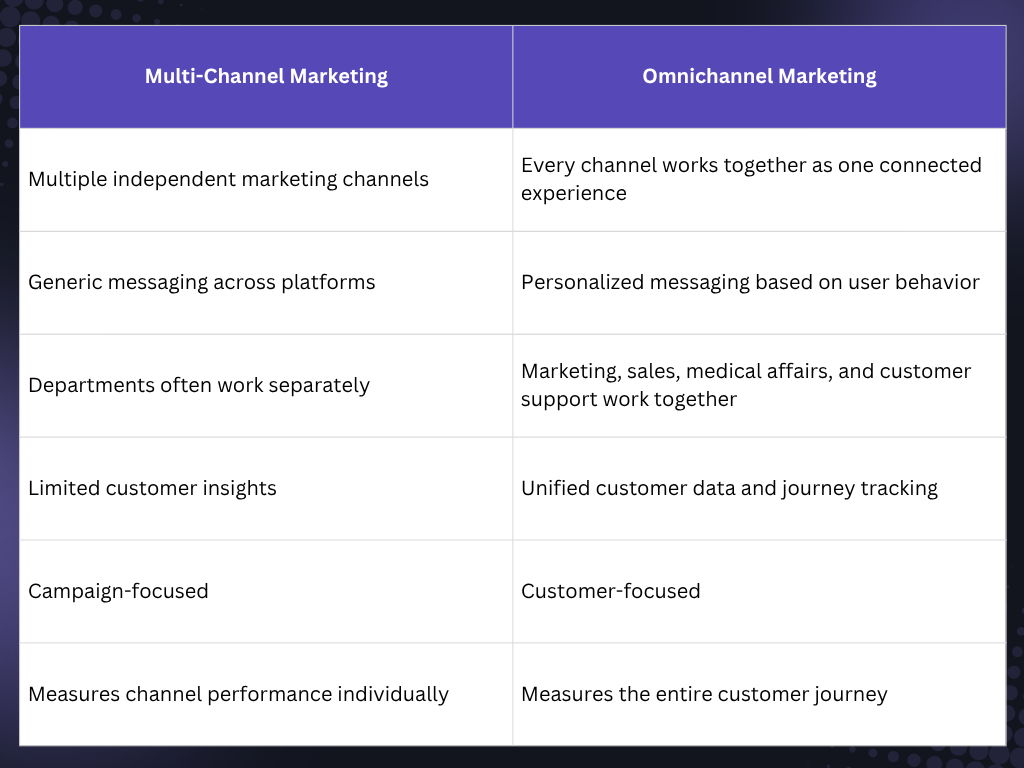
Understanding this difference is critical for pharmaceutical leaders planning future marketing investments.
Multi-Channel Marketing | Omnichannel Marketing |
Multiple independent marketing channels | Every channel works together as one connected experience |
Generic messaging across platforms | Personalized messaging based on user behavior |
Departments often work separately | Marketing, sales, medical affairs, and customer support work together |
Limited customer insights | Unified customer data and journey tracking |
Campaign-focused | Customer-focused |
Measures channel performance individually | Measures the entire customer journey |
The difference may seem subtle, but its business impact is significant.
Organizations adopting omnichannel strategies often improve customer engagement because every interaction feels more relevant, timely, and valuable.
Why Omnichannel Marketing Matters in the Pharmaceutical Industry
Healthcare purchasing decisions rarely happen after a single interaction.
A physician may first hear about your organization during an industry conference.
Weeks later, they may search Google for additional information.
Later, they attend one of your educational webinars.
A few days afterward, they download a clinical resource from your website.
Eventually, they schedule a meeting with your sales team.
From the customer’s perspective, this should feel like one continuous experience-not five disconnected interactions.
If every touchpoint repeats the same generic information or lacks context, trust begins to erode.
When each interaction builds naturally on previous engagement, customers feel understood rather than marketed to.
A Real-World Example of Omnichannel Pharma Marketing
Imagine a biotechnology company launching an innovative oncology therapy.
Instead of relying only on sales representatives, the company creates a connected marketing journey.
Step 1: Awareness
An oncologist discovers a research-based article through Google discussing recent advances in cancer treatment.
The article references emerging therapies while remaining educational and evidence-driven.
Step 2: Engagement
Interested in learning more, the physician downloads a clinical whitepaper after completing a short registration form.
Rather than immediately promoting the product, the whitepaper focuses on research findings, patient outcomes, and current treatment challenges.
Step 3: Education
Over the following weeks, the physician receives several educational emails containing:
- Clinical updates
- Webinar invitations
- Expert interviews
- Newly published research
- Conference highlights
Every email expands upon the previous interaction instead of repeating promotional messaging.
Step 4: Personal Interaction
The physician attends a webinar where industry experts discuss treatment innovations and answer questions.
Following the webinar, a medical science liaison reaches out with additional scientific resources tailored to the physician’s area of interest.
Step 5: Ongoing Relationship
Months later, the physician continues receiving relevant educational updates, new clinical evidence, and invitations to future events.
By the time a commercial discussion occurs, the organization has already established credibility through multiple meaningful interactions.
This is omnichannel marketing in action.
The relationship develops gradually through trust rather than pressure.
The Modern Pharmaceutical Customer Journey
Understanding how people make decisions is far more important than simply increasing marketing activity.
Today’s healthcare professionals rarely follow a straight path from awareness to purchase.
Instead, they move back and forth between different information sources before making decisions.
A simplified customer journey often looks like this:
Stage | Customer Questions | Recommended Marketing Activities |
Awareness | Who are you? | SEO, educational blogs, PR, LinkedIn, conferences |
Consideration | Can I trust your expertise? | Whitepapers, webinars, research, case studies |
Evaluation | Why should I choose your organization? | Product comparisons, clinical evidence, demos |
Decision | Is this the right solution? | Sales consultations, ROI discussions, implementation support |
Retention | How can we continue working together? | Customer education, newsletters, product updates |
Organizations that support every stage of this journey consistently outperform those focused only on lead generation.
Personalization Is Becoming an Industry Standard
Healthcare professionals receive hundreds of marketing messages every week.
Generic communication is increasingly ignored.
Modern pharmaceutical marketing uses data responsibly to deliver more relevant experiences.
For example:
A cardiologist should receive cardiovascular research rather than oncology updates.
A hospital procurement manager may prefer pricing insights and supply chain information.
Researchers are more likely to engage with scientific publications than product brochures.
Personalization doesn’t necessarily mean collecting more data.
It means using existing information more effectively.
When organizations deliver content aligned with each audience’s interests, engagement naturally improves.
Marketing Automation: Scaling Without Losing the Human Touch
As pharmaceutical organizations grow, manually managing every customer interaction becomes nearly impossible.
Marketing automation helps streamline communication while maintaining consistency.
Automation can support:
- Email nurturing campaigns
- Webinar reminders
- Lead qualification
- Educational content recommendations
- Event follow-ups
- Customer onboarding
- Product update notifications
The key is remembering that automation should enhance relationships-not replace them.
Poor automation creates spam.
Effective automation delivers timely, relevant information that genuinely helps the audience.
Why Data Should Drive Every Marketing Decision
One of the biggest mistakes leadership teams make is relying on assumptions rather than evidence.
Questions like these should always have measurable answers:
- Which marketing channels generate qualified leads?
- Which content influences purchasing decisions?
- Which webinars drive the highest engagement?
- Which physicians regularly interact with educational resources?
- Which campaigns contribute to revenue growth?
- Which topics attract the most organic search traffic?
Without reliable data, marketing becomes guesswork.
With accurate analytics, organizations can invest confidently in initiatives that deliver measurable business value.
The KPIs That Actually Matter
Many pharmaceutical organizations celebrate metrics that have little connection to business performance.
High website traffic may look impressive.
Large social media followings may appear successful.
But neither guarantees commercial growth.
Leadership teams should focus on metrics that align with strategic objectives.
Examples include:
Business Growth Metrics
- Qualified marketing leads
- Sales-qualified opportunities
- Customer acquisition cost
- Marketing-attributed revenue
- Return on marketing investment
- Customer lifetime value
Digital Performance Metrics
- Organic search visibility
- AI search visibility
- Content engagement
- Webinar registrations
- Email engagement
- Landing page conversion rates
Trust and Authority Metrics
- Returning website visitors
- Branded search growth
- Industry backlinks
- Speaking invitations
- Research citations
- Healthcare publication mentions
These indicators provide a far clearer picture of marketing effectiveness than vanity metrics alone.
Common Mistakes That Hold Pharma Marketing Back
Even organizations with substantial budgets can struggle if their strategy is built on outdated assumptions.
Below are some of the most common issues we see across the industry.
Mistake 1: Treating Marketing as a Cost Instead of a Growth Function
Marketing is often viewed as a support department rather than a strategic growth driver.
When marketing is excluded from business planning, campaigns become reactive instead of proactive.
The strongest organizations involve marketing in product planning, market expansion, customer research, and long-term growth strategy.
Mistake 2: Publishing Content That Talks About the Company Instead of the Customer
Many pharmaceutical websites contain pages filled with product specifications and company achievements.
While these details have value, they rarely answer the questions potential customers are asking.
Instead, organizations should focus on solving problems, explaining complex topics clearly, and sharing practical insights that support better decision-making.
Educational content earns attention.
Promotional content often loses it.
Mistake 3: Ignoring Search Intent
Not every visitor is ready to speak with a sales representative.
Some are researching treatment options.
Others are comparing suppliers.
Some simply want to understand a medical concept.
Publishing content that addresses every stage of this journey dramatically improves long-term visibility and engagement.
Mistake 4: Measuring Success Too Early
One of the most common leadership frustrations is expecting immediate returns from long-term marketing initiatives.
SEO, thought leadership, and educational content require consistency.
Organizations that stop after a few months often abandon strategies just before they begin producing meaningful results.
Sustainable growth comes from building long-term authority rather than chasing short-term spikes in visibility.
Mistake 5: Treating AI Search as an Afterthought
Many pharmaceutical companies still optimize exclusively for traditional search engines.
However, healthcare professionals are increasingly using AI-powered platforms to research treatments, summarize clinical topics, and compare vendors.
Brands that publish comprehensive, structured, authoritative content are far more likely to appear in AI-generated responses.
Preparing for this shift today creates a competitive advantage for the years ahead.
Leadership Perspective: Marketing Is Becoming a Competitive Asset
Forward-thinking pharmaceutical organizations no longer see marketing as simply a way to promote products.
They recognize it as a business capability that influences brand perception, customer trust, physician engagement, commercial growth, and long-term market leadership.
Companies that educate consistently, embrace digital transformation, and create connected customer experiences will be better positioned to adapt as healthcare continues to evolve.
The question is no longer whether pharmaceutical companies should modernize their marketing.
The question is how quickly they can do it before competitors establish stronger digital authority.
What Is Market Access in Pharma?
One of the most misunderstood terms in the pharmaceutical industry is market access.
Many business owners assume it refers to marketing or selling pharmaceutical products. In reality, market access is a completely different business function.
While pharma marketing creates awareness, builds trust, and generates demand, market access focuses on ensuring that a medicine can actually reach patients by securing approval, reimbursement, pricing acceptance, and adoption within healthcare systems.
In simple terms:
Marketing helps people discover your product. Market access helps people obtain your product.
Both functions are essential, but they solve different business challenges.
A Simple Example
Imagine a pharmaceutical company has developed an innovative therapy that has successfully completed clinical trials.
The product receives regulatory approval and is ready for commercialization.
Does that automatically mean hospitals will purchase it?
Not necessarily.
Several important questions still need to be answered:
- Will insurance providers reimburse the treatment?
- Do healthcare systems consider it cost-effective?
- Have hospital formularies approved its use?
- Does the pricing align with market expectations?
- Can physicians easily prescribe it within existing guidelines?
Answering these questions is the responsibility of the market access team, not the marketing department.
Without a successful market access strategy, even an outstanding product may struggle to reach the patients who could benefit from it.
Market Access vs. Pharma Marketing
Although these functions often work closely together, they have different objectives.
Pharma Marketing | Market Access |
Builds awareness and trust | Secures product availability |
Educates healthcare professionals | Engages payers, regulators, and healthcare systems |
Generates demand | Enables reimbursement and adoption |
Supports commercial growth | Supports patient access and market availability |
Focuses on communication | Focuses on pricing, value, and healthcare policy |
Think of it this way:
Marketing opens the conversation.
Market access removes the barriers that prevent adoption.
Organizations that align both functions typically achieve stronger commercial outcomes than those treating them as separate initiatives.
Why Business Leaders Should Care About Market Access
For executives, market access isn’t just a regulatory process-it has a direct impact on revenue, market expansion, and long-term competitiveness.
A delayed reimbursement decision can postpone product adoption for months.
Poor pricing strategy can limit market penetration.
Insufficient clinical value communication can reduce physician confidence.
Strong collaboration between commercial, medical, and market access teams helps organizations launch products more effectively and scale with greater confidence.
Where Digital Marketing Supports Market Access
Digital marketing cannot replace market access, but it can significantly strengthen it.
Educational content helps stakeholders understand the clinical value of a therapy.
Thought leadership builds confidence among healthcare professionals.
Search visibility makes scientific resources easier to discover.
Webinars encourage dialogue around emerging treatments.
Research summaries improve knowledge sharing.
Interactive resources simplify complex medical information.
When these activities are aligned with market access objectives, organizations create stronger awareness while supporting informed decision-making across the healthcare ecosystem.
Why SEO Has Become Essential for Pharmaceutical Companies
Many pharmaceutical organizations still think of SEO as a tactic designed primarily to increase website traffic.
In reality, modern SEO is about making trustworthy healthcare information accessible whenever people search for answers.
Whether someone is looking for treatment information, clinical research, pharmaceutical partners, or healthcare technology, search engines often represent the first point of contact.
If your organization cannot be found during those moments, you’re missing opportunities long before a sales conversation begins.
Modern Pharmaceutical SEO Is Built Around Trust
Healthcare belongs to one of the most scrutinized content categories online.
Search engines evaluate medical content more rigorously because inaccurate information can have real-world consequences.
This means pharmaceutical organizations must prioritize quality over quantity.
Successful healthcare SEO focuses on:
- Evidence-based content
- Clear explanations
- Expert authorship
- Transparent sourcing
- Accurate medical information
- User-focused experiences
- Strong website performance
- Structured content
Organizations that consistently demonstrate expertise and credibility are more likely to earn long-term visibility.
The Future of Search Is No Longer Just Google
Search behavior is changing rapidly.
Instead of clicking through multiple websites, many professionals now ask AI-powered platforms for immediate answers.
Healthcare executives increasingly use AI tools to explore topics such as:
- Emerging pharmaceutical trends
- Drug development
- Regulatory changes
- Digital transformation
- Healthcare technology
- Pharmaceutical marketing strategies
These platforms generate responses by evaluating high-quality sources rather than simply displaying ranked web pages.
As a result, organizations must optimize content for both traditional search engines and AI-driven discovery experiences.
Building Content for AI Search
Creating AI-friendly content doesn’t require writing for machines.
It requires writing exceptionally well for people.
Content that performs well across AI platforms typically shares several characteristics.
It Answers Real Questions
Instead of focusing only on keywords, successful content answers complete questions that business leaders and healthcare professionals are already asking.
Examples include:
- What is omnichannel marketing in pharma?
- How can pharmaceutical companies improve physician engagement?
- Why do pharmaceutical websites struggle to generate leads?
- What metrics should healthcare executives monitor?
Directly answering these questions improves clarity for both readers and AI systems.
It Demonstrates Expertise
Healthcare audiences expect accuracy.
Publishing superficial articles filled with generic advice rarely creates authority.
Instead, organizations should include:
- Industry insights
- Practical recommendations
- Business examples
- Clinical context
- Original perspectives
- Leadership experience
Expertise is demonstrated through the depth and usefulness of the information provided-not through complicated language.
It Uses Clear Structure
Well-organized content is easier for both people and AI systems to understand.
Effective pharmaceutical articles typically include:
- Descriptive headings
- Logical sections
- Comparison tables
- Frequently Asked Questions
- Definitions
- Summaries
- Practical examples
Clear organization improves readability while increasing the likelihood of appearing in featured snippets and AI-generated summaries.
Understanding EEAT in Healthcare
Google introduced the concept of Experience, Expertise, Authoritativeness, and Trustworthiness (EEAT) to help evaluate content quality.
For pharmaceutical organizations, EEAT isn’t an optional SEO technique.
It’s a business requirement.
Let’s look at each element.
Experience
Readers want practical insights from organizations that understand the healthcare industry.
Share real-world examples, implementation challenges, and lessons learned rather than relying on generic advice.
Expertise
Medical and pharmaceutical content should demonstrate a deep understanding of the subject.
Whenever appropriate, involve qualified subject matter experts, reference credible evidence, and explain complex topics in a way that remains accurate and understandable.
Authoritativeness
Authority develops over time through consistent publishing, research contributions, industry recognition, partnerships, and high-quality educational resources.
Organizations become trusted references by repeatedly providing value.
Trustworthiness
Trust influences every stage of the customer journey.
Visitors should immediately recognize that your organization values transparency.
Provide clear company information, accurate claims, accessible contact details, privacy policies, and well-maintained content.
Trust is earned through consistency-not marketing slogans.
Creating a Content Ecosystem Instead of Individual Blog Posts
One of the biggest opportunities in pharmaceutical marketing is shifting from isolated content creation to building an interconnected knowledge hub.
Instead of publishing unrelated articles, organize content around major themes.
For example:
Pillar Topic
Pharma Marketing
Supporting articles might include:
- What Is Omnichannel Marketing in Pharma?
- What Is Market Access in Pharma?
- Digital Marketing for Pharmaceutical Companies
- Healthcare SEO Best Practices
- AI in Pharmaceutical Marketing
- Measuring Pharma Marketing ROI
- Pharmaceutical Website Design Best Practices
- Common Challenges in Pharma Commercialization
- Content Marketing for Life Sciences Companies
Each article supports the others through strategic internal linking.
This structure helps readers explore topics naturally while strengthening topical authority for search engines and AI platforms.
Why Health Information Publishers Need Specialized Pharma Marketing
Health information publishers occupy a unique position within the healthcare ecosystem.
Unlike pharmaceutical manufacturers, their primary goal is not selling treatments.
Their value lies in publishing credible, educational, and accessible healthcare information.
However, many publishers face similar digital challenges:
- Organic traffic has become increasingly competitive.
- AI-generated summaries are changing user behavior.
- Traditional display advertising revenues continue to decline.
- Trust and authority now matter more than publishing volume.
- Readers expect deeper, evidence-based content.
To remain competitive, publishers need marketing strategies that go beyond increasing page views.
They need to become trusted destinations for healthcare knowledge.
Common Growth Challenges for Health Information Publishers
Many publishers produce excellent content but struggle to transform readership into sustainable business growth.
Some of the most common obstacles include:
Declining Organic Visibility
Publishing more articles doesn’t automatically improve search performance.
Without a structured content strategy, topical authority becomes difficult to establish.
Weak Brand Recognition
Readers may consume individual articles without remembering who published them.
Strong branding, consistent messaging, and expert-led content help publishers become recognized industry resources.
Limited Audience Engagement
Traffic alone isn’t enough.
Organizations should encourage newsletter subscriptions, webinar registrations, community participation, downloadable resources, and repeat visits.
Long-term engagement creates significantly more business value than one-time page views.
Difficulty Demonstrating Expertise
Healthcare audiences expect information they can trust.
Publishers that collaborate with medical experts, cite reputable sources, and maintain editorial transparency are better positioned for long-term success.
How the Right Pharma Marketing Agency Can Help
Many pharmaceutical companies and health information publishers have talented internal teams.
However, executing a comprehensive digital growth strategy requires specialized expertise across multiple disciplines.
An experienced pharma marketing agency can help organizations:
- Build long-term SEO strategies
- Improve AI search visibility
- Develop educational content ecosystems
- Increase qualified lead generation
- Strengthen thought leadership
- Optimize websites for conversions
- Implement marketing automation
- Improve analytics and reporting
- Support international expansion
- Create omnichannel marketing strategies
The right agency doesn’t simply deliver campaigns.
It becomes a strategic partner focused on measurable business outcomes.
A Leadership Perspective
The pharmaceutical industry is entering a new era where scientific innovation alone is no longer enough to guarantee commercial success.
Organizations must also compete for digital visibility, customer trust, thought leadership, and AI discoverability.
The companies that invest today in educational content, search optimization, connected customer experiences, and long-term authority will be better prepared for tomorrow’s healthcare landscape.
Marketing is no longer just a communication function.
It has become a strategic business capability that influences growth, reputation, and competitive advantage.
What's the Best Pharma Marketing Agency for Health Information Publishers?
This is one of the most common questions healthcare publishers ask when they’re ready to scale their digital presence.
The answer isn’t simply the agency with the biggest portfolio or the most recognizable clients.
The best pharma marketing agency is the one that understands the unique challenges of the healthcare industry and can balance growth, compliance, credibility, and measurable business outcomes.
Health information publishers operate differently from pharmaceutical manufacturers.
Their success depends on becoming trusted sources of healthcare knowledge while simultaneously growing readership, attracting commercial partnerships, increasing subscriptions, and strengthening their digital authority.
That requires far more than traditional digital marketing.
It requires a strategic partner who understands both healthcare content and modern search behavior.
What Should You Look for in a Pharma Marketing Agency?
Not every digital marketing agency is equipped to work in regulated industries.
Healthcare and pharmaceutical organizations should evaluate agencies based on their ability to combine technical expertise with industry understanding.
Here are some of the qualities that matter most.
Industry Knowledge
Healthcare audiences expect accuracy.
An agency should understand the language, challenges, and decision-making processes within pharmaceutical and life sciences organizations.
This doesn’t necessarily mean having medical professionals on staff, but it does mean knowing how to communicate complex topics clearly and responsibly.
Strong SEO and AI Search Expertise
Search is evolving rapidly.
Your agency should understand how to optimize content not only for Google but also for AI-powered discovery platforms.
This includes:
- Search intent optimization
- Structured content
- Topic clusters
- Internal linking
- Schema implementation
- Answer Engine Optimization (AEO)
- Generative Engine Optimization (GEO)
- AI-friendly content architecture
Organizations that ignore these developments risk losing visibility as search behavior continues to evolve.
Content Strategy Before Content Production
Publishing more articles doesn’t automatically create authority.
An experienced agency starts with strategy.
That means identifying:
- Audience needs
- Business goals
- Content gaps
- Competitor opportunities
- Search demand
- Conversion opportunities
Every piece of content should have a clear purpose within a larger knowledge ecosystem.
Data-Driven Decision Making
Marketing should be measured against business outcomes-not assumptions.
A reliable agency helps leadership understand:
- Which channels generate qualified opportunities
- Which content drives conversions
- Which campaigns influence revenue
- Where customers drop off
- What should be improved next
Transparent reporting builds confidence and supports better strategic decisions.
Long-Term Partnership
The best agencies don’t focus only on delivering monthly tasks.
They contribute ideas, identify new opportunities, monitor market trends, and continuously refine strategy based on performance.
As the pharmaceutical industry evolves, your marketing strategy should evolve with it.
Questions Every Business Leader Should Ask Before Hiring a Pharma Marketing Agency
Before making a decision, ask potential partners questions like these:
- How do you approach healthcare and pharmaceutical marketing differently from other industries?
- How do you ensure content remains accurate, trustworthy, and user-focused?
- What is your approach to SEO in highly regulated industries?
- How do you prepare content for AI-powered search?
- How do you measure marketing success beyond traffic?
- What reporting and analytics do you provide?
- Can you demonstrate long-term growth rather than short-term campaign performance?
- How do you align marketing with business objectives?
The answers will often reveal whether the agency thinks strategically or simply executes predefined tasks.
Pharma Marketing Checklist for Business Leaders
Whether you’re building an internal marketing team or working with an external agency, this checklist can help evaluate your current strategy.
Strategy
✔ Clearly defined marketing objectives
✔ Audience segmentation
✔ Competitive analysis
✔ Customer journey mapping
✔ Omnichannel strategy
Website
✔ Fast loading pages
✔ Mobile-first experience
✔ Clear conversion paths
✔ Strong calls to action
✔ Educational resource center
✔ Technical SEO implementation
Content
✔ Topic clusters
✔ Pillar pages
✔ Industry insights
✔ Research-backed articles
✔ Executive thought leadership
✔ Case studies
✔ Frequently Asked Questions
Search Optimization
✔ Keyword research
✔ Search intent optimization
✔ Internal linking
✔ Structured data
✔ AI search optimization
✔ Featured snippet opportunities
Analytics
✔ Conversion tracking
✔ Marketing dashboards
✔ ROI measurement
✔ Attribution reporting
✔ Customer journey analytics
Authority
✔ Expert contributors
✔ Industry partnerships
✔ Research publications
✔ Speaking engagements
✔ Brand mentions
✔ Digital PR
Future Trends Shaping Pharma Marketing
The pharmaceutical industry is entering one of its most significant periods of transformation.
Several trends are expected to redefine how organizations engage with healthcare professionals, business leaders, and patients over the coming years.
AI Will Become Part of Every Customer Journey
Artificial intelligence is already changing how people search for information, compare providers, summarize research, and evaluate solutions.
Organizations that create clear, authoritative, and structured content will be better positioned to appear in AI-generated recommendations.
Personalization Will Continue to Expand
Generic marketing campaigns will become increasingly ineffective.
Healthcare professionals expect communication that reflects their interests, specialties, and information needs.
Organizations capable of delivering personalized educational experiences at scale will build stronger long-term relationships.
First-Party Data Will Become More Valuable
As privacy regulations continue evolving, organizations will rely more heavily on their own customer relationships.
Newsletters, educational platforms, webinars, professional communities, and gated resources will become increasingly important sources of audience insights.
Educational Content Will Outperform Promotional Messaging
Healthcare audiences consistently reward organizations that provide genuine value.
The companies that become trusted educators rather than constant promoters will strengthen both customer relationships and search visibility.
AI Search Optimization Will Become a Competitive Requirement
Visibility will increasingly depend on how well organizations structure information for AI systems.
Comprehensive guides, well-organized FAQs, clear definitions, comparison tables, and evidence-based content will become even more important.
Final Thoughts
Pharma marketing has evolved far beyond traditional advertising.
Today’s pharmaceutical organizations compete in an environment where trust, expertise, digital visibility, and customer experience are just as important as scientific innovation.
Healthcare professionals expect educational resources rather than promotional messaging.
Business leaders expect measurable return on investment rather than vanity metrics.
Search engines and AI platforms increasingly prioritize organizations that consistently publish accurate, comprehensive, and user-focused information.
The companies that succeed over the next decade won’t necessarily be those with the largest marketing budgets.
They’ll be the ones that invest in understanding their audience, educating consistently, embracing digital transformation, and building long-term authority across every customer touchpoint.
Whether you’re a pharmaceutical company launching a new therapy, a healthcare technology provider expanding into new markets, or a health information publisher seeking sustainable growth, the principles remain the same:
Build trust first. Educate consistently. Measure what matters. Optimize for people before platforms.
That’s the foundation of successful pharma marketing in 2026 and beyond.
Conclusion
The future of pharmaceutical marketing belongs to organizations that lead with knowledge rather than promotion. By combining scientific credibility with modern digital strategies, businesses can strengthen relationships with healthcare professionals, improve search visibility, and create lasting competitive advantages.
As search engines and AI platforms continue to prioritize comprehensive, trustworthy, and user-focused content, pharmaceutical companies and health information publishers have an opportunity to stand out-not by producing more content, but by producing better content.
Organizations that embrace this mindset today will be better positioned to earn trust, increase visibility, and achieve sustainable growth in the years ahead.


Boost Your Brand Visibility 🚀
Get personalized digital strategies that drive growth and engagement.
Let’s Talk📬 Stay Updated
Get the latest insights and guides delivered right to your inbox.
🔗 Related Topics
- Loading related posts...