Your marketing problem:
is not marketing - it's misalignment.

Why the smartest companies in 2026 have stopped fixing their marketing and started fixing themselves.
- 1Most businesses blame marketing when revenue stalls - but in reality, the issue is deeper: strategic misalignment.
- 2The “Misalignment Tax” is the hidden cost created by the gap between your internal strategy and external messaging.
- 3Scaling a broken message doesn’t fix growth - it amplifies inefficiency and wasted spend.
- 4Real alignment starts at the top - CEO, sales, and marketing must operate with one unified narrative.
- 5A simple five-question Alignment Audit can quickly expose where your growth is breaking.
You have hired agencies. Run campaigns. Refreshed the website. Posted consistently on LinkedIn. Invested in ads that generate clicks but not clients. And yet – revenue feels stuck.
The natural response is to blame the marketing. The copy was not sharp enough. The funnel needed work. The agency did not understand your industry. So you try a new agency. A new channel. A new strategy. The cycle repeats – and nothing changes.
Here is the truth that almost no marketer will say out loud: the problem is almost never the marketing. |
The problem is misalignment – and it runs deeper than most business owners realise. It lives between your sales team and your marketing team. Between your offer and your audience. Between your leadership’s vision and the message that reaches the market. Between what you think you are selling and what your buyers actually want to buy.
Marketing cannot fix a misalignment problem. Better campaigns cannot fix a misalignment problem. Only clarity – at the leadership level – can.
This is what Mindcentrix calls the Misalignment Tax: the invisible cost businesses pay every single month for the gap between their internal strategy and their external message. In 2026, that tax is higher than it has ever been – and most companies are paying it without knowing it exists.
What misalignment actually looks like
Misalignment is not obvious. It does not announce itself. It hides inside activity – inside full content calendars, campaign dashboards, and monthly agency reports. Here are the four faces of the Misalignment Tax:
- Sales and marketing are telling different stories.
Your marketing team is promoting one value proposition. Your sales team is pitching a slightly different one. Buyers hear two versions of your brand and trust neither. This is not a communication failure – it is a strategy failure that marketing alone cannot solve.
- Your message is built around your offer, not your buyer’s problem.
Most B2B marketing talks about the company: our process, our methodology, our results. Buyers do not care about your process. They care about their problem. Until your messaging is built around the exact language your buyers use to describe their own pain, you will keep generating interest without generating revenue.
- Your marketing is targeting the wrong version of your ideal client.
ICP (Ideal Customer Profile) drift is one of the most expensive silent problems in B2B. Your company evolved. Your best clients changed. But your marketing is still targeting the client you had three years ago – not the client who creates the most value today.
- Leadership’s vision has not been translated into market-facing language.
The founder or CEO has a clear vision for what the business stands for. But that vision lives in their head – or in a strategy document – and never makes it into the messaging or the conversations the sales team is having. The result: a brand that looks generic even when the thinking behind it is exceptional.
Misalignment is not a marketing problem. It is a leadership problem wearing a marketing costume. |
Why most companies keep solving the wrong problem
When revenue stalls, the instinct is to increase marketing activity. More content. More ads. More outreach. More budget. This is an entirely understandable response, and it almost always makes the problem worse.
If your messaging is misaligned, scaling that messaging does not amplify your results. It amplifies the misalignment. You reach more people with the wrong story. You attract more leads who are not the right fit. You generate more activity that does not convert.
The Misalignment Tax compounds. Every rupee spent on marketing a misaligned message is not just wasted – it actively works against you, because it trains your market to see you in the wrong way.
The Misalignment Trap A company notices revenue is flat. They hire a new marketing agency. The agency runs campaigns based on the existing strategy – which is misaligned. Campaigns underperform. The company blames the agency. They hire a new one. The cycle repeats, sometimes for years, without anyone asking the foundational question: Is our strategy actually aligned with what our market wants and needs? |
The companies that break this cycle are not the ones who found a better agency. They are the ones who paused – and did the harder work of diagnosing the misalignment before spending another rupee on marketing.

Get an Expert Google Ads Audit for Your Business
Uncover wasted spend, fix performance gaps, and scale ROI with certified Google Ads specialists.
The Mindcentrix Alignment Audit: five questions that reveal your real growth problem
Before you change your campaigns, your channels, or your creative – run this diagnostic. Answer honestly. These five questions reveal misalignment at the root level, not the symptom level.
Q1: Can every person in your company describe your value proposition in one sentence – and do they all say the same thing?
If the answer is no, or if you are not sure, you have a misalignment problem. Your company’s core promise must be so clear that it sounds identical whether it comes from the CEO, the sales team, or the most junior person in marketing.
Q2: Is your messaging built around the words your buyers use, or the words your leadership prefers?
Pull the last three proposals, pitches, or sales calls. Look at the language used. Now look at your marketing. Do they use the same words, describe the same problems, and speak to the same fears? If they do not, your marketing and your sales process are operating in parallel, not in alignment.
Q3: Who is your ideal client today, not who they were when you wrote your last strategy document?
Your market has shifted. Your own capabilities have evolved. The clients who generate the most revenue, the most referrals, and the most satisfaction today – do they look like the clients your marketing is designed to attract? If not, you have ICP drift. And no amount of better creative will fix it.
Q4: Is your brand’s point of view clearly stated – and does it appear in every customer-facing touchpoint?
Thought leadership is not content. It is a specific, held, defensible point of view about your industry, your market, and the problem you solve. If you removed your logo from your website and your content, could a reader tell who you are and what you stand for? If not, your brand has no real positioning – only presence.
Q5: Does your leadership team make strategic marketing decisions – or do they delegate marketing entirely and rarely think about it?
This is the most revealing question. In companies with strong marketing results, leadership is deeply involved in strategy, messaging, and positioning. In companies with flat marketing results, leadership treats marketing as a department that runs itself. Marketing is a leadership function. It cannot be fully delegated without consequences.
Scoring Your Audit If you answered ‘no’ or ‘not sure’ to 1 question: Minor misalignment, addressable with messaging work. If you answered ‘no’ to 2-3 questions: Moderate misalignment, requires a strategy review with leadership. If you answered ‘no’ to 4-5 questions: Significant misalignment, your marketing spend is actively working against you. Stop, diagnose, rebuild. |
What alignment actually looks like in practice
When a business achieves genuine strategic alignment, something remarkable happens: marketing starts working without trying harder. Not because the campaigns suddenly got cleverer, but because the message is now true – true to the market’s actual problem, true to the company’s actual capability, and true to the leadership’s actual vision.
Here is what that looks like on the ground:
- Sales and marketing are using the same language and telling the same story, because that story was built together, at the leadership level.
- Content is not produced to fill a calendar. It is produced to answer the exact questions that appear in every sales conversation, which means prospects arrive pre-sold, pre-educated, and already trusting.
- The ICP is reviewed quarterly, not annually. As the business evolves, so does the target — which means the market never receives messaging designed for a version of the client that no longer exists.
- The founder or CEO’s voice is present in the brand, not as a personality cult, but as a clear point of view that only this company holds. Buyers know not just what you do, but how you think. And that thinking is the reason they choose you.
- Marketing is measured by revenue outcomes, not activity metrics. Not posts published, not impressions generated, not leads counted, but qualified pipeline created and clients converted.
Alignment is not a marketing project. It is a strategic decision that starts at the top of the organisation, and changes everything below it. |
Three things to do before you spend another rupee on marketing
If this article has diagnosed something familiar, if you recognize the Misalignment Tax in your own business, here is where to start:
- Stop all non-essential marketing spend. Temporarily.
Not permanently. Until you have done the alignment work. Every day you run misaligned marketing, you are spending money to build the wrong brand in your market. Pause. Diagnose. Then rebuild with intention.
- Run the Alignment Audit with your full leadership team, not just the marketing team.
The biggest mistake in fixing misalignment is treating it as a marketing department problem. It is not. Bring the CEO, the sales lead, the delivery lead, and the marketing lead into the same room. Answer the five questions together. The disagreements in those answers are your misalignment, made visible.
- Rebuild your messaging from the outside in, starting with your best clients.
Speak to five of your best-fit clients this week. Ask them: What problem were you trying to solve when you found us? What made you choose us over others? What would you tell a peer who was considering us? Their language is your new marketing strategy. Use their exact words. Address their exact problems. You will attract more people exactly like them.
The bottom line
You do not have a marketing problem.
You have a clarity problem, and clarity is a leadership discipline, not a creative one.
The businesses that will grow in 2026 and beyond are not the ones with the biggest marketing budgets or the most sophisticated campaigns. They are the ones whose leadership has done the hard, unglamorous work of getting brutally honest about who they are, who they serve, and what they uniquely offer, and then aligned everything, inside and outside the business, around that clarity.
That is what Mindcentrix exists to help you build.
Not more marketing. More alignment.
Quick Recap: Key Takeaways
- The Misalignment Tax is the invisible monthly cost of the gap between your internal strategy and your external message. Most companies are paying it without realising it.
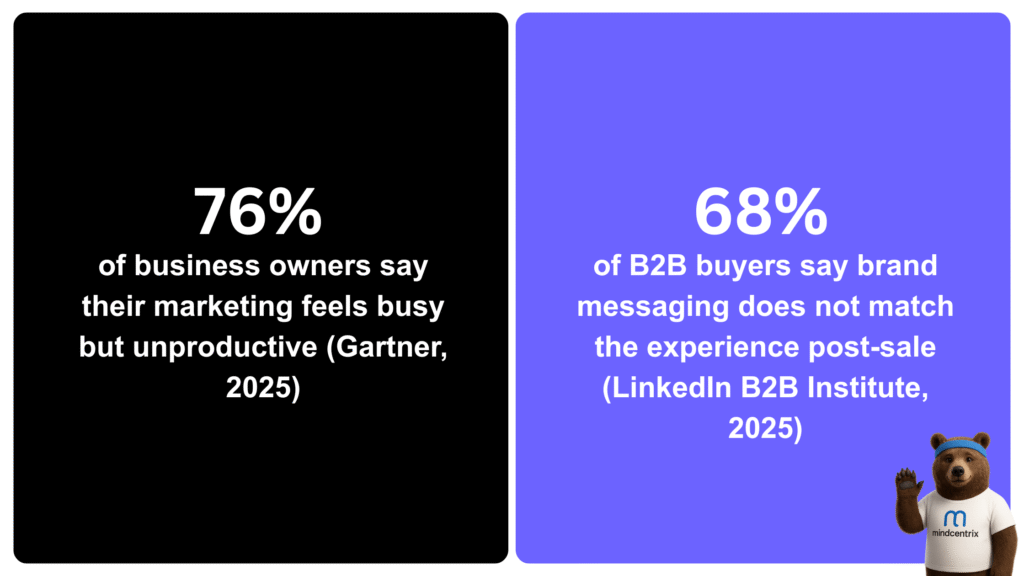
- 76% of business owners say their marketing feels busy but unproductive. 68% of buyers say brand messaging does not match their experience post-sale.
- The four faces of misalignment: disconnected sales-marketing stories, offer-led messaging, ICP drift, and untranslated leadership vision.
- Scaling misaligned marketing does not fix the problem, it amplifies it. More spend on a misaligned message builds the wrong brand faster.
- Alignment requires leadership involvement, it cannot be fixed by the marketing team alone.
- Run the five-question Mindcentrix Alignment Audit before spending another rupee on campaigns.
- Three actions to start today: pause non-essential spend, run the audit with leadership, rebuild messaging from your best clients’ words.
We do not focus on adding more marketing. We focus on making your existing strategy, messaging, and execution actually work together. Because when your leadership, your sales, and your market narrative are aligned — growth stops being unpredictable and starts becoming repeatable.


Boost Your Brand Visibility 🚀
Get personalized digital strategies that drive growth and engagement.
Let’s Talk📬 Stay Updated
Get the latest insights and guides delivered right to your inbox.
🔗 Related Topics
- Loading related posts...