Healthcare Website Design Company:
The Executive Guide

- 1Build confidence within seconds of a visitor arriving.
- 2Simplify the patient journey from search to appointment.
- 3Demonstrate clinical expertise and organizational credibility.
- 4Support AI search engines with structured, authoritative content.
- 5Generate measurable business outcomes through patient acquisition, retention, and operational efficiency.
This fundamental shift has changed the role of healthcare websites. They are no longer digital brochures—they are digital trust platforms.
Organizations that continue treating their website as a design project risk losing visibility, patient trust, and market share to competitors investing in digital transformation. This guide explains how healthcare executives can evaluate, plan, and build websites that perform not only in traditional search engines but also across AI-powered discovery platforms shaping the future of healthcare marketing.
The Executive Perspective: Your Website Has Become Your Second Hospital Lobby
Healthcare executives spend millions improving patient experiences inside their facilities.
They redesign waiting rooms.
Invest in medical technologies.
Hire exceptional clinicians.
Improve operational workflows.
Yet many organizations overlook the very first place patients interact with their brand.
Their website.
Today’s patient journey rarely begins with a referral letter or a phone call.
It begins with a search.
A parent searching for a pediatrician.
A family comparing orthopedic surgeons.
A patient researching treatment options after receiving a diagnosis.
A healthcare executive evaluating specialists for a partnership.
Every one of these journeys begins digitally.
The first impression patients develop is no longer formed by your physicians.
It is formed by your website.
Researchers at Carleton University found that users form visual impressions of a website in approximately 50 milliseconds. While trust in healthcare ultimately depends on clinical outcomes, those first milliseconds strongly influence whether users perceive an organization as modern, credible, and professional.
Healthcare leaders should therefore view website investments through the same strategic lens as facility improvements.
Both influence patient confidence.
One simply happens much earlier.
Healthcare Is Entering the AI Discovery Era
For over two decades, healthcare organizations optimized websites primarily for Google’s traditional search results.
That model is changing.
Today’s patients increasingly receive answers from:
- Google AI Overviews
- Conversational AI assistants
- Voice search
- Large Language Models (LLMs)
- Intelligent recommendation systems
Instead of clicking ten search results, patients increasingly receive summarized recommendations generated from multiple trusted sources.
The question has therefore evolved.
Healthcare organizations are no longer asking:
“How do we rank on Google?”
They are asking:
“Will AI recommend our organization when patients ask for trusted healthcare providers?”
Those are fundamentally different questions requiring fundamentally different website strategies.
What Is a Healthcare Website Design Company?
Executive Definition
A healthcare website design company specializes in creating secure, patient-centered digital platforms that combine user experience (UX), healthcare compliance, technical SEO, accessibility, analytics, and AI-ready content architecture to improve patient acquisition and organizational growth.
Unlike traditional web design agencies that primarily focus on visual presentation, healthcare-focused firms understand the operational, regulatory, and strategic complexities unique to hospitals, medical practices, specialty clinics, behavioral health providers, dental groups, telehealth companies, and healthcare networks.
Their objective extends beyond launching attractive websites.
They create digital ecosystems that improve measurable business outcomes.

Get an Expert Google Ads Audit for Your Business
Uncover wasted spend, fix performance gaps, and scale ROI with certified Google Ads specialists.
Why Healthcare Requires Specialized Website Design
Healthcare belongs to one of Google’s highest-trust content categories.
Patients make decisions affecting their health, finances, and well-being based on information found online.
Consequently, healthcare websites must satisfy significantly higher expectations than websites in most other industries.
An effective healthcare website should simultaneously support:
- Patient education
- Appointment scheduling
- Physician discovery
- Reputation management
- Accessibility compliance
- Privacy and security
- Local search visibility
- AI-powered discovery
- Marketing attribution
- Business intelligence
This combination requires expertise that extends well beyond traditional web design.
The Digital Trust Gap™: A MindCentrix Perspective
At MindCentrix, we believe one concept explains why many healthcare organizations struggle to generate meaningful digital growth despite delivering exceptional clinical care.
We call it the Digital Trust Gap™.
Definition
The Digital Trust Gap™ is the difference between the quality of healthcare an organization delivers and the confidence its digital presence creates before a patient ever interacts with its clinical team.
Many healthcare providers offer outstanding medical care.
Yet their websites communicate:
- Outdated technology
- Confusing navigation
- Limited physician information
- Poor accessibility
- Slow performance
- Generic content
- Weak credibility signals
Patients cannot evaluate clinical excellence before becoming patients.
They evaluate digital trust instead.
Closing the Digital Trust Gap™ has become one of the highest-return investments healthcare organizations can make because digital confidence increasingly determines whether prospective patients choose one provider over another.
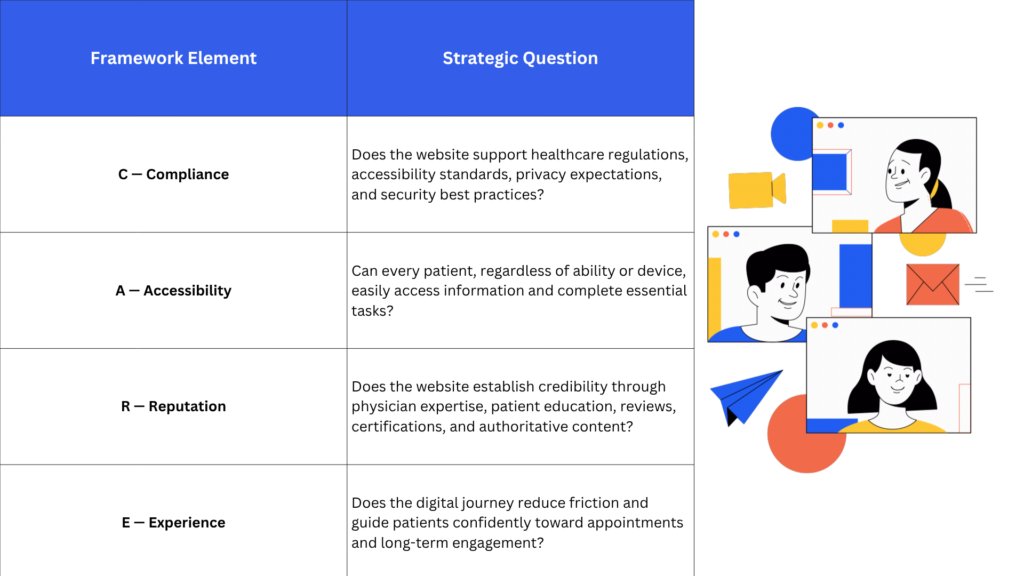
The CARE™ Framework for Modern Healthcare Websites
Most website discussions focus on design elements such as colors, layouts, or animations.
Healthcare executives should instead evaluate websites through a strategic framework.
At MindCentrix, we recommend the CARE™ Framework.
Framework Element | Strategic Question |
C — Compliance | Does the website support healthcare regulations, accessibility standards, privacy expectations, and security best practices? |
A — Accessibility | Can every patient, regardless of ability or device, easily access information and complete essential tasks? |
R — Reputation | Does the website establish credibility through physician expertise, patient education, reviews, certifications, and authoritative content? |
E — Experience | Does the digital journey reduce friction and guide patients confidently toward appointments and long-term engagement? |
Organizations excelling across all four pillars consistently create stronger patient experiences and more sustainable digital growth.
Why Your Healthcare Website Is No Longer a Marketing Asset
Many executive teams still classify websites as marketing expenses.
That perspective is increasingly outdated.
Today’s healthcare website influences nearly every stage of the patient lifecycle.
Patient Acquisition
According to industry research, most patients research providers online before scheduling appointments.
Your website therefore influences:
- New patient acquisition
- Referral decisions
- Insurance comparisons
- Provider evaluations
- Treatment research
Every improvement in digital experience can positively influence conversion rates.
Physician Recruitment
Healthcare professionals evaluate employers digitally just as patients evaluate providers.
An outdated website may unintentionally communicate:
- Limited innovation
- Weak employer branding
- Poor organizational culture
Conversely, modern websites showcasing physician achievements, research initiatives, community involvement, and organizational values strengthen recruitment efforts.
Operational Efficiency
An effective healthcare website reduces unnecessary administrative workload.
Examples include:
- Online appointment booking
- Insurance information
- Downloadable patient forms
- Self-service FAQs
- Location directories
- Secure patient resources
Every digital interaction that replaces a phone call reduces operational friction.
Brand Authority
Healthcare organizations increasingly compete on expertise.
Publishing authoritative educational content demonstrates leadership while strengthening trust among:
- Patients
- Referring physicians
- Healthcare partners
- Employers
- Community organizations
Authority compounds over time.
Organizations consistently publishing high-quality educational resources become recognized knowledge leaders rather than simply service providers.
Healthcare Consumer Behavior Has Changed Permanently
Healthcare executives often ask whether digital transformation represents a temporary trend.
It does not.
Patient expectations have fundamentally changed.
Today’s healthcare consumers expect experiences similar to those delivered by leading technology companies.
They expect:
- Immediate answers
- Personalized experiences
- Mobile accessibility
- Transparent pricing where appropriate
- Convenient scheduling
- Educational resources
- Digital communication
- Seamless navigation
Organizations failing to meet these expectations risk losing patients before clinical interactions ever begin.
What Modern Patients Actually Evaluate
Patients rarely assess websites using marketing terminology.
Instead, they ask practical questions.
“Can I trust this organization?”
A website answers this through:
- Professional design
- Physician credentials
- Clinical expertise
- Patient testimonials
- Certifications
- Community involvement
- Educational resources
“Can they help someone like me?”
Patients look for:
- Conditions treated
- Success stories
- Treatment pathways
- Physician specialization
- Insurance acceptance
- Nearby locations
Specificity builds confidence.
“Can I get help quickly?”
Healthcare websites should minimize unnecessary effort.
Patients expect:
- Click-to-call functionality
- Online scheduling
- Fast-loading pages
- Mobile optimization
- Live support where appropriate
- Clear next steps
Every additional click increases abandonment risk.
The New Patient Journey in 2026
Understanding how patients make decisions is essential for healthcare executives planning digital investments.
The journey typically follows six stages:
Stage 1 — Awareness
Patients recognize a healthcare concern.
Search begins.
Stage 2 — Research
Patients compare providers, treatments, insurance compatibility, reviews, and educational resources.
Stage 3 — Trust Validation
Patients verify physician expertise, organizational reputation, patient experiences, and professional credibility.
Stage 4 — Digital Interaction
Patients explore locations, schedule appointments, complete forms, and contact providers.
Stage 5 — Clinical Experience
Digital expectations transition into in-person care.
Stage 6 — Long-Term Relationship
Satisfied patients return, recommend providers, leave reviews, and engage with preventive healthcare resources.
Every stage is influenced by digital experience.
Executive Insight
Healthcare organizations often ask whether investing in a specialized healthcare website design company is worthwhile.
The better question is this:
What is the cost of allowing an outdated digital experience to influence every patient decision before your clinical team has an opportunity to demonstrate the quality of care you provide?
The organizations that will lead healthcare over the next decade will not necessarily be those with the largest marketing budgets.
They will be the organizations that build the highest levels of digital trust, communicate expertise with clarity, and create patient experiences that are as exceptional online as they are inside their facilities.
What's Next
In the next section, we’ll explore how AI-powered search, Google AI Overviews, Answer Engine Optimization (AEO), and Large Language Models are fundamentally changing healthcare website strategy. We’ll also examine the technologies, content structures, and design principles that distinguish future-ready healthcare organizations from those simply maintaining a website.
The Five Strategic Forces Reshaping Healthcare Website Design in 2026
Healthcare organizations are no longer competing in the same digital environment they were just a few years ago.
Search engines have evolved into answer engines. Patients expect digital experiences comparable to those offered by leading consumer brands. AI assistants increasingly summarize providers before patients ever visit a website. At the same time, healthcare organizations must navigate growing compliance requirements, increasing competition, and rising patient expectations.
Rather than viewing these as isolated trends, healthcare executives should recognize them as five interconnected strategic forces that are redefining digital healthcare.
Strategic Force #1: AI Has Become the New Front Door to Healthcare
Historically, healthcare organizations optimized websites for search rankings.
Today, they must optimize for recommendations.
When patients ask:
- “Who is the best dermatologist near me?”
- “Which orthopedic clinic accepts same-day appointments?”
- “Find a pediatrician specializing in asthma.”
AI platforms increasingly provide summarized recommendations instead of simply displaying search results.
This represents one of the biggest shifts in digital healthcare since mobile-first indexing.
Healthcare organizations must now optimize for two audiences simultaneously:
- Human visitors
- AI systems interpreting healthcare information
This requires websites that are not only visually appealing but also structured, authoritative, and semantically organized.
What AI Looks for Before Recommending a Healthcare Provider
Modern AI systems evaluate far more than keyword usage.
They assess whether an organization demonstrates:
Evaluation Signal | Why It Matters |
Medical expertise | Demonstrates subject authority |
Structured information | Makes content machine-readable |
Content depth | Indicates topical completeness |
Local relevance | Improves recommendation confidence |
Website performance | Supports user satisfaction |
Entity relationships | Helps AI understand organizational context |
Trust signals | Reduces misinformation risk |
The organizations most likely to appear in AI-generated answers are those that consistently demonstrate expertise rather than simply optimize pages.
Strategic Force #2: Patients Expect Consumer-Grade Digital Experiences
Healthcare consumers compare digital experiences across industries—not just healthcare.
A patient ordering groceries online or booking travel expects the same simplicity when scheduling a medical appointment.
Healthcare websites should therefore remove friction wherever possible.
Patients should never struggle to:
- Find the right physician.
- Understand available treatments.
- Compare locations.
- Verify insurance.
- Schedule appointments.
- Contact the appropriate department.
Every unnecessary step creates an opportunity for abandonment.
The Cost of Digital Friction
Digital friction rarely appears on financial reports, yet it directly impacts revenue.
Examples include:
- Patients abandoning appointment forms.
- Phone calls generated by missing website information.
- Lost local search visibility.
- Reduced patient satisfaction.
- Lower referral conversion rates.
Healthcare executives often invest heavily in improving clinical operations while overlooking digital inefficiencies that occur before patients ever arrive.
Strategic Force #3: Trust Is Becoming the Primary Competitive Advantage
Price is rarely the deciding factor in healthcare.
Trust is.
Patients entrust providers with their health, finances, and families.
Consequently, every digital interaction should reinforce confidence.
Healthcare websites establish trust through:
- Transparent physician profiles
- Educational resources
- Community involvement
- Clinical expertise
- Secure infrastructure
- Accessible design
- Consistent branding
- Authentic patient stories
Collectively, these elements create confidence long before the first consultation.
Strategic Force #4: Healthcare Is Becoming Increasingly Local
Although digital healthcare continues to expand, most healthcare decisions remain geographically driven.
Patients search for providers they can realistically visit.
Examples include:
- Cardiologist near me
- Pediatrician in Austin
- Orthopedic clinic Los Angeles
- Family physician accepting new patients
Healthcare websites should therefore support local discovery through:
- Dedicated location pages
- Local physician directories
- Community-focused content
- Regional healthcare resources
- Neighborhood-specific landing pages
Strong local relevance improves visibility while making healthcare more accessible.
Strategic Force #5: Knowledge Is Becoming the New Marketing Strategy
Traditional marketing interrupts.
Education attracts.
Healthcare organizations that consistently educate patients become trusted authorities within their communities.
Educational content should answer questions patients genuinely ask, including:
- Symptoms
- Treatments
- Recovery timelines
- Preventive care
- Insurance considerations
- Lifestyle recommendations
- Frequently asked questions
Knowledge builds trust.
Trust drives patient acquisition.
How AI Search Has Fundamentally Changed Healthcare SEO
Many organizations continue treating AI optimization as an extension of traditional SEO.
It is not.
The objective has shifted from ranking pages to becoming a trusted knowledge source.
Traditional SEO vs AI Search
Traditional SEO | AI Search Optimization |
Optimize for keywords | Optimize for entities and relationships |
Rank individual pages | Build topical authority |
Target search volume | Answer user intent |
Focus on rankings | Focus on citations and recommendations |
Optimize metadata | Optimize structured knowledge |
Increase clicks | Increase trust and discoverability |
Healthcare organizations should continue investing in SEO while expanding their strategy to support AI-powered search experiences.
The MindCentrix TRUST™ Model for AI-Ready Healthcare Websites
At MindCentrix, we recommend evaluating every healthcare website using the TRUST™ Model.
Principle | Executive Question |
T – Transparency | Does the website clearly communicate services, physicians, pricing (where appropriate), and patient expectations? |
R – Relevance | Does every page answer a specific patient question? |
U – Usability | Can patients complete important tasks within minutes? |
S – Structure | Can search engines and AI systems understand the content through schema, entities, and logical architecture? |
T – Trust | Does the website demonstrate expertise, authority, and credibility throughout the patient journey? |
Organizations consistently applying these principles become significantly more competitive across both traditional and AI-driven search.
Why Answer Engine Optimization (AEO) Matters
Search behavior has become conversational.
Patients ask complete questions rather than isolated keywords.
For example:
Old Search
Dermatologist Austin
Modern Search
Who is the best dermatologist in Austin accepting new patients?
Healthcare websites should therefore answer questions directly.
Example:
What does a healthcare website design company do?
Direct Answer
A healthcare website design company creates secure, patient-centered websites that improve trust, appointment conversions, accessibility, search visibility, and long-term digital growth for healthcare organizations.
Supporting Explanation
These companies combine UX design, healthcare strategy, SEO, compliance, accessibility, analytics, and AI optimization into one integrated digital platform.
This structure significantly improves snippet eligibility.
Characteristics of a High-Performing Healthcare Website
High-performing healthcare websites consistently share several characteristics.
- Patient-First Information Architecture
Navigation should mirror patient thinking—not internal organizational structures.
Patients search by:
- Condition
- Specialty
- Physician
- Location
- Treatment
Not departmental hierarchies.
- Mobile-First Experience
Google reports that mobile devices account for the majority of healthcare-related searches.
Healthcare websites should therefore prioritize:
- Responsive layouts
- Fast page loading
- Click-to-call functionality
- Simplified forms
- Thumb-friendly navigation
Mobile optimization directly influences patient acquisition.
- Physician Authority Pages
Provider profiles should function as authoritative content hubs.
Include:
- Credentials
- Certifications
- Clinical interests
- Research
- Publications
- Videos
- Languages
- Patient philosophy
These pages strengthen both trust and search visibility.
- Educational Resource Centers
Healthcare organizations should publish resources covering:
- Symptoms
- Conditions
- Treatments
- Preventive care
- Recovery guides
- Frequently asked questions
- Downloadable resources
Educational content establishes long-term authority.
- Technical Excellence
High-performing healthcare websites prioritize:
- Core Web Vitals
- Secure hosting
- Clean architecture
- XML sitemaps
- Schema markup
- Image optimization
- Accessibility
- Crawl efficiency
Technical quality directly supports discoverability.
Website Features That Increase Patient Acquisition
Rather than asking, “What pages should our website include?”
Healthcare executives should ask:
“What digital experiences reduce patient effort?”
The following features consistently improve conversion performance.
Feature | Business Impact |
Online appointment scheduling | Higher appointment completion |
Physician finder | Faster provider discovery |
Insurance verification | Reduced administrative workload |
Live chat or AI assistant | Improved patient support |
Patient portal integration | Better patient retention |
Online bill payment | Operational efficiency |
Educational content hub | Increased trust |
Interactive location maps | Better local engagement |
Click-to-call buttons | Higher mobile conversions |
Digital intake forms | Faster onboarding |
Each feature should solve a specific patient problem rather than simply add functionality.
Healthcare Website Design Company Los Angeles
Los Angeles represents one of the most competitive healthcare markets in North America.
Home to internationally recognized hospitals, private specialty practices, cosmetic surgery clinics, fertility centers, behavioral health providers, and digital health startups, the region demands sophisticated digital strategies.
A healthcare organization competing in Los Angeles must also address unique market realities:
- A highly multilingual population requiring localized patient experiences.
- Neighborhood-level search intent across areas such as Santa Monica, Beverly Hills, Pasadena, Glendale, and Downtown Los Angeles.
- Strong competition for physician reputation and online reviews.
- Growing demand for telehealth and hybrid care models.
- Medical tourism driven by specialized treatments and elective procedures.
A healthcare website design company Los Angeles should therefore focus on more than visual design. It should build digital authority through local SEO, multilingual content strategy, physician branding, AI-ready architecture, and patient education tailored to the region’s diverse population.
Healthcare Website Design Company Austin
Austin has emerged as one of the fastest-growing healthcare innovation ecosystems in the United States.
Population growth, technology investment, employer-sponsored healthcare expansion, and the presence of institutions such as Dell Medical School have accelerated demand for digitally mature healthcare organizations.
Healthcare providers operating in Austin should prioritize:
- Mobile-first patient experiences for a technology-savvy audience.
- Local SEO targeting neighborhoods such as Round Rock, Cedar Park, Pflugerville, and South Austin.
- AI-ready content supporting conversational search.
- Physician thought leadership.
- Educational content aligned with preventive care.
- Digital experiences that reflect Austin’s innovation-focused economy.
Choosing a healthcare website design company Austin with expertise in healthcare growth strategies can help organizations differentiate themselves within an increasingly competitive market.
Executive Takeaway
Healthcare organizations are entering an era where websites are evaluated by patients, search engines, and AI systems simultaneously.
Success will not belong to the organizations with the most visually impressive websites.
It will belong to those that create the clearest, most trustworthy, and most helpful digital experiences.
Organizations that combine strategic design, authoritative content, technical excellence, and AI-ready architecture will be better positioned to attract patients, strengthen their reputation, and remain discoverable as healthcare search continues to evolve.
In the final section, we’ll examine the most common mistakes healthcare organizations make, provide an executive checklist for choosing the right healthcare website design company, explain the MindCentrix implementation methodology, and conclude with advanced FAQs, references, author guidance, and structured data recommendations.
Common Mistakes Healthcare Organizations Make When Investing in Website Design
The majority of healthcare website redesigns fail for one simple reason—they focus on launching a new website instead of improving business performance.
A modern healthcare website should not be evaluated by how it looks on launch day. It should be measured by how effectively it acquires patients, strengthens trust, supports operational efficiency, and adapts to changing search behaviors over the next five years.
Below are the most common strategic mistakes healthcare executives should avoid.
Mistake #1: Treating the Website as a Marketing Project
Many organizations assign website redesigns exclusively to the marketing department.
While marketing plays a critical role, healthcare websites also impact:
- Patient acquisition
- Operations
- Physician recruitment
- Patient experience
- Community engagement
- Brand reputation
- Analytics and executive reporting
A successful website initiative requires collaboration between marketing leaders, clinical stakeholders, IT teams, operations, compliance, and executive leadership.
Executive Insight:
Think of your website as a business platform—not a marketing asset.
Mistake #2: Designing for Internal Teams Instead of Patients
Many healthcare websites mirror an organization’s internal structure rather than the way patients search for care.
Patients don’t think in terms of departments—they think in terms of problems.
For example, a patient is more likely to search for:
- Knee pain treatment
- Pediatric asthma specialist
- Same-day urgent care
- Women’s heart health clinic
Rather than:
- Department of Orthopedics
- Pulmonary Medicine Division
A patient-first navigation model consistently improves engagement and appointment conversion.
Mistake #3: Publishing Generic Healthcare Content
AI search engines have significantly raised the quality threshold for healthcare content.
Publishing generic articles such as “10 Benefits of Exercise” or “Why Regular Checkups Matter” no longer creates competitive advantage.
Instead, healthcare organizations should produce:
- Specialist-authored treatment guides
- Physician interviews
- Clinical insights
- Local healthcare resources
- Preventive care education
- Frequently asked patient questions
- Procedure-specific content
- Recovery timelines
High-value educational content demonstrates expertise while improving organic visibility.
Mistake #4: Ignoring Technical SEO
Many healthcare organizations invest heavily in visual design while neglecting technical performance.
Critical elements often overlooked include:
- Structured Schema Markup
- Core Web Vitals
- Crawlability
- Internal linking
- Canonical tags
- XML sitemaps
- Image optimization
- Accessibility compliance
- Structured navigation
Without these technical foundations, even outstanding content may struggle to achieve maximum visibility.
Mistake #5: Failing to Measure Business Outcomes
Traffic alone is not a healthcare KPI.
Executive teams should monitor metrics that directly influence organizational performance.
Examples include:
Business Metric | Why It Matters |
Appointment conversion rate | Measures patient acquisition efficiency |
Patient acquisition cost | Evaluates marketing ROI |
Local search visibility | Supports regional growth |
Provider profile engagement | Indicates physician interest |
Mobile conversion rate | Reflects usability |
Call-to-appointment ratio | Measures lead quality |
Form completion rate | Identifies friction |
Returning patient engagement | Supports retention |
Successful healthcare organizations measure outcomes—not page views.
Executive Checklist: How to Choose the Right Healthcare Website Design Company
Selecting a healthcare website design partner should be approached with the same diligence used when evaluating strategic technology investments.
Below is a practical executive checklist.
Industry Expertise
✔ Proven healthcare experience
✔ Understanding of healthcare marketing
✔ Familiarity with patient behavior
✔ Knowledge of regulatory considerations
Strategic Capabilities
✔ Patient acquisition strategy
✔ UX research
✔ Conversion optimization
✔ Content strategy
✔ AI search readiness
✔ Local SEO expertise
Technical Capabilities
✔ Core Web Vitals optimization
✔ Technical SEO
✔ Schema implementation
✔ Mobile-first development
✔ Accessibility best practices
✔ Secure hosting architecture
Analytics & Measurement
✔ GA4 implementation
✔ Conversion tracking
✔ Executive dashboards
✔ Attribution reporting
✔ CRM integration
✔ Performance monitoring
Long-Term Partnership
✔ Ongoing optimization
✔ Technical maintenance
✔ SEO growth roadmap
✔ Content support
✔ Quarterly strategy reviews
Why MindCentrix Takes a Different Approach
Most agencies begin healthcare projects by discussing website layouts.
We begin by asking business questions.
- What are your growth objectives?
- Which specialties generate the highest lifetime value?
- Where do patients abandon the digital journey?
- Which service lines require greater visibility?
- What questions are patients asking AI platforms today?
- Which markets represent your next expansion opportunity?
Only after understanding these strategic priorities do we begin designing the digital experience.
Our Four-Phase Healthcare Growth Methodology™
Phase 1 – Discover
We evaluate:
- Business goals
- Patient personas
- Competitive landscape
- Existing analytics
- Website performance
- Search visibility
- AI readiness
Deliverable: Executive Digital Opportunity Assessment.
Phase 2 – Design
Our UX and UI specialists create patient-centered digital journeys focused on:
- Accessibility
- Simplicity
- Conversion optimization
- Mobile usability
- Physician discoverability
Deliverable: Experience-first website architecture.
Phase 3 – Optimize
We integrate:
- Technical SEO
- AEO
- LLM Optimization
- Schema Markup
- Internal linking
- Local SEO
- Core Web Vitals improvements
Deliverable: AI-ready healthcare website.
Phase 4 – Grow
Digital success doesn’t stop after launch.
We continuously improve through:
- Performance monitoring
- CRO testing
- Content expansion
- Search trend analysis
- AI visibility optimization
- Executive reporting
Deliverable: Sustainable digital growth.
The Future of Healthcare Website Design
Healthcare websites will become increasingly intelligent over the next decade.
Emerging capabilities will include:
- AI-powered patient navigation
- Personalized educational pathways
- Predictive appointment recommendations
- Voice-first healthcare search
- Intelligent provider matching
- Hyper-local healthcare personalization
- Connected patient ecosystems
- Integrated wearable health experiences
Organizations investing in flexible digital platforms today will be better prepared for these innovations.
References
To strengthen credibility and support EEAT principles, consider citing authoritative sources throughout the article, such as:
- Google Search Central – Helpful Content & Search Quality Guidelines
- Google Core Web Vitals Documentation
- World Health Organization (WHO)
- U.S. Department of Health & Human Services (HHS)
- W3C Web Accessibility Initiative (WAI)
- Carleton University research on first impressions of website design
- Think with Google healthcare consumer insights
- Pew Research Center (digital behavior and internet usage)
Final Executive Perspective
The future of healthcare will be shaped by organizations that earn trust before the first appointment.
Clinical excellence will always remain the foundation of healthcare. However, in an AI-driven world where patients begin their journey online, digital trust becomes the gateway to that excellence.
A high-performing healthcare website is no longer measured by its visual appeal alone. It is measured by how effectively it answers patient questions, demonstrates expertise, supports accessibility, simplifies complex healthcare journeys, and generates measurable business outcomes.
Partnering with an experienced healthcare website design company is not simply an investment in a better website—it’s an investment in stronger patient relationships, greater operational efficiency, enhanced brand authority, and long-term competitive advantage.
As healthcare continues to evolve, the organizations that combine clinical expertise with exceptional digital experiences will be the ones patients discover, trust, and choose first.
Healthcare Website Design FAQs
- Appointment bookings
- Conversion rate
- Organic traffic quality
- Local search visibility
- Patient engagement
- Call volume
- Mobile usability
- Form completion rates
- Patient retention metrics


Boost Your Brand Visibility 🚀
Get personalized digital strategies that drive growth and engagement.
Let’s Talk📬 Stay Updated
Get the latest insights and guides delivered right to your inbox.
🔗 Related Topics
- Loading related posts...