GEO (Generative Engine Optimization) Best Practices for Financial Services:
The Complete Guide for AI Search in 2026

- 1Publish expert-led content that is fact-checked and reviewed for accuracy.
- 2Demonstrate strong E-E-A-T signals through expertise, authority, and trustworthiness.
- 3Use structured data and entity optimization to improve AI understanding.
- 4Create answer-first content that can be easily cited by generative engines.
- 5Support claims with trusted sources and maintain regulatory compliance.
- 6Build topical authority using conversational, long-tail, and comparison-driven content.
The Future of Financial Search Has Changed
For decades, financial institutions competed for rankings on traditional search engines.
Today, users increasingly ask questions like:
- “What is the best investment strategy during inflation?”
- “How much life insurance do I need?”
- “What are the tax implications of mutual funds?”
- “Should I refinance my mortgage in 2026?”
Instead of clicking ten blue links, users often receive an AI-generated answer instantly.
Google AI Overviews now reach billions of users globally and continue expanding across search experiences.
This shift means financial brands must optimize not only for search engines but also for AI systems that summarize, evaluate, and cite content.
This new discipline is called Generative Engine Optimization (GEO).
What is Generative Engine Optimization (GEO)?
Generative Engine Optimization (GEO) is the process of optimizing content so AI-powered search engines can easily understand, trust, reference, and cite it when generating answers.
Unlike traditional SEO, GEO focuses on:
Traditional SEO | GEO |
Ranking web pages | Being cited by AI answers |
Keywords | Entities and concepts |
Backlinks | Authority and trust signals |
SERP positions | AI visibility |
Clicks | Citations and mentions |
Search bots | Large Language Models |
According to the original GEO research published by Princeton University researchers, GEO techniques can improve content visibility within AI-generated responses by as much as 40%.
Why GEO Matters for Financial Services
The financial industry is among the most sensitive sectors impacted by AI search.
Users increasingly ask AI systems about:
- Retirement planning
- Wealth management
- Banking products
- Personal loans
- Credit scores
- Tax strategies
- Insurance policies
- Investment planning
- Financial compliance
Because these topics affect people’s finances, AI systems prioritize trustworthy and authoritative sources.
This creates an opportunity for financial institutions that publish high-quality content.

Get an Expert Google Ads Audit for Your Business
Uncover wasted spend, fix performance gaps, and scale ROI with certified Google Ads specialists.
Financial Services and AI Search: Key Statistics
AI Search Adoption
Statistic | Value |
Google AI Overviews monthly users | 2+ billion |
AI Mode monthly users | 100+ million |
GEO visibility improvement observed in research | Up to 40% |
Question-based searches triggering AI answers | Significantly higher than standard searches |
AI-generated responses displayed for many informational queries | Increasing rapidly |
Sources: Google, Princeton GEO Research, AI Search Studies.
How Financial Brands Get Selected by AI Models
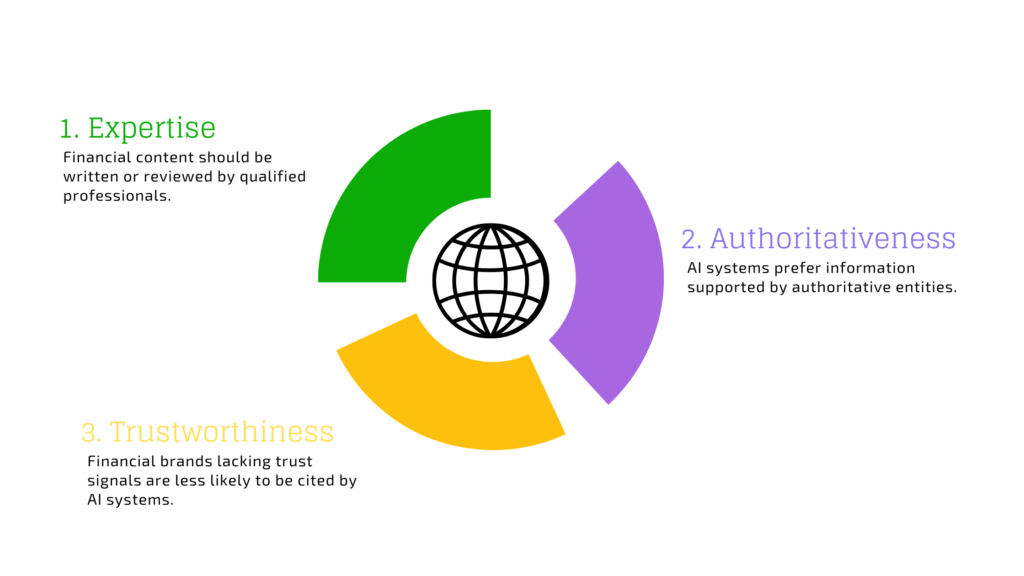
Large language models evaluate content based on several trust indicators:
- Expertise
Financial content should be written or reviewed by qualified professionals.
Include:
- CFP credentials
- CFA certifications
- CPA expertise
- Legal review
- Industry experience
Example:
Instead of:
“Investing early is important.”
Write:
“According to financial planners, investing consistently over long periods may help investors benefit from compound growth.”
- Authoritativeness
AI systems prefer information supported by authoritative entities.
Reference:
- Government agencies
- Financial regulators
- Central banks
- Academic studies
- Industry reports
Examples:
- Reserve Bank of India
- Securities and Exchange Board of India
- U.S. Securities and Exchange Commission
- Trustworthiness
Trust signals include:
- Source citations
- Editorial review
- Updated dates
- Compliance disclosures
- Transparent authorship
Financial brands lacking trust signals are less likely to be cited by AI systems.
GEO Best Practices for Financial Services
- Use an Answer-First Content Structure
AI engines prefer direct answers.
Example:
What is Generative Engine Optimization?
Generative Engine Optimization (GEO) is the practice of improving content visibility within AI-generated search responses by optimizing authority, clarity, structure, and factual accuracy.
Only then should you expand with details.
This format improves:
- Featured snippets
- AI Overviews
- ChatGPT citations
- Perplexity references
- Create AI-Citable Definitions
Financial content should include clear definitions.
Example:
What is a Fixed Deposit?
A fixed deposit (FD) is a financial product offered by banks that allows customers to deposit funds for a specified period in exchange for a predetermined interest rate.
AI systems frequently cite concise definitions.
- Optimize for Conversational Queries
Users now search naturally.
Examples:
- How much should I save for retirement?
- Is a SIP better than a fixed deposit?
- What happens if inflation rises?
- How does life insurance work?
Create content clusters around these questions.
- Add Original Statistics and Research
AI systems favor unique data.
Examples:
- Industry surveys
- Internal research
- Customer trend reports
- Market analysis
Original data increases citation probability significantly.
- Build Topic Clusters
Financial websites should create content ecosystems.
Example cluster:
Retirement Planning Hub
- Retirement calculator
- Pension planning
- Tax-saving strategies
- Investment options
- Inflation planning
- Withdrawal strategies
This builds topical authority.
- Implement Structured Data
Use schema markup:
- FAQ Schema
- Organization Schema
- Financial Service Schema
- Article Schema
- Author Schema
- Review Schema
Structured data improves machine understanding.
- Strengthen Entity Optimization
AI engines understand entities better than keywords.
Instead of targeting only:
“mutual funds”
Cover related entities:
- SIP
- NAV
- Equity Funds
- Debt Funds
- Risk Tolerance
- Asset Allocation
This creates semantic relevance.
- Maintain Regulatory Compliance
Financial content must remain current.
Update:
- Interest rates
- Tax regulations
- Investment rules
- Banking policies
Outdated content may lose trust signals.
GEO Content Framework for Financial Services
To maximize visibility in AI-generated search experiences, financial institutions should structure content around the information patterns most frequently retrieved, summarized, and cited by generative engines.
This structure closely aligns with how AI search systems retrieve, evaluate, summarize, and cite information. Each section provides a distinct content signal that improves comprehension, authority, and citation potential within generative search environments.
Sample GEO-Optimized Financial Content Block
What Is Inflation?
Inflation is the rate at which the prices of goods and services increase over time, reducing purchasing power. Moderate inflation is a normal part of economic growth, but high inflation can reduce savings value and increase borrowing costs.
Why It Matters
Higher inflation may affect:
- Savings accounts
- Fixed-income investments
- Retirement planning
- Loan affordability
Key Takeaway
Investors often seek diversified portfolios to help manage inflation-related risks.
This format is highly AI-citable.
Common GEO Mistakes Financial Companies Make
Publishing Generic Content
AI systems rarely cite repetitive articles.
Missing Sources
Unsupported claims reduce trust.
No Author Credentials
Financial content requires expertise.
Weak Internal Linking
Disconnected content reduces topical authority.
Outdated Information
Financial regulations change frequently.
GEO + SEO + AEO Checklist for Financial Services
Use this framework to ensure your financial content is optimized for traditional search engines, answer engines, and AI-powered discovery platforms.
- ✓ Answer-first structure
- ✓ Conversational language
- ✓ Original insights
- ✓ Expert review
- ✓ Source citations
- ✓ Schema markup
- ✓ Fast page speed
- ✓ Mobile optimization
- ✓ Crawlability
- ✓ Entity optimization
- ✓ Topical clusters
- ✓ FAQ sections
- ✓ Definitions
- ✓ Statistical references
- ✓ Author credentials
- ✓ Compliance disclosures
- ✓ Updated content dates
- ✓ Transparent sourcing
Financial institutions that align content quality, technical SEO, AI visibility signals, and trust indicators are significantly better positioned to appear in search results, AI-generated answers, and emerging generative discovery experiences.
The Future of GEO in Financial Services
Financial institutions that adapt to AI-driven discovery today will gain a substantial competitive advantage tomorrow.
Research indicates AI-generated search experiences are rapidly becoming mainstream, with billions of users interacting with AI-powered search features monthly.
The winners will not simply rank in search engines.
They will become the sources AI engines trust enough to cite.
For banks, insurance providers, fintech companies, investment firms, and wealth management organizations, GEO is no longer optional.
It is becoming a core digital marketing strategy.
GEO for Financial Services FAQs
What is GEO in digital marketing? +
Why is GEO important for financial services? +
Is GEO replacing SEO? +
How can banks optimize for AI search? +
What content performs best in AI Overviews? +
How often should financial content be updated? +
Sources & References
- Princeton University – GEO: Generative Engine Optimization Research (KDD 2024).
- Google AI Overviews User Adoption Statistics.
- Research on AI Overview activation and publisher visibility.
- Recent developments in AI search transparency and source attribution.


Boost Your Brand Visibility 🚀
Get personalized digital strategies that drive growth and engagement.
Let’s Talk📬 Stay Updated
Get the latest insights and guides delivered right to your inbox.
🔗 Related Topics
- Loading related posts...