AI in Marketing:
Where It Actually Delivers ROI (and Where It Doesn't)

A decision-grade guide for founders, CMOs, and C-suite leaders who need the truth — not the hype deck.
- 1Personalization at scale
- 2Paid media and campaign optimization
- 3Content production velocity
- 4Predictive analytics and pipeline forecasting
- 5Customer service automation
The Uncomfortable Split-Screen
Here is a number that should make every founder and CMO stop scrolling: 88% of organizations now use AI in some part of their marketing operations. Yet McKinsey’s research consistently finds that fewer than 10% of those organizations see any meaningful bottom-line impact.
Let that gap sit with you for a moment.
The budgets are being approved. The tools are being purchased. The press releases are being written. And most of it is generating heat, not revenue.
The problem is not that AI in marketing does not work. It does — in specific, well-governed, data-backed scenarios. The problem is that most leadership teams are making AI investment decisions based on competitive anxiety and vendor pitch decks rather than a clear-eyed assessment of where value actually compounds.
This article is not a tool listicle. It is not another “Top 10 AI marketing tools” roundup dressed up with statistics. It is a decision-grade analysis for the people in the room who have to actually sign off on AI strategy — and live with the results.
THE CENTRAL QUESTION THIS ARTICLE ANSWERS:
Where should a CEO or CMO direct AI investment to move the revenue needle — and what should they stop funding immediately?
Why the ROI Gap Exists, and Why It's a Leadership Problem
The most convenient explanation for AI underperformance is technical. The model was not good enough. The integration was too complex. The vendor over-promised. These things happen. But when you look at the pattern across organizations that have failed to get returns from AI in marketing, the real culprit is almost never the technology.
The numbers tell a clear story
95% of generative AI pilots are failing to deliver Source: MIT, 2025 |
Only 6% of companies qualify as AI high performers — defined as attributing 5%+ EBIT impact to AI Source: McKinsey, 2025 |
Only 29% of executives can confidently measure AI ROI — despite 79% reporting productivity gains Source: IBM Q4, 2025 |
That last data point is the most important one. Productivity and ROI are not the same thing. Your team can be measurably faster and more productive with AI tools while the business itself moves no faster toward revenue. When productivity gains stay inside the workflow and do not translate into pipeline, retention, or margin — you have a productivity simulation, not a business transformation.
The variable that separates winners from everyone else
McKinsey’s research on AI high performers reveals a consistent pattern: they are three times more likely to have senior leadership that actively champions, owns, and governs AI initiatives — not delegates them to a tech team, an agency, or a recently hired “Head of AI.”
Deloitte’s 2026 analysis reinforces this. Executive sponsorship and formal governance frameworks are the strongest predictors of AI scaling success. Not the tools selected. Not the budget allocated. Not even the quality of the data at the start.
PwC puts it plainly: failures happen because leaders chase market hype instead of mapping AI to specific, measurable business workflows.
THE MINDCENTRIX PRINCIPLE:
You cannot outsource AI strategy and expect owned results. The moment AI becomes someone else’s problem in your organization, it stops being your competitive advantage.

Get an Expert Google Ads Audit for Your Business
Uncover wasted spend, fix performance gaps, and scale ROI with certified Google Ads specialists.
Where AI Actually Delivers ROI, The Confirmed Use Cases
Let’s be specific. These are the marketing applications where the data is consistent, the case studies are real, and the ROI is traceable back to business outcomes — not just activity metrics.
Personalization at Scale
Personalization has been a marketing promise for two decades. AI is the first technology that actually delivers it at enterprise scale, without an army of analysts rebuilding segments every quarter.
- Personalization reduces customer acquisition costs by up to 50% and lifts marketing ROI by 10–30% (McKinsey).
- AI-driven targeting generates 40% higher conversion rates and 35% higher average order values.
- Starbucks Deep Brew AI manages personalized offers for 27.6 million loyalty members and contributed to a 34% increase in per-member spending.
The leadership caveat here is important: AI personalization is only ROI-positive when it runs on first-party, owned data. The moment you are feeding AI with third-party data, you are building on a foundation that is both unreliable and legally fragile. Personalization powered by data you do not own is a liability dressed as a strategy.
Paid Media and Campaign Optimization
This is currently the fastest and most direct path to provable, measurable ROI for most marketing teams. Paid media optimization is where AI’s pattern-recognition capabilities are perfectly matched to the task — bidding, targeting, creative testing — and where the feedback loop is tight enough to actually measure what is working.
- AI-driven campaigns deliver 22% higher ROI, 32% more conversions, and 29% lower acquisition costs traditional methods.
- Campaigns powered by AI launch 75% faster and generate 47% better click-through rates.
- S. AI-powered search advertising is projected to grow from $1 billion in 2025 to $26 billion by 2029 — the market is moving whether you are in it or not.
For any leadership team still running manual campaign management, this is the single highest-leverage starting point. The ROI is traceable, the timeline to results is short, and the competitive moat compounds over time as your models accumulate more performance data.
Content Operations and Production Velocity
AI has genuinely transformed the economics of content production. What used to require a full-time writer and a week of revisions now takes a skilled human strategist two hours with AI as the production engine.
- 93% of marketers report AI accelerated their content creation — a 1,500-word article dropped from 8–10 hours to under 2 hours.
- Teams using AI for content report 41% more email revenue and 34% more consistent content scheduling vs. non-AI teams.
- 65% say AI-assisted content improved their SEO performance — but only when quality and user-intent alignment were maintained.
The efficiency gains are real. But there is a critical distinction that separates leaders who benefit from this from leaders who damage their brand with it: AI is a production multiplier, not a strategy replacement. Teams that cut human editorial oversight in the name of efficiency end up with high-volume content that sounds like every other company using the same AI tools. Brand dilution is a real cost that does not show up in your content calendar metrics.
Predictive Analytics and Pipeline Forecasting
This is where AI offers perhaps its most underutilized value for leadership teams — and the most direct line to board-level confidence.
- 92% of top-performing marketing teams relied on AI-powered predictive analytics in 2025.
- 82% of CMOs say AI has increased their confidence in forecasting accuracy.
- AI recommendation engines have delivered 150% conversion rate increases and 50% growth in average order values in mature deployments.
The strategic insight here is this: predictive analytics is currently the least deployed AI application in marketing, despite having some of the highest ROI. That makes it a competitive white space. The leaders who build this capability now will be forecasting with precision while their competitors are still arguing about quarterly attribution models.
Customer Service and Chatbot Automation
For most organizations, customer service is a cost center. AI changes that equation — not by replacing the humans who build relationships, but by eliminating the repetitive work that burns them out.
- Support costs decrease by 18% through AI self-service deployment.
- NIB’s AI implementation: saved $22 million by automating customer service processes.
- AI-powered tools reduce resolution times by up to 87%, with 52% of customer interactions now involving AI and satisfaction scores averaging 84%.
For B2B leadership teams, the framing is straightforward: AI chatbots that handle tier-1 queries free your highest-value humans for the work that actually closes deals and deepens relationships. That is not a cost reduction story — it is a talent reallocation strategy.
Where AI Does Not Deliver - The Honest Failure Map
This section is where most AI marketing content falls short, because the people writing it have a vested interest in making AI sound universally applicable. It is not. And if you are making budget decisions based on an incomplete picture, you are setting up your organization for expensive disappointment.
Here is what the data actually shows about where AI in marketing fails:
Failure Zone 1: AI on Top of a Broken Strategy
This is the most common and most expensive mistake. Leadership teams see competitors using AI, approve a budget, and deploy tools against a strategy that was not working before the AI arrived.
McKinsey’s research on digital transformation is consistent: 70%+ of transformation initiatives fail primarily due to poor alignment and unclear objectives — not technology failure. AI does not fix a bad strategy. It executes it faster and at greater scale.
THE DECISION PRINCIPLE: Before asking AI what to say or who to target, make sure you genuinely know who you are talking to, why they should care, and what you want them to do next. AI amplifies direction — it does not provide it. |
Failure Zone 2: Disconnected Tool Stacks — AI Without an Operating System
There is a specific pattern that shows up repeatedly in organizations that are spending on AI but not seeing returns: they are running a collection of disconnected point solutions with no unified data model underneath them.
- Bain’s 2025 research found that AI programs fail to scale when ownership, measurement discipline, and workflow redesign are absent.
- Companies with fully integrated AI stacks achieve 2× greater cost efficiency gains vs. those running point solutions.
The red flag to watch for in your own organization: if your team can list more than six AI tools they use regularly but cannot tell you how the data flows between them, you are running productivity theatre. The tools are busy. The business is not moving.
Failure Zone 3: AI Brand and Creative Risk
This failure mode is qualitatively different from the others because the cost is not just financial — it is reputational, and it accumulates in ways that do not show up in dashboards until it is too late.
The real-world examples here are instructive: Coca-Cola’s AI-generated holiday campaign triggered significant consumer backlash. The Willy Wonka AI experience became a case study in brand damage. Multiple corporate chatbots have generated harmful or embarrassing outputs in public-facing contexts.
AI-generated content that goes wrong does not damage the tool. It damages the brand. That is a board-level concern, not a marketing operations concern.
THE RULE FOR C-SUITE: Any customer-facing AI output that touches brand voice, crisis communication, or human relationships requires a human review gate. This is not bureaucracy. It is brand protection. |
Failure Zone 4: Over-Personalization and Customer Fatigue
There is a ceiling to personalization, and most AI deployments are not sophisticated enough to recognize when they have hit it.
- In B2B, excessive AI-driven personalization across multiple stakeholders creates decision fatigue and disengagement — the opposite of its intended effect.
- Only 9% of marketers are actually prioritizing personalization as a 2026 goal (CoSchedule, 2026) — the gap between hype and practice is significant.
Past a certain threshold, AI personalization stops feeling like service and starts feeling like surveillance. The line is context-dependent, and right now, only human judgment can reliably read which side of it you are on.
Failure Zone 5: Pilot Purgatory — The Scaling Failure
This might be the most strategically dangerous failure mode of all, because it looks like progress from the outside.
- BCG’s 2026 CEO study found that while AI pilot activity is high across industries, most organizations cannot demonstrate quantifiable business impact from those pilots.
- Only 16% of AI initiatives have scaled enterprise-wide. Only 25% deliver expected ROI (IBM, 2025).
The cost of staying in pilot mode is not just the wasted budget on experiments that never scale. It is the compounding competitive disadvantage. The organizations that committed to AI in marketing in 2024 are not running experiments in 2026. They are running markets. Every quarter spent in a pilot is a quarter of advantage handed to whoever committed first.
The MindCentrix ROI Audit Framework, The 4-Gate Test
Based on the consistent patterns in both successful and failed AI marketing deployments, we have developed a simple framework for evaluating any AI initiative before resources are committed. We call it the 4-Gate ROI Test. Run every AI marketing proposal through all four gates before approving a budget.
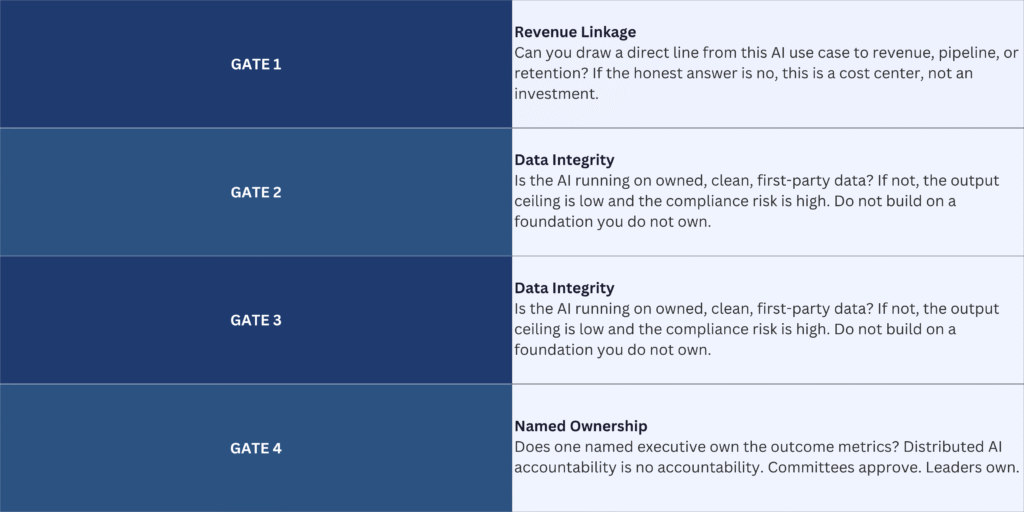
Any AI initiative that cannot pass all four gates is either not ready to fund or not designed correctly. This is not about being restrictive — it is about making sure that when AI investments succeed, they succeed in ways you can measure, defend, and repeat.
The AI Marketing Investment Matrix
Use this as a quick reference when prioritizing where to direct resources across your marketing AI portfolio:
Quadrant | Characteristics | Examples |
Start Here | High ROI / Lower readiness required | Paid media optimization, email personalization |
Scale To Here | High ROI / Higher readiness required | Predictive analytics, agentic workflows |
Govern First | Lower ROI / Higher readiness required | AI brand creative, autonomous content generation |
Stop Here | Lower ROI / Lower readiness required | Disconnected point tools, AI for AI’s sake |
The Agentic Frontier, What Leadership Must Prepare for Now
Everything discussed so far sits within the realm of AI as a tool — something a human uses to work faster or smarter. What is coming is qualitatively different: AI as an agent. And the leaders who are waiting to understand it before engaging with it are already behind.
By end of 2026, 40% of enterprise applications will feature task-specific AI agents — an 8× increase from 2025 Source: Gartner |
In marketing terms, this means campaigns that self-optimize in real time without human intervention. Leads that self-score and route based on live behavioral signals. Content calendars that populate based on trending demand signals and strategic priorities. Customer journeys that adapt dynamically to individual behavior rather than being designed around assumed segments.
Early adopters allocating more than 50% of their AI budgets to agentic tools report 88% ROI realization — compared to 74% across all AI adopters. The gap will widen as the technology matures.
Why governance is the competitive infrastructure
There is a version of the agentic future where AI moves faster than your organization’s ability to verify what it is doing in your name. That is not a technology risk — it is a leadership governance failure.
- Forrester’s 2026 B2B warning: companies will lose $10B+ due to ungoverned use of generative AI. Governance is a revenue protection strategy.
- PwC 2025 Responsible AI survey: 60% of executives say responsible AI boosts ROI and efficiency — yet nearly half struggle to operationalize it.
THE MINDCENTRIX POSITION: AI governance is not bureaucracy. It is the infrastructure for compounding returns. Every organization that builds governance frameworks now will be able to move faster, not slower, as AI capabilities accelerate. |
What to Do in the Next 90 Days, The Leadership Decision Checklist
Enough analysis. Here is what a leadership team that has read this article should do before anything else.
In the Next 30 Days
- Audit your current AI tool spend: For every active AI tool, apply Gate 1 from the 4-Gate Test. Can you draw a line to revenue? If not, kill it or consolidate it.
- Name one executive as AI ROI owner for marketing: Not a committee. Not a rotating responsibility. One person, one set of KPIs, one quarterly review.
- Identify your top two owned data assets: Your email list, your CRM, your behavioral data from owned platforms. These are the only foundations worth building AI personalization on.
In the Next 60 Days
- Launch one AI pilot in paid media optimization: Define the hypothesis, the success metric, and the review date upfront. This is your fastest path to demonstrable ROI.
- Establish a human review gate for customer-facing AI content: Document the protocol before you need it. Brand incidents are not the time to discover you did not have one.
In the Next 90 Days
- Run the full 4-Gate Audit across all active AI initiatives: Promote winners into the operating model. Kill pilot purgatory. Make the call.
Begin building the data infrastructure for predictive analytics: This is your 2026–2027 competitive moat. The organizations starting now will have 18 months of model training before the competition decides to begin.
The Honest Verdict
AI in marketing works. In specific places, with the right foundations, owned by the right leaders, it is already generating returns that are rewriting the competitive dynamics of entire categories.
But the majority of organizations using AI in marketing right now are not in those specific places. They are running experiments, buying tools, and reporting productivity metrics to boards who are getting progressively harder to impress.
The companies that will lead their categories by 2027 are not the ones that experimented most. They are the ones that committed fastest to the right use cases, with the right governance, backed by leadership that understood the difference between activity and outcomes.
THE FINAL PRINCIPLE: The companies winning with AI in marketing are not using more tools. They are using fewer tools, with more discipline, at higher commitment. That is the whole thesis. |
MindCentrix exists to help leadership teams make these calls with precision — identifying where AI investment will compound, where it will leak, and how to build the governance infrastructure that turns one successful pilot into an enterprise advantage.


Boost Your Brand Visibility 🚀
Get personalized digital strategies that drive growth and engagement.
Let’s Talk📬 Stay Updated
Get the latest insights and guides delivered right to your inbox.
🔗 Related Topics
- Loading related posts...