
Restaurant Web Development Services: Build a Website That Grows Your Business

- 1Better customer experience: Make menus, hours, contact information, and directions easy to find.
- 2Mobile-friendly design: Help customers browse and take action on smartphones and tablets.
- 3Online ordering: Connect suitable ordering and payment tools to your website.
- 4Local SEO: Organize location details and useful content to support local search visibility.
- 5AI search readiness: Use clear answers, descriptive headings, accurate information, and appropriate structured data.
- 6Long-term performance: Monitor website speed, conversions, security, and ongoing maintenance.
A restaurant website should do more than display your menu. It should help customers discover your restaurant, explore your food, understand what makes your business different, and take the next step—whether that means booking a table, placing an online order, or visiting your location.
Professional Restaurant Web Development Services bring your menu, brand identity, customer experience, local search visibility, and ordering options together in one place. Instead of relying entirely on third-party platforms or social media, you can create a digital experience that reflects your restaurant and supports your business goals.
However, building a restaurant website requires more than choosing an attractive template. Customers expect fast-loading pages, easy navigation, clear menus, mobile-friendly layouts, and simple ways to contact or order from your restaurant. If these elements are missing, even an excellent dining experience can be harder to discover online.
In this guide, we will explore what restaurant website development involves, which features matter most, how SEO supports local discovery, what affects development costs, and how to choose the right development partner.
What Are Restaurant Web Development Services?
Restaurant Web Development Services involve planning, designing, building, and maintaining websites specifically for restaurants, cafes, bakeries, food trucks, bars, and other food businesses.
These services combine website design, technical development, user experience, search engine optimization (SEO), and business functionality. The objective is to create a website that looks professional while helping customers find information and complete important actions without unnecessary effort.
For example, a neighborhood restaurant may need a website that highlights its menu, location, opening hours, and reservations. In contrast, a multi-location restaurant group may require location-specific pages, online ordering integrations, and centralized content management.
Depending on your needs, restaurant website development may include:
- Custom restaurant website design and development
- Mobile-responsive layouts for smartphones and tablets
- Digital menus with clear categories and pricing
- Online ordering and payment integrations
- Table reservations and event booking functionality
- Local SEO and Google Business Profile support
- Website speed, security, and technical optimization
- Analytics and conversion tracking
- Website maintenance and ongoing improvements
The right solution depends on your restaurant’s size, business model, customer expectations, and growth plans. Therefore, a good development process begins with understanding how your restaurant operates before selecting the technology or design.
Why Does Your Restaurant Need a Professional Website?
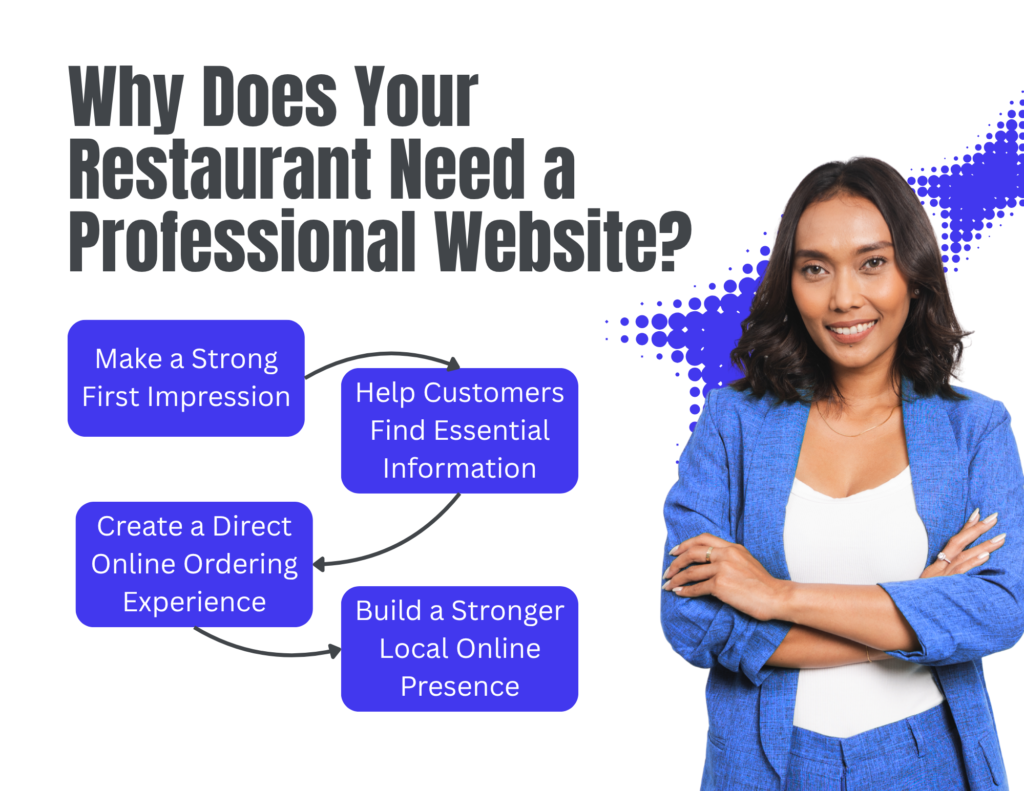
Customers often research restaurants online before deciding where to eat. They may compare menus, check operating hours, look for dietary options, view photos, or search for a convenient place nearby.
If your website makes these tasks difficult, potential customers may leave before contacting you or visiting your restaurant.
- Make a Strong First Impression
Your website is often an important part of your restaurant’s first impression. Its design should reflect the experience customers can expect when they walk through your doors.
For example, a fine-dining restaurant may benefit from elegant typography, carefully selected food photography, and a refined layout. Meanwhile, a casual family restaurant may need a welcoming design, an easy-to-read menu, and prominent directions.
Professional restaurant website design helps align your online presence with your actual brand. As a result, customers can better understand your atmosphere, cuisine, and overall dining experience before they arrive.
- Help Customers Find Essential Information
Customers should not have to search through several pages to find your menu, address, phone number, or opening hours.
A clear website structure makes essential information easy to access. In addition, prominent buttons for reservations, directions, and ordering help visitors take action when they are ready.
This matters especially for mobile visitors who may be deciding where to eat while traveling or searching for nearby dining options.
- Create a Direct Online Ordering Experience
Third-party delivery platforms can help restaurants reach customers. However, depending on the platform and agreement, commissions, service fees, customer data access, and branding limitations may affect profitability and control.
A restaurant website can offer a direct ordering option through an integrated ordering system or a suitable third-party provider. This gives customers another way to place orders while allowing restaurant owners to evaluate their costs and customer relationships more carefully.
Direct ordering does not automatically eliminate fees or guarantee higher profits. Instead, it provides another channel that you can manage according to your business needs.
- Build a Stronger Local Online Presence
A restaurant website supports your local marketing efforts by providing search engines with useful information about your business, location, menu, and services.
When combined with an accurate Google Business Profile, consistent business information, relevant local content, and customer reviews, your website can help people discover your restaurant through location-based searches.
For example, a restaurant in Los Angeles may want to reach customers searching for Indian food in Los Angeles, lunch near a particular neighborhood, or a restaurant offering vegetarian dishes.
Although no website can guarantee a particular search position, a useful and well-optimized website provides a stronger foundation for local visibility.
Essential Features of Restaurant Web Development Services
Not every restaurant needs the same website features. Nevertheless, several core elements can improve usability, support marketing, and make day-to-day restaurant operations easier.
- Mobile-Friendly Restaurant Website Design
Many customers access restaurant websites from smartphones. Therefore, your website should adapt to different screen sizes without making information difficult to read or actions difficult to complete.
A responsive restaurant website should include:
- Text that remains readable on smaller screens
- Menus that do not require excessive zooming
- Buttons large enough to tap comfortably
- Images that fit the screen without unnecessary cropping
- Simple navigation and accessible contact information
- Ordering and reservation forms that work on mobile devices
Furthermore, developers should test the actual experience across common screen sizes and browsers. A layout that looks good on a desktop computer may still create problems on a smartphone.
- Easy-to-Update Digital Menus
Your menu is one of the most important sections of your restaurant website. Customers want to understand what you serve, how much it costs, and whether suitable options are available.
A useful digital menu should organize dishes into clear categories, display current prices, and describe items in simple language. Where relevant, you can also include dietary information, ingredient notes, portion details, and clear descriptions of popular dishes.
For example, a restaurant serving Indian cuisine might organize its menu into appetizers, vegetarian entrees, chicken specialties, breads, desserts, and beverages.
Whenever possible, use accessible HTML text for your menu rather than relying exclusively on a PDF or image. Search engines and assistive technologies can generally interpret properly structured text more effectively than information embedded in images.
An easy-to-manage content system also helps your team update prices, remove unavailable dishes, and add seasonal specials without rebuilding the entire page.
- Online Ordering and Payment Integration
If your restaurant accepts takeout or delivery orders, an online ordering system can make the process more convenient.
Depending on your operations, the integration may support:
- Menu selection and item customization
- Pickup and delivery options
- Order scheduling, where supported
- Secure payment processing
- Order confirmation notifications
- Connections with compatible restaurant management systems
The ordering experience should remain straightforward from start to finish. Customers should be able to understand the total price, review their selections, and see relevant fees before submitting an order.
Before selecting a platform, confirm its transaction costs, payment options, delivery capabilities, POS compatibility, and data policies. These details can have a greater impact on daily operations than the appearance of the ordering interface.
- Table Reservations and Event Booking
Restaurants that accept reservations can benefit from an integrated booking system.
A reservation feature allows customers to select an available date, time, and party size without needing to call during business hours. Depending on the platform, it may also support confirmation messages, cancellation management, and special requests.
Restaurants that host private events, tasting menus, or group dining can also provide dedicated inquiry forms.
However, reservation functionality should match your actual workflow. A simple contact form may be enough for private-event inquiries, while a busy restaurant may require a more advanced booking platform.
- High-Quality Food Photography
Food photography helps customers understand your menu and the atmosphere of your restaurant.
Use genuine, high-quality images of your dishes, dining space, staff, and restaurant exterior where appropriate. Authentic photography can give visitors a clearer picture of what to expect and help your brand feel more personal.
At the same time, large image files can slow down your website. Developers should optimize image dimensions, choose suitable modern formats, and use responsive image delivery where appropriate.
Descriptive alternative text should explain the meaningful content of each image. For example, an image showing a restaurant’s signature dish could use alt text such as “Paneer tikka served with grilled vegetables at [Restaurant Name].”
Avoid stuffing image descriptions with repeated keywords. Accessibility and accurate descriptions should come first.
- Clear Contact Information and Directions
Your website should make it easy for customers to reach your restaurant.
Display your business phone number, full address, current hours, and directions in a clear location. If your restaurant has multiple locations, provide a separate page for each one with accurate, location-specific information.
You can also include parking information, accessibility details, public transportation guidance, and pickup instructions when relevant.
These details help customers make practical decisions and reduce avoidable questions for your staff.
- Secure Forms and Reliable Website Performance
Customers may submit personal information when making reservations, contacting your restaurant, or placing orders. Therefore, your website should use HTTPS and follow appropriate security practices.
Depending on the setup, this may include secure payment integrations, regular software updates, spam protection, controlled administrator access, and reliable backups.
Performance matters as well. Slow pages, broken links, failed forms, and ordering errors can interrupt the customer journey.
Professional restaurant website development should include testing for both appearance and functionality. In addition, ongoing maintenance helps identify problems before they affect too many visitors.

Ready to Build a Better Restaurant Website?
Make it easier for customers to explore your menu, discover your restaurant, and place orders with a website built for usability, local SEO, and business growth. Let's discuss your goals with MindCentrix.
Restaurant Website Development Options at a Glance
Different restaurants need different levels of customization. The following table can help you compare common approaches before deciding what to build.
Website solution | Best suited for | Key considerations |
Template-based website | New restaurants and smaller budgets | Lower initial complexity; customization may be limited. |
Custom restaurant website | Restaurants with specific branding and functionality needs | Greater flexibility; more planning and development may be required. |
Online ordering website | Restaurants accepting pickup or delivery orders | Review payment fees, order management, and POS compatibility. |
Multi-location website | Restaurant groups and growing chains | Requires accurate location data and a manageable content structure. |
Reservation-focused website | Restaurants accepting table bookings or event inquiries | Booking tools should match staffing and reservation workflows. |
The best option depends on your restaurant’s current needs and future plans. For instance, a small restaurant may start with a straightforward website and add ordering later. Meanwhile, a growing restaurant group may need centralized content management and location-specific functionality from the beginning.
How Restaurant Website Development Supports SEO
A visually appealing website is valuable, but customers must also be able to discover it. Search engine optimization helps make your website easier to understand, crawl, and find for relevant searches.
Restaurant SEO involves more than adding a few keywords to your homepage. It requires useful content, clear site structure, accurate business information, sound technical implementation, and a strong connection between your website and local presence.
- Target Relevant Restaurant Search Keywords
Start by identifying the searches that align with your restaurant, location, cuisine, and services.
Relevant keyword themes may include:
- Restaurant website development
- Restaurant website design
- Restaurant web development services
- Online ordering website for restaurants
- Restaurant website designer
- Restaurant SEO services
- Cuisine-specific restaurant searches in your city
- Restaurants near a neighborhood or landmark
Your development service pages and your restaurant’s own website serve different search intents. A web development agency should target business owners looking for website solutions, while a restaurant should focus on customers searching for food, dining experiences, and nearby locations.
Use each keyword where it genuinely fits the page. Avoid forcing unrelated terms into restaurant content simply to increase keyword density.
- Create Location-Specific Restaurant Pages
For restaurant groups with multiple locations, dedicated location pages can help visitors find relevant information for each branch.
Each page should provide genuinely useful local details, such as:
- The location’s full address and phone number
- Accurate opening hours
- Its own menu or location-specific offerings
- Directions and parking information
- Original photographs of that branch
- Reservation or ordering options
- Relevant neighborhood information
For instance, a restaurant with locations in Pasadena and Santa Monica should not publish two pages that differ only in the city name. Instead, each page should accurately describe the relevant location and help customers plan their visit.
A single-location restaurant usually does not need dozens of nearly identical neighborhood pages. Focus on useful pages that reflect your real service area and provide meaningful information.
- Improve Technical SEO
Technical SEO helps search engines access and understand your website.
Important considerations include:
- A logical URL structure
- Descriptive page titles and meta descriptions
- Proper heading hierarchy
- XML sitemap configuration
- Appropriate robots.txt rules
- Canonical tags where needed
- Mobile usability
- Secure HTTPS connections
- Working internal links
- Image optimization
- Useful 404 pages and redirect management
Developers should also check for accidental indexing problems, duplicate pages, broken links, and important content that cannot be accessed properly.
These improvements do not guarantee rankings. However, they reduce avoidable technical barriers and help create a more reliable foundation for search visibility.
- Use Structured Data Where Appropriate
Structured data helps search engines interpret specific information about a business or page.
Depending on the website, relevant Schema.org types may include Restaurant, LocalBusiness, Organization, WebSite, and BreadcrumbList. The appropriate selection depends on the business, page purpose, and available information.
For a restaurant, suitable structured data may describe its name, address, telephone number, opening hours, cuisine, menu URL, and official website.
Only include details that are accurate and supported by the visible page or legitimate business information. Validate the implementation with Google’s Rich Results Test where applicable and the Schema.org Validator for general markup checks.
Remember that valid structured data does not guarantee a rich result or special search display. Its purpose is to provide clear, machine-readable context.
- Strengthen Google Business Profile Connections
Your website and Google Business Profile should support one another.
Keep the website URL, address, phone number, and opening hours accurate and consistent wherever applicable. Link your profile to the most relevant page, especially when you operate multiple locations.
You should also make it easy for visitors to access directions, menus, reservations, and ordering options from your website.
Customer reviews, accurate profile information, and a useful website can all contribute to a stronger local presence. However, local search results also depend on factors such as relevance, distance, and prominence, so website optimization alone cannot control the outcome.
Restaurant Websites and AI Search: What Should You Know?
Customers increasingly use AI-powered tools to ask specific questions about restaurants, compare options, and understand available services.
For example, someone might ask which restaurants offer vegetarian entrees, whether a restaurant accepts reservations, or where to order a particular cuisine nearby.
A useful website gives search engines and AI systems clearer information to work with. Although no particular implementation guarantees that a business will be mentioned in an AI-generated answer, several practices can improve content clarity and accessibility.
Write Clear, Direct Answers
Organize important information around real customer questions.
A well-structured page can answer questions such as:
- What type of cuisine does the restaurant serve?
- Where is the restaurant located?
- Does it offer dine-in, takeout, or delivery?
- How can customers make a reservation?
- Are menu prices available online?
- What are the restaurant’s current hours?
Provide direct answers first, followed by useful details. This structure benefits customers and makes the page easier for search systems to interpret.
Use Clear Headings and Descriptive Content
Organize information with descriptive headings, short paragraphs, lists, and meaningful internal links.
For example, a heading such as “Online Ordering for Pickup and Delivery” communicates more than a vague heading such as “Our Services.”
Likewise, use specific descriptions instead of generic claims. Explain what your restaurant offers, where it operates, and how customers can place an order.
Keep Business Information Accurate
Outdated menus, incorrect opening hours, and broken reservation links can confuse customers and undermine trust.
Establish a process for updating your website whenever prices, operating hours, menu items, or location details change.
For restaurants with several branches, ensure that each location’s information is maintained accurately.
Treat Schema as Supporting Context, Not a Shortcut
Structured data can clarify business information, but it is not a substitute for useful content or technical accessibility.
Use schema that matches your actual business and visible page content. Avoid unsupported claims, fabricated reviews, and irrelevant markup.
You also do not need to create a separate page for every AI platform. A fast, accessible, well-organized website with reliable information is a more useful starting point than chasing unverified AI ranking tactics.
How to Choose the Right Restaurant Web Development Company
Selecting a development partner is an important business decision. The right team should understand not only how to build a website but also how customers interact with restaurants online.
Before committing to a project, consider the following factors.
- Review Relevant Experience
Ask to see examples of restaurant websites or comparable hospitality projects.
Review the mobile experience, menu structure, booking flow, ordering functionality, and overall ease of use. If possible, test the websites yourself rather than judging them only through screenshots.
A strong portfolio should demonstrate practical problem-solving, not just attractive visual design.
- Understand the Development Process
Ask how the team handles discovery, planning, design, development, testing, launch, and ongoing support.
A clear process helps identify potential problems early. It also gives you a better understanding of what your team must provide, such as menu data, photographs, brand assets, and access to existing systems.
- Confirm Ownership and Access
Before the project begins, clarify who will own and control the domain, website files, hosting account, content, analytics, and relevant integrations.
Make sure your restaurant can access the systems it pays for. If a vendor uses a proprietary platform, understand the costs and limitations of moving to another provider later.
- Discuss SEO Before Development Begins
SEO should be considered during planning rather than added as an afterthought.
Your development partner should understand page structure, internal linking, mobile usability, performance, metadata, redirects, indexing, and relevant structured data.
If your restaurant already has a website, ask how the team will preserve valuable URLs and handle redirects during a redesign.
- Compare the Full Scope of Work
A low initial quote may not include every feature your restaurant needs.
Compare proposals based on the deliverables, integrations, content requirements, revisions, testing, launch support, and maintenance terms.
Ask for a written scope that explains what is included, what costs extra, and how future changes will be handled.
- Evaluate Communication and Ongoing Support
Restaurant websites need updates as menus, prices, promotions, and operations change.
Choose a partner who explains technical decisions in clear language and offers a support arrangement that fits your business.
Reliable communication is especially important when your website handles orders, reservations, or customer inquiries.
How Much Do Restaurant Web Development Services Cost?
The cost of Restaurant Web Development Services depends on the website’s complexity, design requirements, integrations, content needs, and ongoing support.
A basic informational website will usually require less development work than a custom platform with online ordering, payment processing, multiple locations, and connections to restaurant management systems.
Rather than relying on one universal price, evaluate the work required for your particular business.
Factors That Affect Restaurant Website Development Costs
Website design and customization: A template-based site may be more affordable initially, while a custom design requires additional planning and development.
Number of pages: A single-location restaurant with a few essential pages has different needs from a multi-location group with separate menus, location pages, and event information.
Online ordering and reservations: Third-party integrations, custom ordering workflows, and advanced booking features can increase project complexity.
Content creation: Professional photography, menu writing, location content, and copywriting may be separate costs.
Technical integrations: Payment providers, POS systems, inventory tools, customer relationship management platforms, and marketing systems may require additional setup or ongoing fees.
Maintenance and hosting: Updates, backups, monitoring, security, hosting, and technical support should be considered as part of the total cost of ownership.
How to Budget for Your Restaurant Website
Begin by separating essential launch features from improvements that can be added later.
For example, a new neighborhood restaurant may prioritize a responsive website, digital menu, contact information, directions, and reservation links. Once the website is established, it may add direct ordering, event booking, or more advanced marketing integrations.
A restaurant group with several locations may need a more comprehensive solution from the start.
Request an itemized proposal that separates one-time development costs from recurring platform, hosting, transaction, and maintenance fees. This makes it easier to compare providers and understand the long-term financial commitment.
Common Restaurant Website Development Mistakes to Avoid
Even a well-funded website project can underperform when important details are overlooked.
Relying on Design Without Considering Usability
An attractive website is not enough if customers cannot find the menu or complete a reservation.
Prioritize clear navigation, readable content, and straightforward calls to action. Test the customer journey before launch.
Using Outdated Menus and Business Information
Incorrect prices, unavailable dishes, and outdated opening hours can create frustration.
Assign responsibility for website updates and make sure staff know how to submit changes when business information changes.
Ignoring Mobile Performance
A website may look polished on a desktop while loading slowly or displaying poorly on mobile devices.
Test real pages, menus, forms, and ordering flows on different screen sizes. Optimize images and remove unnecessary scripts where possible.
Treating SEO as Keyword Repetition
Repeating the same keyword throughout a page does not make the content more useful.
Instead, answer customer questions, explain your offerings, use relevant local information, and organize the website clearly. Place keywords naturally in titles, headings, body content, and metadata when appropriate.
Overlooking Website Analytics
Without reliable measurement, it can be difficult to understand how customers use your website.
Set up suitable analytics and conversion tracking to measure meaningful actions such as reservation submissions, order clicks, phone calls, and contact form completions.
Track what your tools can measure accurately, and respect applicable privacy requirements and consent choices. Use the results to identify areas for improvement.
Launching Without a Maintenance Plan
A website is not a one-time project that never needs attention.
Software updates, broken links, changing menus, security concerns, and integration issues can affect the customer experience over time.
Plan for regular maintenance, backups, testing, and performance reviews so your website remains useful as your restaurant grows.
How MindCentrix Approaches Restaurant Web Development Services
At MindCentrix, we believe a business website should connect the customer experience with practical business goals.
Our approach to Restaurant Web Development Services starts with understanding your restaurant, your customers, and the actions you want visitors to take. From there, the website structure, design, functionality, and marketing strategy can be aligned around those needs.
Depending on the project scope, our approach can include:
- Website planning and design: Create a clear, brand-aligned experience that helps customers explore your restaurant and its offerings.
- Responsive website development: Build pages that work across desktop, tablet, and mobile devices.
- Menu and ordering functionality: Organize menu content and connect appropriate ordering or reservation tools.
- SEO-focused development: Establish a clear page structure, relevant metadata, internal links, and technical SEO foundations.
- Local search support: Help present accurate location information and support your broader local visibility strategy.
- Analytics and conversion tracking: Measure relevant website actions to understand how visitors interact with your business.
- Ongoing improvements: Identify opportunities to improve usability, performance, and customer journeys over time.
Every restaurant has different priorities. Therefore, the right solution should reflect your operations, budget, technology requirements, and growth plans rather than forcing your business into a one-size-fits-all package.
Explore MindCentrix web development services to learn more about our broader approach to website development and digital growth.
If you are planning a new restaurant website or looking to improve an existing one, start by identifying the biggest challenge you want to solve. That might be a difficult-to-use menu, limited mobile usability, an outdated design, or a lack of clear paths to reservations and orders.
A focused plan can help turn those needs into a website that is easier for customers to use and easier for your team to manage.
Final Thoughts: Build a Restaurant Website Around Your Customers
Your restaurant website should make it easier for people to discover your business, understand your offerings, and decide what to do next.
The most effective Restaurant Web Development Services combine thoughtful design, dependable functionality, mobile usability, useful content, and a strong technical foundation. When these elements work together, your website becomes more than an online brochure. It becomes a practical part of your restaurant’s customer experience and digital marketing strategy.
Start with the essentials: an accurate menu, clear contact information, a mobile-friendly layout, and simple paths to reservations or ordering. Then build on that foundation with relevant SEO, analytics, and features that support your business goals.
If your current website no longer reflects your restaurant or makes it difficult for customers to take action, it may be time to rethink the experience.
Ready to improve your restaurant’s online presence? Connect with MindCentrix to explore website development solutions aligned with your business needs and growth objectives.
Frequently Asked Questions About Restaurant Web Development Services
Explore common questions about restaurant website design, development costs, online ordering, local SEO, and the features that help restaurants create a better digital customer experience.
Restaurant Web Development Services cover website planning, design, development, and maintenance for restaurants and other food businesses. They may include digital menus, online ordering, reservations, responsive design, SEO, analytics, and third-party integrations.
A professional website gives customers a reliable place to explore your menu, check opening hours, find directions, make reservations, and place orders where supported. It also gives your restaurant greater control over its brand presentation and digital customer experience.
The cost depends on design complexity, the number of pages, ordering and reservation features, integrations, content creation, and ongoing support. Request an itemized proposal based on your restaurant's actual requirements rather than comparing prices alone.
The timeline depends on the project's scope, content readiness, design requirements, integrations, and approval process. A straightforward informational website may take less time than a custom ordering platform or a multi-location website. Your development partner should provide a realistic schedule after reviewing the requirements.
Yes. A restaurant website can connect to a suitable online ordering platform or use custom ordering functionality. Before choosing a solution, review transaction fees, payment processing, order management, delivery options, and compatibility with your existing systems.
SEO can be included as part of the development scope, but the exact deliverables vary by provider. Ask whether the proposal covers technical SEO, metadata, mobile usability, page structure, local content, structured data, redirects, and analytics setup. Ongoing content and SEO work may require a separate engagement.
A well-structured website can provide accurate location details, useful menu information, relevant local content, and clear connections to your Google Business Profile. These elements support local discovery, although rankings also depend on competition, relevance, distance, prominence, and other factors.
The best platform depends on your budget, technical requirements, staff capabilities, and future plans. WordPress may suit restaurants that want flexible content management, while specialized restaurant platforms may offer built-in ordering or reservation tools. Compare functionality, recurring fees, integrations, ownership, and portability before deciding.
Restaurants with multiple physical locations can benefit from dedicated pages that provide accurate addresses, hours, menus, directions, and other location-specific details. However, each page should offer genuine value rather than repeat nearly identical content with only the city name changed.
Track relevant actions such as online orders, reservation submissions, calls, direction clicks, and contact inquiries. Review organic search traffic, mobile performance, landing-page engagement, and conversion rates where reliable data is available. Use these insights to improve the customer journey and focus on outcomes that matter to your business.
Yes, a clear and accessible website can help search systems understand your restaurant's services, menu, location, and business information. Descriptive headings, direct answers, accurate details, and appropriate structured data can support clarity. However, no specific optimization guarantees that an AI system will recommend or mention your restaurant.
Review relevant experience, mobile usability, technical SEO knowledge, ordering and reservation integrations, project scope, ownership terms, communication, and ongoing support. Choose a partner whose approach matches your business goals.
Strategic Digital Growth for Modern Businesses

MindCentrix is a digital growth partner helping businesses turn digital potential into profitable performance.
If you're trying to figure out what's holding your ecommerce growth back, start with the problem — not the marketing package.
Explore Your Growth Opportunities

Boost Your Brand Visibility 🚀
Get personalized digital strategies that drive growth and engagement.
Let’s Talk📬 Stay Updated
Get the latest insights and guides delivered right to your inbox.
🔗 Related Topics
- Loading related posts...
Insights to help you
grow smarter.
Practical strategies, expert perspectives, and fresh ideas to help your business navigate the digital world.
Loading latest insights...