How to Prompt AI to
Write Like a Human
If you want AI to write like a human, don't start with "write naturally."
Give the model five things instead:
- CContext: What are you writing and why?
- LLanguage: How do you normally communicate?
- EExperience: What real knowledge, examples, or observations should shape the content?
- AAttitude: What do you believe, challenge, recommend, or disagree with?
- RRules: What should the writing avoid or consistently follow?
This is the C.L.E.A.R. framework.
"Write a blog post about digital marketing in a human tone."
"Write for business owners who already understand basic digital marketing but struggle to turn traffic into qualified leads. Use a direct, practical tone. Avoid generic introductions and exaggerated claims. Explain concepts using realistic business situations. Take a clear position instead of presenting every option as equally good."
The second prompt gives AI a point of view. That is what makes the output feel more human.
AI can write a 1,500-word article in seconds. It can summarize a report, create an email, rewrite a landing page, or turn a few bullet points into something that looks polished.
But polished isn’t the same as human.
You have probably seen it yourself. The grammar is perfect. The sentences are clean. The structure is logical. Yet something feels off. The writing sounds generic, overly careful, and strangely similar to everything else published online.
That is why knowing how to prompt AI to write like a human matters.
The solution isn’t to tell AI to “sound human” and hope for the best. That instruction is too vague. AI needs something human to work with: your audience, your experience, your opinions, your examples, your vocabulary, and the way you naturally communicate.
The goal isn’t to make AI pretend to be human.
The goal is to make AI reflect human thinking.
What Does "Human-Written" Actually Mean?
Human writing isn’t defined by typos, random sentence fragments, or deliberately awkward grammar.
It is defined by intent and perspective.
A human writer usually has a reason for saying something. They have an audience in mind. They make choices based on experience. They emphasize certain points because they believe those points matter.
Consider these two sentences:
“Businesses should leverage digital marketing strategies to enhance their online presence.”
There is nothing technically wrong with it.
But it doesn’t tell the reader much.
Compare it with:
“Getting more traffic doesn’t help much if the people visiting your website have no reason to contact you.”
The second sentence has a position.
It sounds like someone has actually dealt with the problem.
That distinction is important when learning how to prompt AI to write like a human.
Human-sounding content usually contains:
- Specific observations
- Clear opinions
- Relevant examples
- Natural transitions
- Appropriate sentence variation
- Audience awareness
- Concrete details
- Some personality
- A reason behind each recommendation
The answer isn’t “make AI imperfect.”
The answer is give AI better instructions and better source material.
Why Does AI Writing Sound Robotic?
AI-generated writing often sounds robotic for a simple reason: the model is trying to produce a safe, broadly acceptable answer.
That creates predictable patterns.
- It starts too generally
AI loves introductions such as:
“In today’s rapidly evolving digital landscape…”
The sentence sounds professional, but it could introduce almost any article.
A human writer is more likely to start with the actual problem.
“Your website can rank on page one and still generate almost no qualified leads.”
That immediately gives the reader a reason to continue.
- It avoids strong opinions
AI often presents every side equally.
That’s useful for neutral explanations, but weak for thought leadership.
Human writers say:
“I wouldn’t recommend doing this.”
or:
“This looks like a good idea on paper, but it usually creates another problem.”
A useful prompt should tell AI when you want a position rather than a neutral summary.
- It relies on predictable vocabulary
Words such as “leverage,” “robust,” “seamless,” “comprehensive,” “landscape,” and “unlock” aren’t automatically bad.
The problem is repetition.
When every paragraph uses the same corporate vocabulary, the writing begins to feel generated.
- It lacks lived experience
AI doesn’t automatically know what happened during your last client meeting, what mistake your team made, or which strategy failed after you tested it.
Without those details, it fills the gap with general statements.
That’s why personal context is one of the most powerful inputs you can provide.
- Every sentence sounds equally important
Human writing has rhythm.
Some sentences explain.
Some challenge.
Some are short.
Some provide detail.
AI often produces paragraphs where every sentence has roughly the same structure and weight.
Good prompting can correct that.
Why "Write Like a Human" Is a Weak Prompt
The phrase sounds useful, but it doesn’t tell AI what “human” means to you.
Human writing can be:
- Casual
- Academic
- Direct
- Funny
- Technical
- Emotional
- Analytical
- Persuasive
- Conversational
- Authoritative
So when you say:
“Write like a human.”
AI has to guess.
And generic instructions usually produce generic writing.
Instead, describe the specific human qualities you want.
For example:
“Write like an experienced marketing consultant explaining the problem to a CEO during a one-to-one conversation. Be direct, practical, and confident. Use short sentences when making an important point. Explain technical concepts in plain English. Don’t exaggerate benefits and don’t use generic motivational language.”
Now AI has something concrete to follow.
The C.L.E.A.R. Framework for Human-Sounding AI Writing
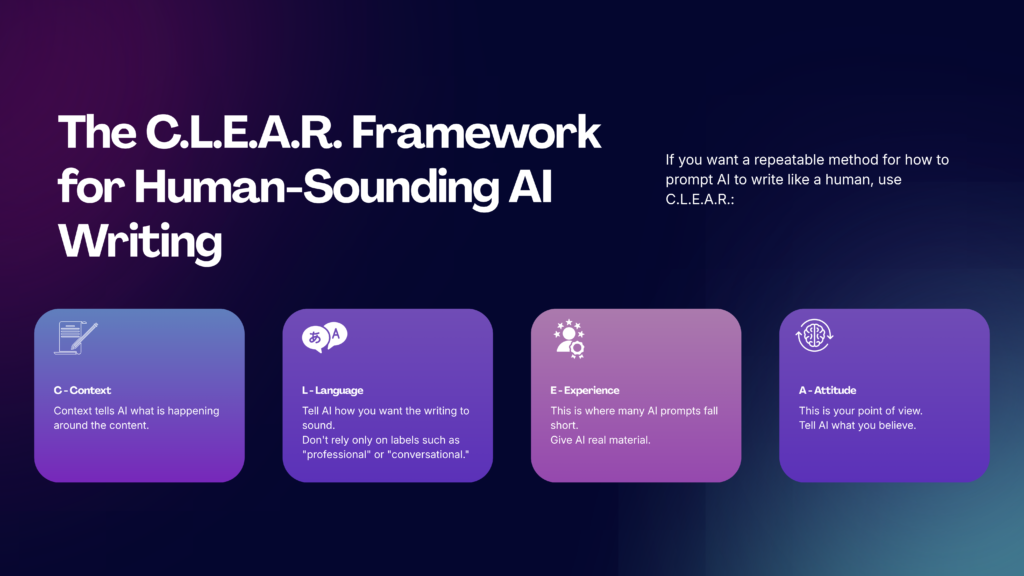
If you want a repeatable method for how to prompt AI to write like a human, use C.L.E.A.R.:
C – Context
L – Language
E – Experience
A – Attitude
R – Rules
Let’s break it down.
C – Context
Context tells AI what is happening around the content.
Don’t simply provide a topic.
Explain:
- Who is reading?
- What do they already know?
- What problem are they facing?
- What action should they take?
- Where will the content be published?
- What is the purpose?
Weak:
“Write about SEO for SaaS companies.”
Better:
“Write for SaaS founders who are generating website traffic but aren’t getting enough qualified demo requests. The reader understands basic SEO but doesn’t know why traffic and revenue aren’t increasing together.”
The second prompt immediately changes the direction of the writing.
L – Language
Tell AI how you want the writing to sound.
Don’t rely only on labels such as “professional” or “conversational.”
Describe the actual characteristics.
For example:
“Use plain English. Keep the tone confident but not corporate. Avoid unnecessary jargon. Write as if you’re explaining the topic to an intelligent business owner during a conversation. Use contractions where they sound natural.”
You can also provide your own writing samples.
That is even better.
If you have five LinkedIn posts or articles that sound like you, ask AI to identify the patterns rather than simply saying “copy my style.”
E – Experience
This is where many AI prompts fall short.
Give AI real material.
For example:
- A client situation
- A failed campaign
- A successful experiment
- A customer question
- A personal observation
- A result you measured
- A lesson you learned
- A common mistake you’ve seen
Instead of:
“Explain why SEO takes time.”
Try:
“I’ve worked with businesses that expected rankings within a few weeks. Explain why SEO takes time using the pattern I’ve observed: technical fixes can happen quickly, but content authority, links, search visibility, and conversion improvements usually take longer.”
Now the content has an experience behind it.
AI isn’t inventing humanity.
It’s organizing yours.
A – Attitude
This is your point of view.
Tell AI what you believe.
For example:
“I don’t believe businesses should publish content simply because competitors are publishing three articles every week. I believe fewer, more useful pieces are often better.”
That opinion gives the content a personality.
Without an attitude, AI tends to produce safe conclusions like:
“Both approaches have advantages depending on your goals.”
Sometimes that’s true.
But sometimes the reader wants you to actually make a recommendation.
Tell AI when you want it to take a position.
R – Rules
Rules keep the output consistent.
Your rules might include:
- Don’t invent statistics.
- Don’t create fake personal experiences.
- Don’t use generic introductions.
- Don’t repeat the same point.
- Avoid unnecessary jargon.
- Don’t overuse headings.
- Don’t use exaggerated claims.
- Don’t add filler conclusions.
- Don’t force keywords into sentences.
- Don’t make every paragraph the same length.
- Use examples where they clarify the point.
Rules are especially useful when you’re creating long-form content.
They prevent the model from drifting back toward generic writing.

Get an Expert Google Ads Audit for Your Business
Uncover wasted spend, fix performance gaps, and scale ROI with certified Google Ads specialists.
The First Rule: Give AI Something Human to Work With
This is the biggest lesson in how to prompt AI to write like a human.
You cannot consistently get authentic writing from empty instructions.
If you give AI:
“Write a human-sounding article about email marketing.”
you’ll probably receive an article containing familiar advice.
If you give it:
- Your audience
- Your experience
- Your opinion
- Your examples
- Your preferred vocabulary
- Your communication style
- Your editorial rules
the result changes dramatically.
Think of AI as an extremely fast writing assistant.
A good assistant needs context.
The better the briefing, the better the draft.
And that brings us to the most useful asset in this guide: a master prompt you can reuse.
The Master Prompt: How to Prompt AI to Write Like a Human
Instead of rebuilding your instructions every time, create one master prompt that establishes your writing standards.
You can then add the specific topic underneath it.
Here is a practical version you can copy and adapt:
ROLE
Act as an experienced writer and editor helping me communicate clearly with my audience. Your job is not to make the content sound artificially human. Your job is to preserve real human perspective, reasoning, and personality in the writing.
AUDIENCE
[Describe exactly who will read this. Include their role, experience level, concerns, and goals.]
PURPOSE
[Explain what this content needs to achieve.]
CONTEXT
[Provide the background, situation, product, service, problem, or experience behind the content.]
MY POINT OF VIEW
[Explain what I believe, recommend, disagree with, or have learned from experience.]
VOICE
Write in a [direct/conversational/analytical/etc.] voice. Sound confident without sounding promotional. Use plain English. Prefer specific language over impressive-sounding language.
WRITING STYLE
Vary sentence length naturally. Use contractions where appropriate. Don’t make every paragraph follow the same structure. Use examples when they make an idea clearer. Don’t add filler simply to make the content longer.
RULES
Don’t invent statistics, experiences, quotes, customers, or results. Don’t use generic introductions. Don’t repeat the same idea using different wording. Don’t force keywords into unnatural sentences. Don’t use corporate jargon unless the audience genuinely uses it.
HUMANITY CHECK
Before finishing, ask yourself:
- Does this sound like something a real person would actually say?
- Does the writer have a clear point of view?
- Are the examples specific?
- Are there generic claims that could apply to any company?
- Is anything exaggerated?
- Does every section provide a reason for the reader to continue?
If something sounds generic, rewrite it with greater specificity rather than simply adding casual language.
The most important part is not the wording of this prompt.
It’s the information you put into it.
15 Prompts to Make AI Writing More Human
You don’t always need the entire master prompt. These targeted prompts are useful when you’re editing an existing draft.
- Learn My Writing Style
“Analyze the writing samples below. Identify my sentence patterns, vocabulary, level of formality, use of examples, paragraph length, transitions, and how I express opinions. Create a practical voice profile I can reuse. Don’t imitate individual sentences.”
- Remove the Corporate Tone
“Rewrite this so it sounds like an experienced professional explaining the subject to a client. Remove unnecessary corporate language, vague claims, inflated adjectives, and phrases that sound like marketing copy.”
- Remove Repetition
“Review this draft for repeated ideas, repeated sentence structures, and repeated vocabulary. Keep the strongest version of each idea and remove the rest.”
- Add Specificity
“Find every sentence that could apply to almost any business. Replace generic statements with specific explanations, examples, situations, or consequences where the available information supports them.”
- Add a Point of View
“Review this section and identify where the writing is too neutral. Where appropriate, make a clear recommendation based on the information provided. Don’t manufacture opinions or facts.”
- Make It Conversational
“Rewrite this as if an experienced professional were explaining the idea directly to one person. Keep the expertise, but remove unnecessary formality.”
- Improve Sentence Rhythm
“Edit the sentence structure for natural rhythm. Mix short and longer sentences where appropriate. Don’t deliberately add fragments or mistakes just to make the writing appear human.”
- Remove the Generic Introduction
“Rewrite the opening. Start with the reader’s actual problem, a surprising observation, a specific situation, or a clear argument. Avoid broad statements about how important or rapidly changing the industry is.”
- Add Real Experience
“Use the experience and examples I provide below to strengthen this section. Do not invent details. If the available experience isn’t enough, identify where another real example would improve the argument.”
- Protect My Voice
“Improve clarity and flow without making the writing sound more corporate, formal, or generic. Preserve my vocabulary, opinions, and natural communication style.”
- Explain It Simply
“Explain this to an intelligent reader who understands the business problem but isn’t an expert in the technical details. Remove unnecessary terminology without removing important meaning.”
- Challenge the Draft
“Act as a skeptical editor. Identify statements that are vague, exaggerated, unsupported, repetitive, or too obvious. Explain what should change before rewriting them.”
- Edit Like a Human Editor
“Don’t rewrite everything. Identify the 20% of sentences that make this draft sound generic or artificial, then improve those sentences while preserving the rest of the author’s voice.”
- Focus on the Reader
“Review this section from the reader’s perspective. For every paragraph, ask: why does the reader need to know this? Remove information that doesn’t help the reader understand, decide, or act.”
- Final Human Voice Audit
“Perform a final human-voice audit. Highlight generic phrases, predictable transitions, repeated patterns, unsupported claims, unnecessary jargon, and sections that sound written for search engines instead of people. Then provide improved versions.”
Before and After: What Better Prompting Changes
The easiest way to understand how to prompt AI to write like a human is to compare instructions.
Example 1: Generic Marketing Advice
Weak prompt
“Write about the benefits of digital marketing.”
Likely result
“Digital marketing offers numerous benefits for businesses, including increased brand awareness, improved customer engagement, and enhanced business growth.”
Nothing is wrong with it.
Nothing is memorable either.
Better prompt
“Explain why digital marketing matters to a small business owner who has already spent money on ads but isn’t sure where the leads are coming from. Be practical and focus on measurement rather than generic claims about visibility.”
Now the content has a reader and a problem.
Example 2: Making an Introduction Stronger
Weak
“In today’s competitive business environment, having a strong online presence is more important than ever.”
Better instruction
“Start with the problem instead of explaining why the topic is important. The reader already knows they need an online presence.”
Possible result
“Your website may be getting traffic every day and still doing almost nothing for your sales team.”
That’s more specific.
Example 3: Avoiding Fake Expertise
Bad instruction
“Write as if you’ve personally helped 500 companies increase their conversions.”
This encourages fabricated experience.
Better instruction
“Use the real client observations I provide. If the information doesn’t support a claim, leave it out rather than inventing an example.”
Authenticity requires honesty, not simulated credentials.
Example 4: Technical Content
Weak
“Explain Google Tag Manager in a professional and engaging way.”
Better
“Explain Google Tag Manager to a marketing manager who understands analytics but doesn’t write code. Focus on why it makes tracking easier to manage and use one realistic example involving a form submission.”
The second prompt defines the level, audience, purpose, and example.
Example 5: Thought Leadership
Weak
“Write a thought leadership article about SEO trends.”
Better
“Write for CEOs who are tired of publishing content without seeing business results. Take the position that publishing more content isn’t automatically a better SEO strategy. Explain when content volume helps and when it simply creates more pages nobody needs.”
Now AI has an argument to develop.
Don't Add Fake Imperfections to Make AI Sound Human
One of the worst approaches to humanizing AI content is deliberately adding mistakes.
Some people tell AI to:
- Add typos.
- Break grammar rules.
- Insert random fragments.
- Use awkward sentences.
- Add unnecessary slang.
- Make the writing “less perfect.”
That’s not what human writing is.
Good human writers make intentional choices.
A typo doesn’t demonstrate personality.
A useful observation does.
A strong opinion does.
A relevant story does.
A specific example does.
If your content sounds too polished, don’t ask AI to make it worse.
Ask it to make it more specific, more opinionated, and more relevant to the reader.
Should You Ban AI Words?
This is where a lot of AI-writing advice becomes too simplistic.
You will find lists telling you to ban words such as:
- delve
- leverage
- robust
- comprehensive
- seamless
- landscape
- unlock
- transformative
Removing these words can sometimes improve a draft.
But banning individual words isn’t the real solution.
The problem is usually the pattern.
For example, there is nothing wrong with:
“We need a robust backup system.”
If “robust” accurately describes the system, keep it.
The problem appears when every article repeatedly says:
“In today’s rapidly evolving landscape, businesses can leverage robust solutions to unlock transformative opportunities.”
At that point, the issue isn’t one word.
It’s the entire construction.
Instead of creating a permanent banned-word list, ask:
“Identify phrases that sound generic or formulaic in this specific draft. Replace them only when a clearer, more natural alternative exists.”
That’s a much better editorial rule.
What About AI Detectors?
AI detectors shouldn’t become your definition of good writing.
Trying to manipulate text specifically to “beat” a detector can lead you in the wrong direction.
Your priority should be:
- Is the information accurate?
- Is the content genuinely useful?
- Does it reflect real expertise or evidence?
- Does it have a clear point of view?
- Is it written for people?
- Has a human reviewed and improved it?
If the answer to those questions is yes, you’ve solved a much more important problem than an arbitrary detection score.
The goal isn’t to disguise AI involvement.
The goal is to produce valuable, truthful, human-directed content.
How to Make AI Write Like You
Getting AI to sound “human” is useful.
Getting it to sound like you is much more valuable.
Your readers don’t need another generic human-sounding article. They need your perspective.
That means your prompt should eventually contain more than instructions about sentence length and vocabulary.
It should contain your thinking.
Build a Personal Voice Profile
Create a simple style sheet before producing a large amount of content.
Voice Element | Your Rule |
Tone | Direct, confident, practical |
Formality | Professional but conversational |
Sentence style | Mix short statements with detailed explanations |
Vocabulary | Plain English; use technical terms only when useful |
Opinions | Take a clear position when evidence supports it |
Examples | Prefer realistic business situations |
Humor | Light and occasional |
Claims | Specific and supportable |
Introductions | Start with the problem, not generic industry statements |
Conclusions | Give the reader a useful takeaway instead of repeating the article |
Jargon | Avoid unnecessary corporate language |
Personal experience | Use real experiences only; never invent them |
You can give this profile to AI before every major piece of content.
Over time, it becomes your editorial operating system.
How to Prompt AI to Write Like a Human for SEO
SEO doesn’t require robotic writing.
The mistake is treating the keyword as the reason the article exists.
The reader is the reason.
Suppose your primary keyword is:
how to prompt ai to write like a human
You should absolutely use it in strategic locations:
- H1
- Introduction
- A relevant H2 or H3
- Early body copy
- Middle sections
- Conclusion
- Relevant FAQ answers
But don’t force it into every paragraph.
Use related language naturally:
- human-sounding AI writing
- humanize AI-generated content
- AI writing prompts
- make AI writing less robotic
- prompt AI to sound natural
- write in your own voice
- improve AI-generated content
- human-first AI writing
This creates topical depth without making the article sound like it was written around a keyword counter.
For a roughly 3,000-word article, 15–20 natural exact-match uses of the primary keyword is a reasonable target when the phrase can genuinely fit. The important part is distribution: don’t place ten mentions in the introduction and then force the rest into awkward sentences.
How to Structure AI Content for AEO, GEO and LLMs
Search is no longer limited to ten blue links.
People increasingly ask questions and expect direct answers.
That means content should be easy for both people and machines to understand.
You can improve this by:
Answering important questions directly
Don’t hide the answer beneath five paragraphs of setup.
Using descriptive headings
A heading such as:
“Why AI Writing Sounds Robotic”
is much clearer than:
“The Challenge”
Defining concepts clearly
If you introduce a framework, explain what it means before expanding on it.
Using structured lists
Lists make complicated ideas easier to scan and extract.
Including original frameworks
A framework such as C.L.E.A.R. gives the content a distinct conceptual structure rather than another generic list of tips.
Supporting important claims
Don’t present invented numbers or unsupported statements as facts.
Keeping entities and terminology consistent
If you call something a “voice profile” in one section, don’t randomly rename it “style architecture” later.
Clear structure helps readers.
It also makes the content easier for search systems and language models to interpret.
The Human-First AI Writing Workflow
A good workflow looks less like:
Prompt → Generate → Publish
and more like:
Experience → Brief → Prompt → Draft → Challenge → Edit → Publish
Here’s the process.
Step 1: Start with your knowledge
Before opening an AI tool, write down what you already know.
What have you seen?
What surprised you?
What mistakes do businesses make?
What would you recommend?
What do you disagree with?
These notes become your raw material.
Step 2: Build the brief
Give AI the audience, objective, context, point of view, and required information.
Step 3: Generate the first draft
Let AI handle structure and first-pass writing.
Don’t expect the first draft to be perfect.
Step 4: Challenge it
Ask:
“What parts of this sound generic, obvious, exaggerated, or unsupported?”
This often produces more improvement than simply asking for another rewrite.
Step 5: Add your voice
Replace generic explanations with your own observations, examples, and opinions.
Step 6: Edit for the reader
Cut anything that doesn’t help.
A shorter useful paragraph is better than a longer impressive one.
Step 7: Fact-check
Verify statistics, dates, names, research, product information, and other factual claims.
Step 8: Final human review
Read the article aloud.
If you wouldn’t say a sentence to another person, ask whether it belongs.
The 10-Minute Human Editing Checklist
Before publishing AI-assisted content, ask:
Voice
- Does this sound like me?
- Would I actually say these sentences?
- Are my opinions visible?
Specificity
- Are there enough concrete examples?
- Are generic claims doing unnecessary work?
- Could this article have been written for any company?
Rhythm
- Do all paragraphs look the same?
- Are sentence structures repetitive?
- Does the article feel natural when read aloud?
Accuracy
- Are statistics verified?
- Are examples real?
- Has anything been invented?
Reader value
- Does every section answer a real question?
- Is anything included only because it helps SEO?
- Can the reader actually use something from this article?
Final test
Ask:
If I removed the author name, would this article still sound like it came from me?
If the answer is no, you haven’t finished editing.
Common Mistakes When Trying to Make AI Writing Human
Mistake 1: Saying “sound human” without context
AI can’t read your mind.
Describe the human qualities you want.
Mistake 2: Overusing banned-word lists
A list of forbidden words can’t replace a good editorial brief.
Mistake 3: Asking AI to add mistakes
Errors aren’t personality.
Mistake 4: Publishing the first draft
AI is excellent at creating a starting point.
That doesn’t mean the first output deserves to be the final output.
Mistake 5: Inventing personal experience
Never ask AI to pretend you’ve worked with a client, achieved a result, conducted research, or experienced something that didn’t happen.
Authenticity can’t be automated through fabrication.
Mistake 6: Optimizing for detectors
Write for the reader, not a detection score.
Mistake 7: Removing your opinions
If you’re writing thought leadership, neutrality can make the article forgettable.
Your experience and judgment are often the most valuable part.
Final Thoughts: Don't Ask AI to Be Human. Give It Something Human to Work With.
The biggest mistake people make when learning how to prompt AI to write like a human is focusing on the output before thinking about the input.
They ask AI to:
“Sound natural.”
Then they ask it to:
“Make it more conversational.”
Then:
“Remove AI words.”
Then:
“Make it pass as human-written.”
None of those instructions solve the underlying problem.
If the original prompt contains no experience, no opinion, no audience insight, and no meaningful context, AI has very little human material to work with.
That’s why the better approach is simple:
Give AI something human to work with.
Tell it:
- Who you’re talking to.
- What you know.
- What you’ve experienced.
- What you believe.
- What you recommend.
- What you disagree with.
- How you normally communicate.
- What you want the reader to understand.
Then use AI for what it does well: organizing ideas, creating drafts, improving clarity, finding gaps, restructuring information, and challenging your thinking.
Let the human provide the experience and judgment.
Let AI help with the execution.
That’s a much better formula for creating content that doesn’t just sound human-but actually has something human behind it.
The best prompt isn’t “Write like a human.”
It’s:
“Here is who I am. Here is who I’m talking to. Here is what I believe. Here is what I’ve learned. Here are the examples from my experience. Here’s how I normally communicate. Now help me turn that into something useful.”
That is where human-sounding AI writing starts.


Boost Your Brand Visibility 🚀
Get personalized digital strategies that drive growth and engagement.
Let’s Talk📬 Stay Updated
Get the latest insights and guides delivered right to your inbox.
🔗 Related Topics
- Loading related posts...